

Customer experience solutions provider Concentrix (NASDAQ:CNXC) missed Wall Street’s revenue expectations in Q3 2026, with sales falling 1.2% year on year to $2.45 billion. Next quarter’s revenue guidance of $2.44 billion underwhelmed, coming in 3.3% below analysts’ estimates. Its non-GAAP profit of $2.92 per share was 8.1% above analysts’ consensus estimates.
Is now the time to buy Concentrix? Find out by accessing our full research report, it’s free.
Concentrix (CNXC) Q3 2026 Highlights:
- Revenue: $2.45 billion vs analyst estimates of $2.48 billion (1.2% year-on-year decline, 1% miss)
- Adjusted EPS: $2.92 vs analyst estimates of $2.70 (8.1% beat)
- Adjusted EBITDA: $363 million vs analyst estimates of $357.5 million (14.8% margin, 1.5% beat)
- Revenue Guidance for Q4 2026 is $2.44 billion at the midpoint, below analyst estimates of $2.52 billion
- Management slightly raised its full-year Adjusted EPS guidance to $11.03 at the midpoint
- Operating Margin: -37.1%, down from 5.9% in the same quarter last year
- Free Cash Flow Margin: 9%, up from 6.4% in the same quarter last year
- Market Capitalization: $1.55 billion
“This quarter, we reached an inflection point where 50% of our revenue is coming from business we have won and deployed within the last 3 years since the introduction of AI,” said Chris Caldwell, President and CEO of Concentrix. “While we are aggressively disrupting our own traditional business, the underlying new business is stronger and healthier as evidenced by our margin expansion, strong free cash flow and growth of our new services."
Company Overview
With a team of approximately 450,000 employees across 75 countries, Concentrix (NASDAQ:CNXC) designs and delivers customer experience solutions that help global brands manage their customer interactions across digital channels and contact centers.
Revenue Growth
A company’s long-term performance is an indicator of its overall quality. Any business can put up a good quarter or two, but the best consistently grow over the long haul.
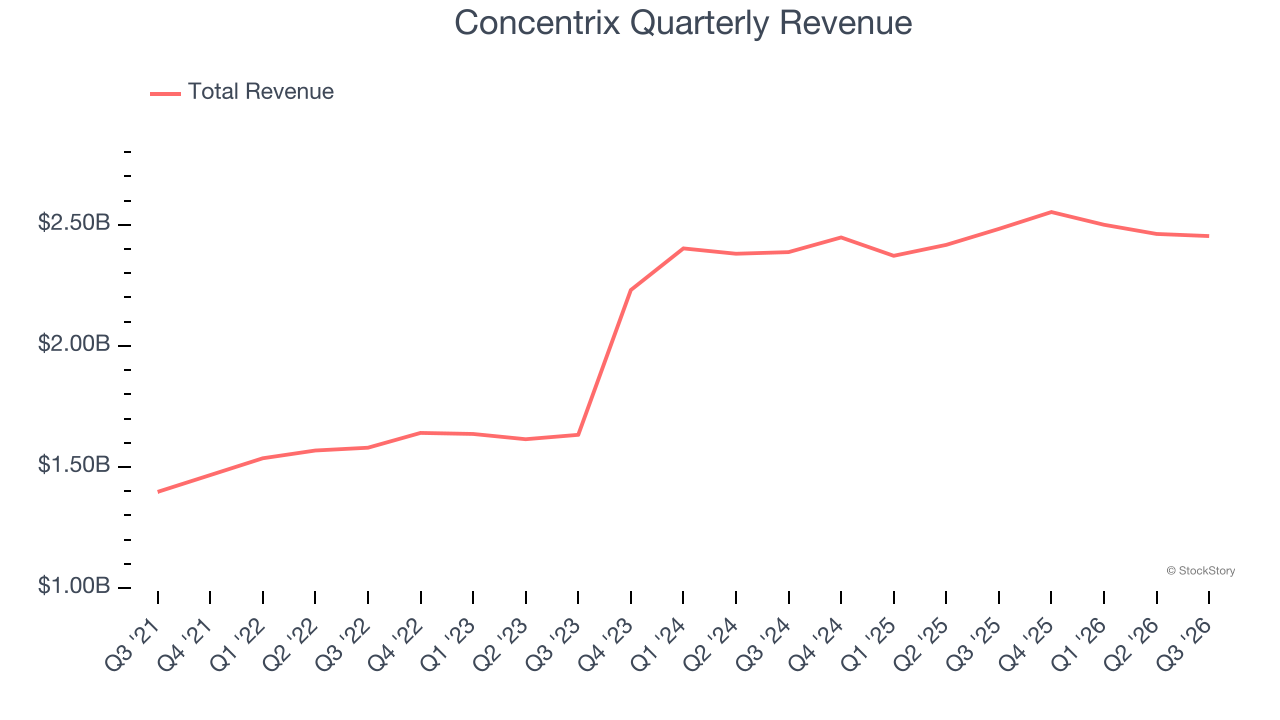
With $9.97 billion in revenue over the past 12 months, Concentrix is one of the larger companies in the business services industry and benefits from a well-known brand that influences purchasing decisions.
As you can see below, Concentrix’s 13% annualized revenue growth over the last five years was excellent. This shows it had high demand, a useful starting point for our analysis.
We at StockStory place the most emphasis on long-term growth, but within business services, a half-decade historical view may miss recent innovations or disruptive industry trends. Concentrix’s recent performance shows its demand has slowed significantly as its annualized revenue growth of 3% over the last two years was well below its five-year trend. 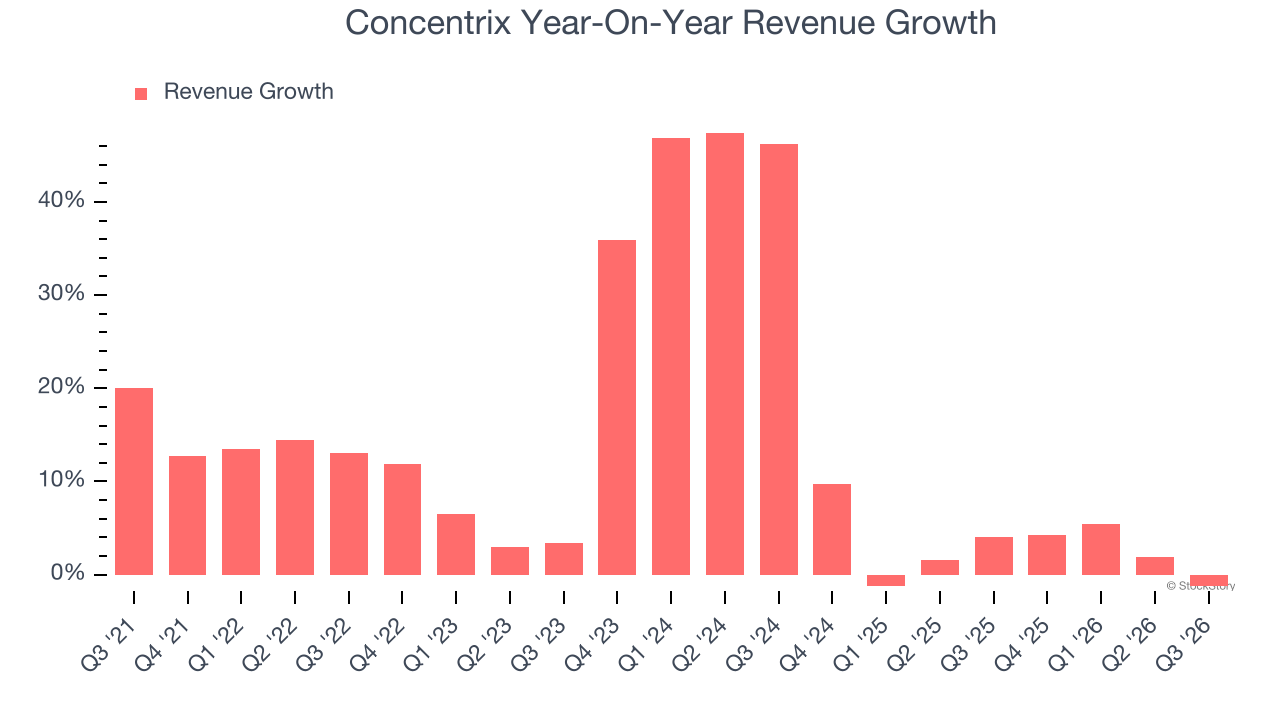
This quarter, Concentrix missed Wall Street’s estimates and reported a rather uninspiring 1.2% year-on-year revenue decline, generating $2.45 billion of revenue. Company management is currently guiding for a 4.6% year-on-year decline in sales next quarter.
Looking further ahead, sell-side analysts expect revenue to remain flat over the next 12 months, a slight deceleration versus the last two years. This projection is underwhelming and indicates its products and services will face some demand challenges.
ONE MORE THING: 3 Hidden Platforms Growing 3X Faster than Amazon, Google, and PayPal. Amazon, Google, and Meta all followed the same playbook: Dominate an ignored market. Build an unbeatable moat. Scale until you’re unstoppable.
These three platforms are running that exact playbook right now. The early investors in Amazon made fortunes. The early investors in these could do the same. Get All 3 Stocks Here for FREE.
Adjusted Operating Margin
Concentrix has managed its cost base well over the last five years. It demonstrated solid profitability for a business services business, producing an average adjusted operating margin of 13.3%.
Analyzing the trend in its profitability, Concentrix’s adjusted operating margin decreased by 1.4 percentage points over the last five years. This raises questions about the company’s expense base because its revenue growth should have given it leverage on its fixed costs, resulting in better economies of scale and profitability.
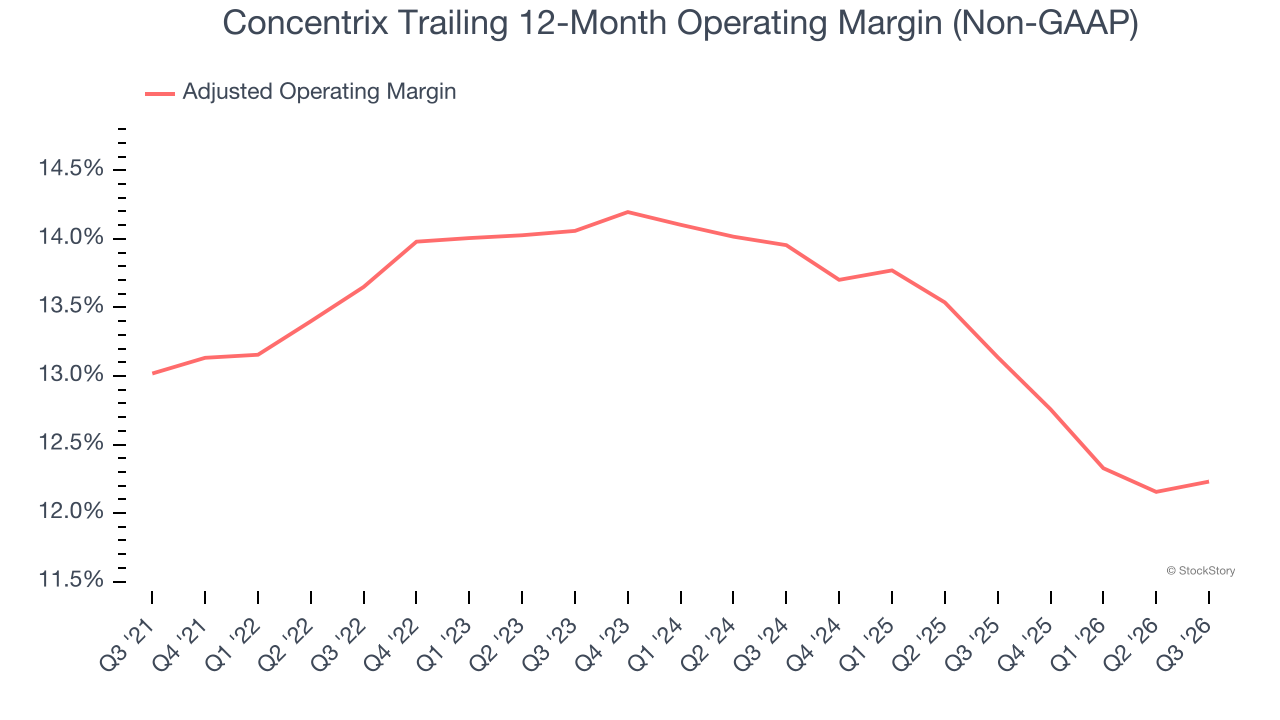
This quarter, Concentrix generated an adjusted operating margin profit margin of 12.6%, in line with the same quarter last year. This indicates the company’s overall cost structure has been relatively stable.
Earnings Per Share
We track the long-term change in earnings per share (EPS) for the same reason as long-term revenue growth. Compared to revenue, however, EPS highlights whether a company’s growth is profitable.
Concentrix’s EPS grew at an unimpressive 3.8% compounded annual growth rate over the last five years, lower than its 13% annualized revenue growth. This tells us the company became less profitable on a per-share basis as it expanded.
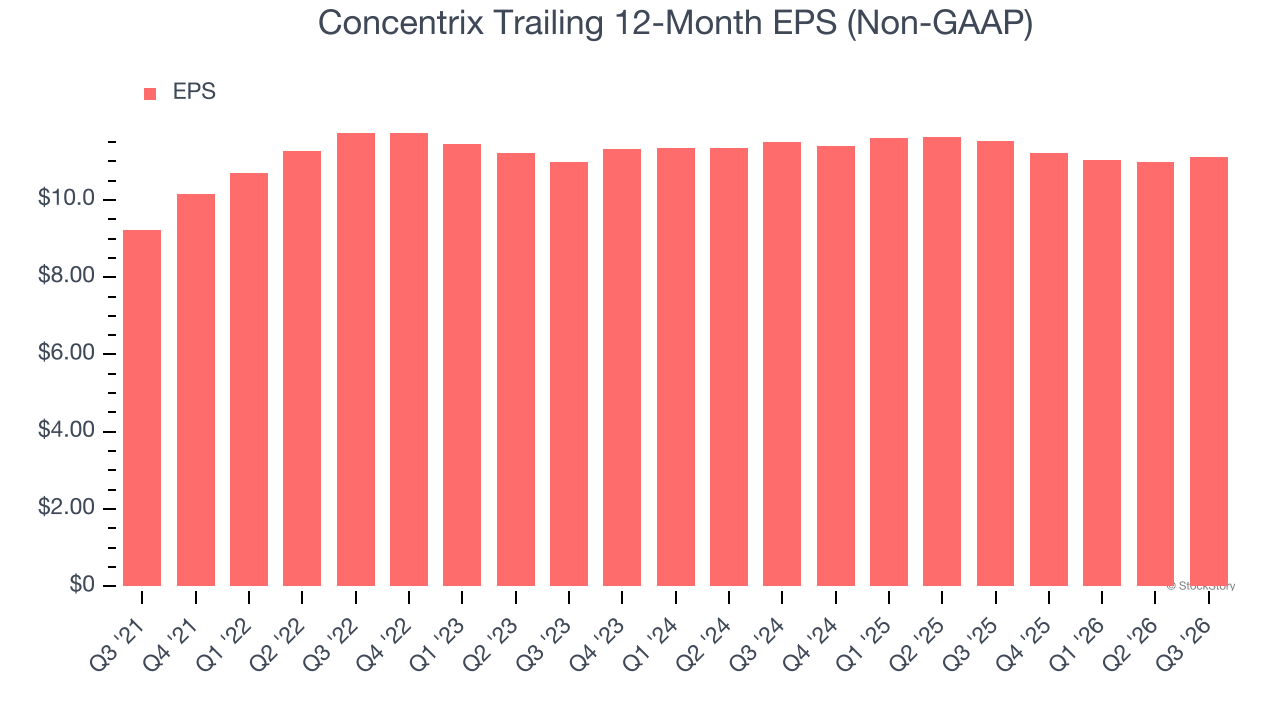
We can take a deeper look into Concentrix’s earnings to better understand the drivers of its performance. As we mentioned earlier, Concentrix’s adjusted operating margin was flat this quarter but declined by 1.4 percentage points over the last five years. Its share count also grew by 17%, meaning the company not only became less efficient with its operating expenses but also diluted its shareholders. 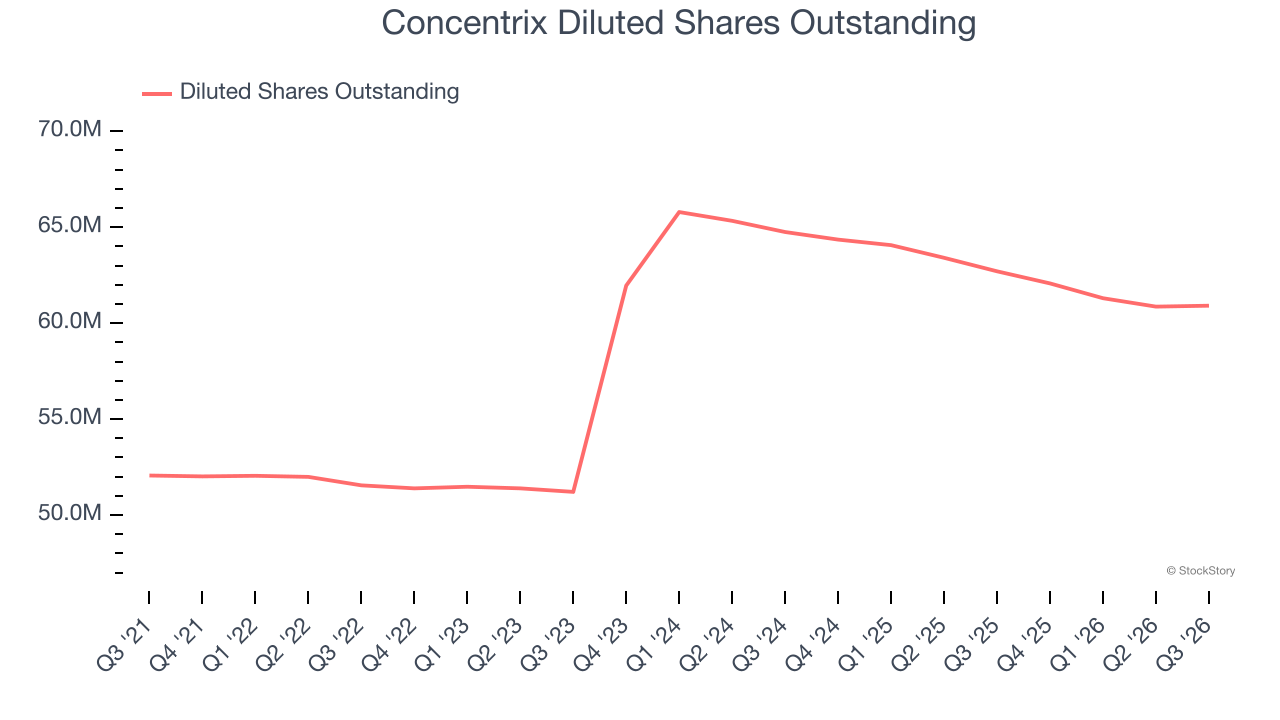
Like with revenue, we analyze EPS over a more recent period because it can provide insight into an emerging theme or development for the business.
For Concentrix, its two-year annual EPS declines of 1.7% show it’s continued to underperform. These results were bad no matter how you slice the data.
In Q3, Concentrix reported adjusted EPS of $2.92, up from $2.78 in the same quarter last year. This print beat analysts’ estimates by 8.1%. Over the next 12 months, Wall Street expects Concentrix’s full-year EPS to stay about the same, moving from $11.11 to $11.20.
Key Takeaways from Concentrix’s Q3 Results
It was good to see Concentrix beat analysts’ EPS expectations this quarter. We were also happy its full-year EPS guidance narrowly outperformed Wall Street’s estimates. On the other hand, its revenue guidance for next quarter missed and its EPS guidance for next quarter fell short of Wall Street’s estimates. Overall, this quarter could have been better. The stock traded down 10% to $22.64 immediately following the results.
Concentrix may have had a tough quarter, but does that actually create an opportunity to invest right now? If you’re making that decision, you should consider the bigger picture of valuation, business qualities, as well as the latest earnings. We cover that in our actionable full research report which you can read here (it’s free).