

Health insurance company Oscar Health (NYSE:OSCR) beat Wall Street’s revenue expectations in Q2 CY2026, with sales up 70.4% year on year to $4.88 billion. Its GAAP profit of $1.10 per share was significantly above analysts’ consensus estimates.
Is now the time to buy Oscar Health? Find out by accessing our full research report, it’s free.
Oscar Health (OSCR) Q2 CY2026 Highlights:
- Revenue: $4.88 billion vs analyst estimates of $4.74 billion (70.4% year-on-year growth, 2.9% beat)
- EPS (GAAP): $1.10 vs analyst estimates of $0.41 (significant beat)
- Adjusted EBITDA: $415.3 million vs analyst estimates of $170.9 million (8.5% margin, significant beat)
- Operating Margin: 8%, up from -8% in the same quarter last year
- Free Cash Flow Margin: 42.6%, up from 17.5% in the same quarter last year
- Market Capitalization: $9.07 billion
Company Overview
Founded in 2012 to simplify the notoriously complex American healthcare system, Oscar Health (NYSE:OSCR) is a technology-focused health insurance company that offers individual and small group health plans through its cloud-native platform.
Revenue Growth
A company’s long-term sales performance is one signal of its overall quality. Any business can experience short-term success, but top-performing ones enjoy sustained growth for years. Luckily, Oscar Health’s sales grew at an incredible 48.7% compounded annual growth rate over the last five years. Its growth surpassed the average healthcare company and shows its offerings resonate with customers, a great starting point for our analysis.
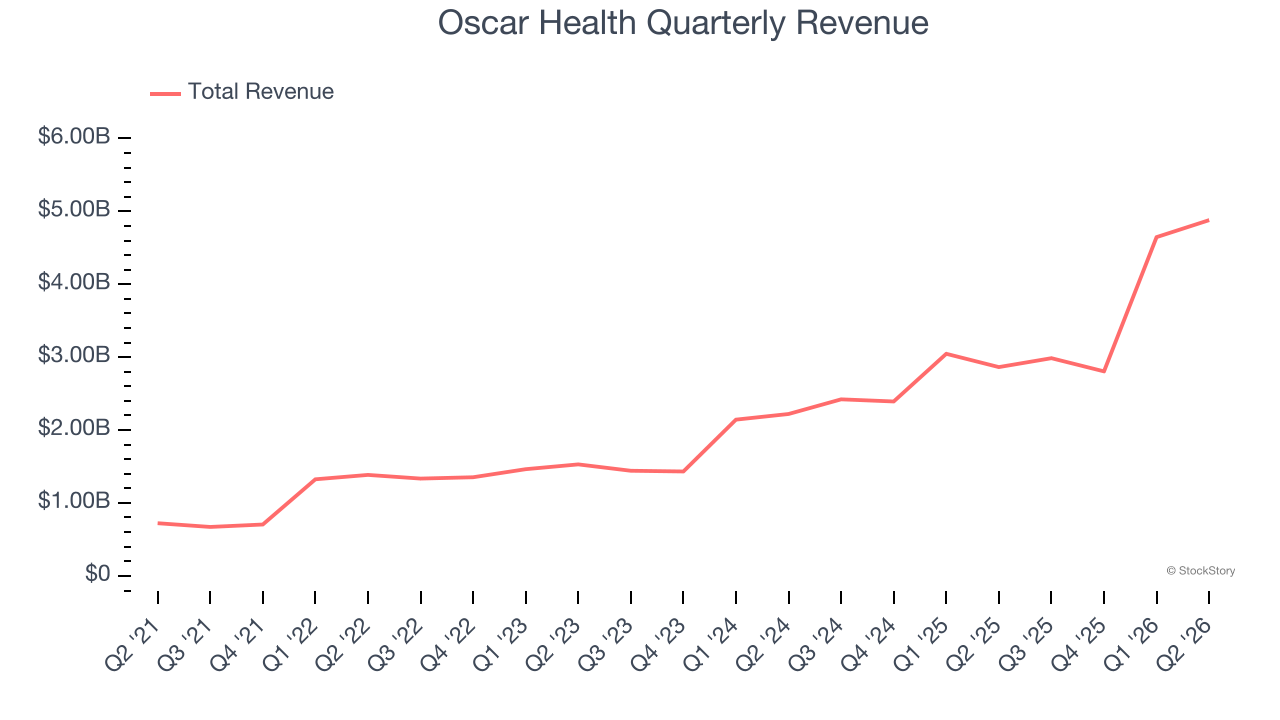
Long-term growth is the most important, but within healthcare, a half-decade historical view may miss new innovations or demand cycles. Oscar Health’s annualized revenue growth of 45.5% over the last two years is below its five-year trend, but we still think the results suggest healthy demand. 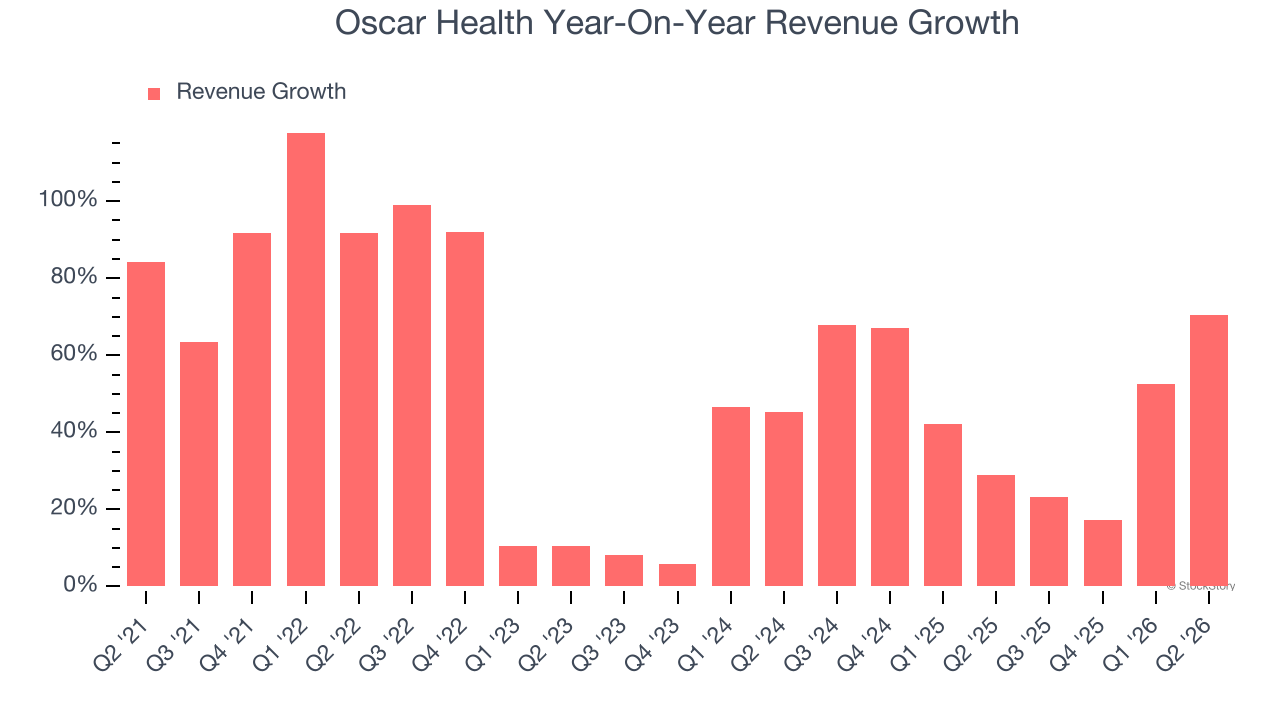
This quarter, Oscar Health reported magnificent year-on-year revenue growth of 70.4%, and its $4.88 billion of revenue beat Wall Street’s estimates by 2.9%.
Looking ahead, sell-side analysts expect revenue to grow 25.5% over the next 12 months, a deceleration versus the last two years. Still, this projection is eye-popping given its scale and implies the market is forecasting success for its products and services.
ONE MORE THING: The $21 AI Application Stock Wall Street Forgot. While Wall Street obsesses over who’s building AI, one company is already using it to print money. And nobody’s paying attention.
AI chip stocks trade at ridiculous valuations. This company processes a trillion consumer signals monthly using AI and trades at a third of the price. The gap won’t last. The institutions will figure it out. You need to see this first. Read the FREE Report Before They Notice.
Adjusted Operating Margin
Adjusted operating margin is a key measure of profitability. Think of it as net income (the bottom line) excluding the impact of non-recurring expenses, taxes, and interest on debt - metrics less connected to business fundamentals.
Although Oscar Health was profitable this quarter from an operational perspective, it’s generally struggled over a longer time period. Its expensive cost structure has contributed to an average adjusted operating margin of negative 1.1% over the last five years. Unprofitable healthcare companies require extra attention because they could get caught swimming naked when the tide goes out.
On the plus side, Oscar Health’s adjusted operating margin rose by 18.6 percentage points over the last five years, as its sales growth gave it operating leverage. Zooming in on its more recent performance, we can see the company’s trajectory is intact as its margin has also increased by 3.6 percentage points on a two-year basis. These data points are very encouraging and show momentum is on its side.
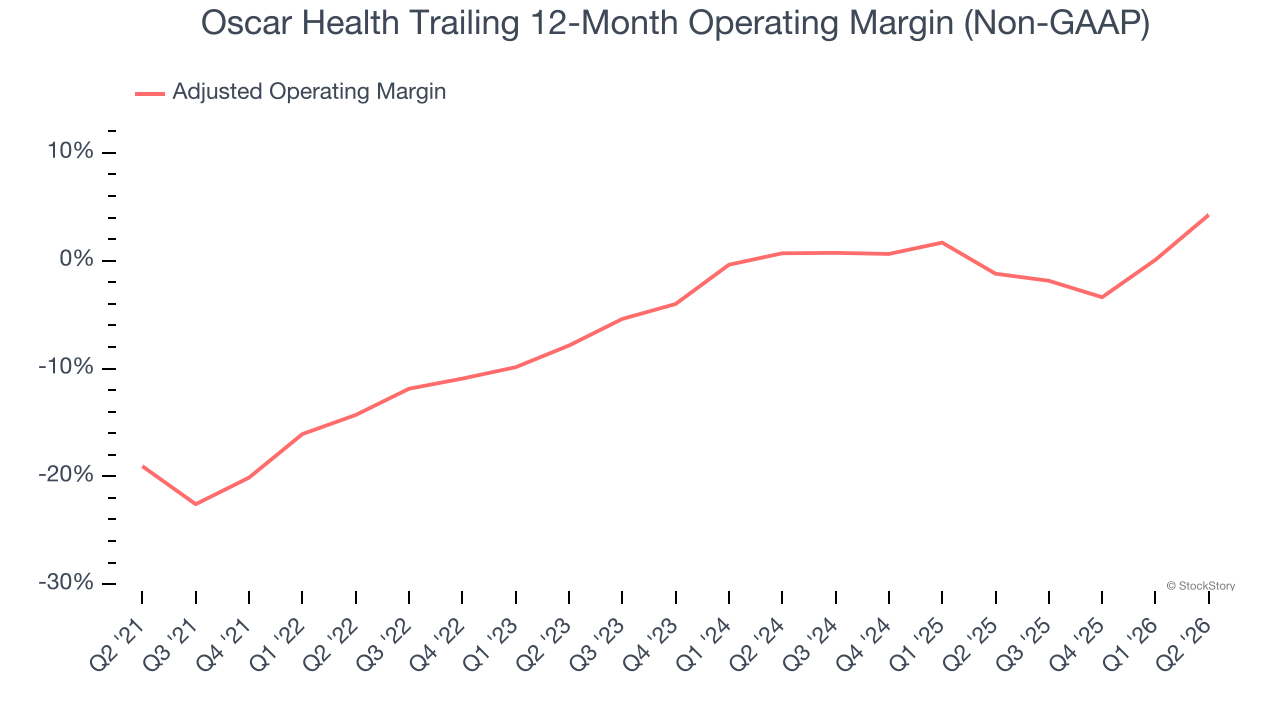
This quarter, Oscar Health generated an adjusted operating margin profit margin of 8.4%, up 16.4 percentage points year on year. This increase was a welcome development and shows it was more efficient.
Earnings Per Share
We track the long-term change in earnings per share (EPS) for the same reason as long-term revenue growth. Compared to revenue, however, EPS highlights whether a company’s growth is profitable.
Oscar Health’s full-year EPS flipped from negative to positive over the last five years. This is a good sign and shows it’s at an inflection point.
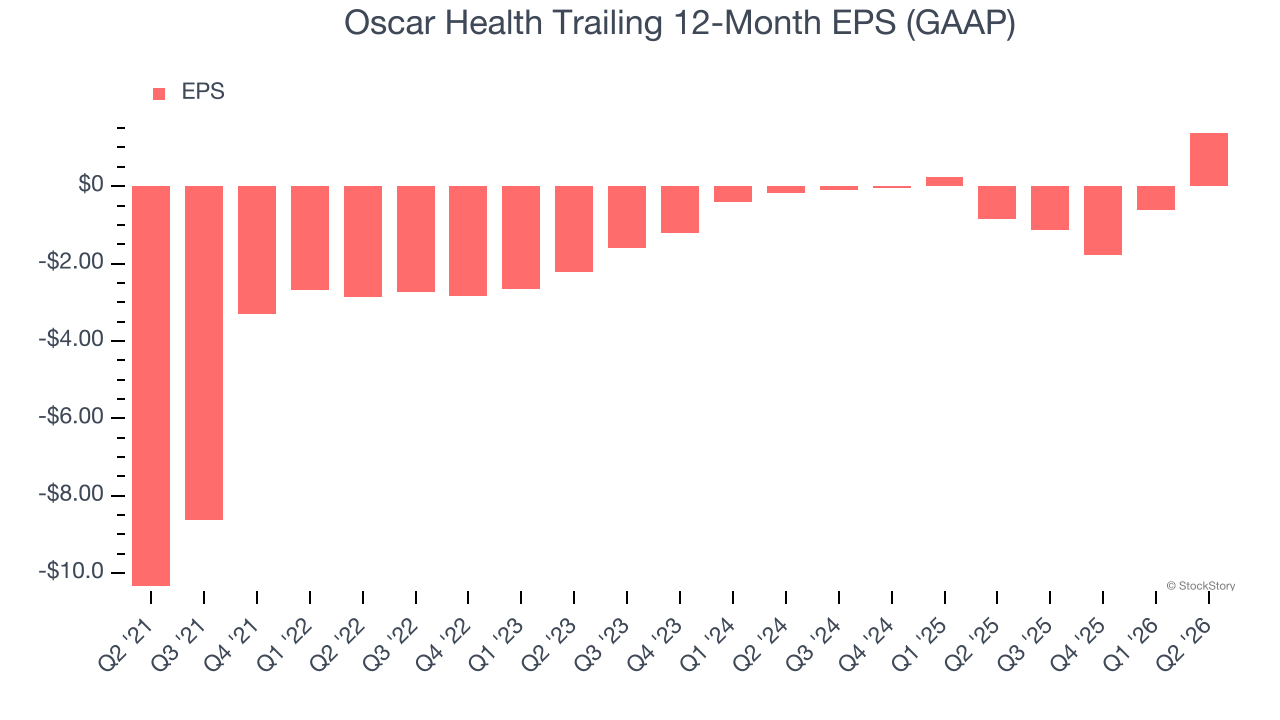
In Q2, Oscar Health reported EPS of $1.10, up from negative $0.89 in the same quarter last year. This print easily cleared analysts’ estimates, and shareholders should be content with the results. Over the next 12 months, Wall Street expects Oscar Health’s full-year EPS to grow 5.3% from $1.38 to $1.46.
Key Takeaways from Oscar Health’s Q2 Results
It was good to see Oscar Health beat analysts’ EPS expectations this quarter. We were also glad its revenue outperformed Wall Street’s estimates. Zooming out, we think this was a solid print. The stock traded up 11.8% to $34.10 immediately after reporting.
Indeed, Oscar Health had a rock-solid quarterly earnings result, but is this stock a good investment here? We think that the latest quarter is only one piece of the longer-term business quality puzzle. Quality, when combined with valuation, can help determine if the stock is a buy. We cover that in our actionable full research report which you can read here (it’s free).