

Financial technology provider Fiserv (NASDAQ:FISV) reported Q2 CY2026 results beating Wall Street’s revenue expectations, with sales up 1.8% year on year to $5.29 billion. Its non-GAAP profit of $1.84 per share was 4.1% below analysts’ consensus estimates.
Is now the time to buy Fiserv? Find out by accessing our full research report, it’s free.
Fiserv (FISV) Q2 CY2026 Highlights:
- Organic Revenue rose 5% year on year
- Revenue: $5.29 billion vs analyst estimates of $5.05 billion (1.8% year-on-year growth, 4.9% beat)
- Pre-tax Profit: $775 million (14.6% margin)
- Adjusted EPS: $1.84 vs analyst expectations of $1.92 (4.1% miss)
- Management lowered its full-year Adjusted EPS guidance to $7.30 at the midpoint, a 10.4% decrease
- Market Capitalization: $28.85 billion
“Our business continues to be supported by volume growth and strong positions in attractive markets,” said Takis Georgakopoulos, Chief Executive Officer of Fiserv.
Company Overview
Powering over 1 billion accounts and processing more than 12,000 financial transactions per second globally, Fiserv (NASDAQ:FISV) provides payment processing and financial technology solutions that enable merchants, banks, and credit unions to accept payments and manage financial transactions.
Revenue Growth
Examining a company’s long-term performance can provide clues about its quality. Any business can experience short-term success, but top-performing ones enjoy sustained growth for years. Regrettably, Fiserv’s revenue grew at a mediocre 6.2% compounded annual growth rate over the last five years. This was below our standard for the financials sector and is a tough starting point for our analysis.
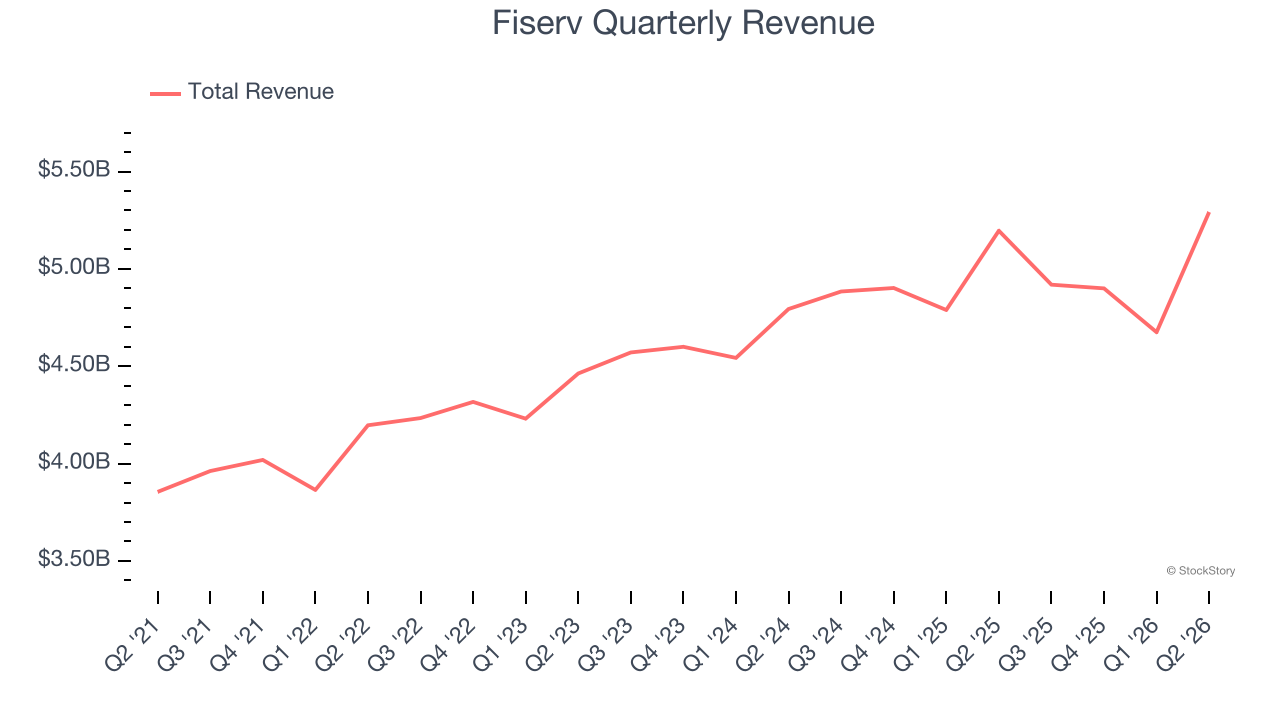
Long-term growth is the most important, but within financials, a half-decade historical view may miss recent interest rate changes and market returns. Fiserv’s recent performance shows its demand has slowed as its annualized revenue growth of 3.4% over the last two years was below its five-year trend. We’re wary when companies in the sector see decelerations in revenue growth, as it could signal changing consumer tastes aided by low switching costs. 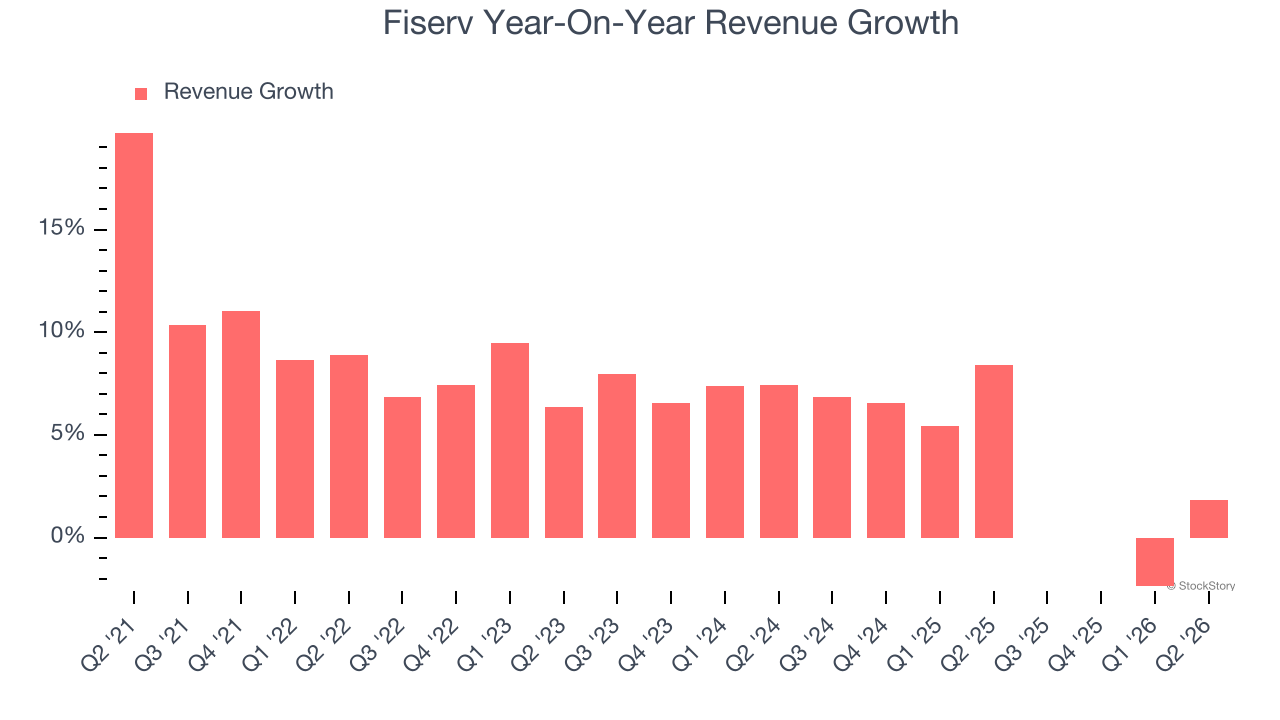 Note: Quarters not shown were determined to be outliers because they were impacted by outsized investment gains/losses that are not indicative of the recurring fundamentals of the business.
Fiserv also reports organic revenue, which strips out one-time events like acquisitions and currency fluctuations that don’t accurately reflect its fundamentals. Over the last three years, Fiserv’s organic revenue averaged 8.3% year-on-year growth. It also grew on a two-year basis, but at a slower pace of 5.6%. Because this shorter-term number is better than its two-year revenue growth, we can see that some mixture of divestitures and foreign exchange rates dampened its headline results. 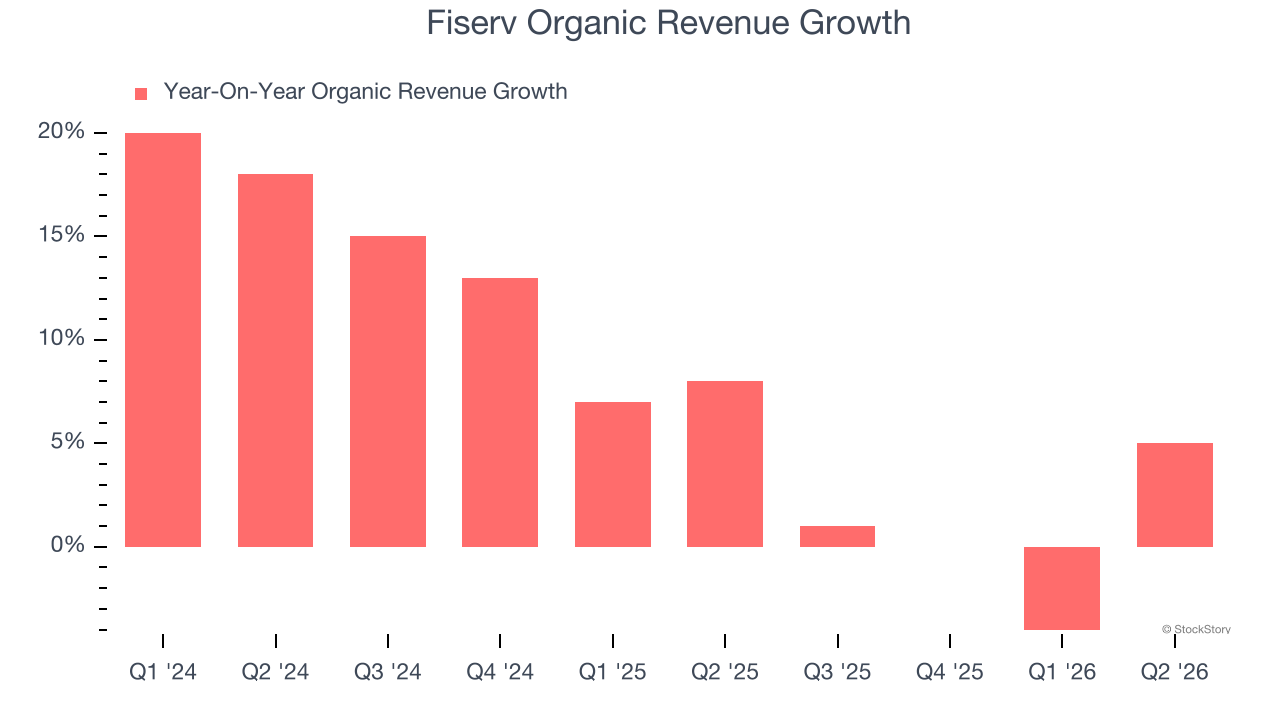
This quarter, Fiserv reported modest year-on-year revenue growth of 1.8% but beat Wall Street’s estimates by 4.9%.
ONE MORE THING: The $21 AI Application Stock Wall Street Forgot. While Wall Street obsesses over who’s building AI, one company is already using it to print money. And nobody’s paying attention.
AI chip stocks trade at ridiculous valuations. This company processes a trillion consumer signals monthly using AI and trades at a third of the price. The gap won’t last. The institutions will figure it out. You need to see this first. Read the FREE Report Before They Notice.
Key Takeaways from Fiserv’s Q2 Results
We enjoyed seeing Fiserv beat analysts’ revenue expectations this quarter. On the other hand, its full-year EPS guidance missed and its EPS fell short of Wall Street’s estimates. Overall, this was a softer quarter. The stock traded down 9.7% to $48.88 immediately following the results.
Fiserv didn’t show its best hand this quarter, but does that create an opportunity to buy the stock right now? We think that the latest quarter is only one piece of the longer-term business quality puzzle. Quality, when combined with valuation, can help determine if the stock is a buy. We cover that in our actionable full research report which you can read here (it’s free).