

Residential swimming pool manufacturer Latham (NASDAQ:SWIM) reported Q2 CY2026 results topping the market’s revenue expectations, with sales up 14.4% year on year to $197.5 million. The company’s full-year revenue guidance of $610 million at the midpoint came in 3.3% above analysts’ estimates. Its GAAP profit of $0.11 per share was 25% below analysts’ consensus estimates.
Is now the time to buy Latham? Find out by accessing our full research report, it’s free.
Latham (SWIM) Q2 CY2026 Highlights:
- Revenue: $197.5 million vs analyst estimates of $188.4 million (14.4% year-on-year growth, 4.8% beat)
- EPS (GAAP): $0.11 vs analyst expectations of $0.15 (25% miss)
- Adjusted EBITDA: $44.62 million vs analyst estimates of $46.02 million (22.6% margin, 3.1% miss)
- The company lifted its revenue guidance for the full year to $610 million at the midpoint from $595 million, a 2.5% increase
- EBITDA guidance for the full year is $115 million at the midpoint, above analyst estimates of $110.5 million
- Operating Margin: 12.7%, down from 14.3% in the same quarter last year
- Free Cash Flow Margin: 32.4%, up from 16.8% in the same quarter last year
- Market Capitalization: $662.2 million
Commenting on the results, Sean Gadd, President and CEO, said, “Second quarter sales growth was driven by execution of our strategic priorities and supports our expectations of continued share gains across our product lines. Our in-ground pool sales increased 22.5%, or 13.6% organically, led by fiberglass pool sales, which are on track to account for approximately 80% of our full year in-ground pool sales in 2026. Cover sales were up 10% in the second quarter, led by growth in autocovers, indicating a steady increase in attachment rates on new pool installations.
Company Overview
Started as a family business, Latham (NASDAQ:SWIM) is a global designer and manufacturer of in-ground residential swimming pools and related products.
Revenue Growth
Reviewing a company’s long-term sales performance reveals insights into its quality. Any business can put up a good quarter or two, but many enduring ones grow for years. Unfortunately, Latham struggled to consistently increase demand as its $576.6 million of sales for the trailing 12 months was close to its revenue five years ago. This was below our standards and suggests it’s a low quality business.
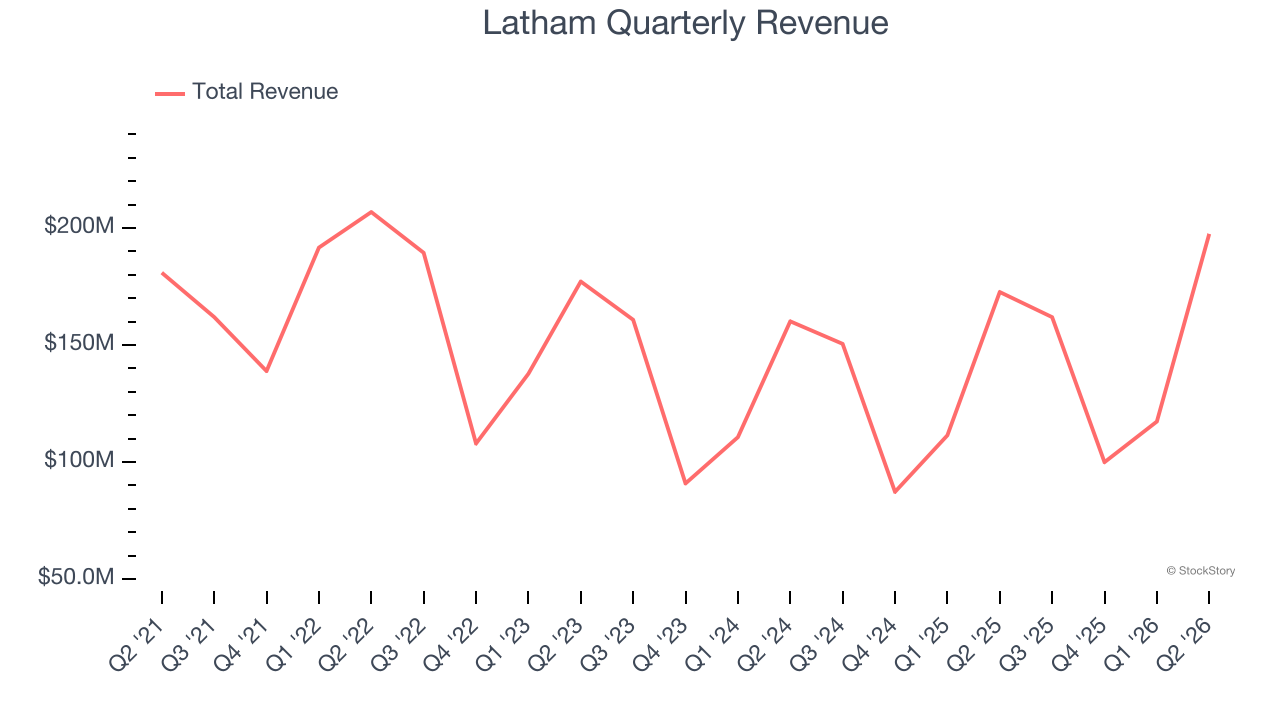
We at StockStory place the most emphasis on long-term growth, but within consumer discretionary, a stretched historical view may miss a company riding a successful new product or trend. Latham’s annualized revenue growth of 5.1% over the last two years is above its five-year trend, which is encouraging. 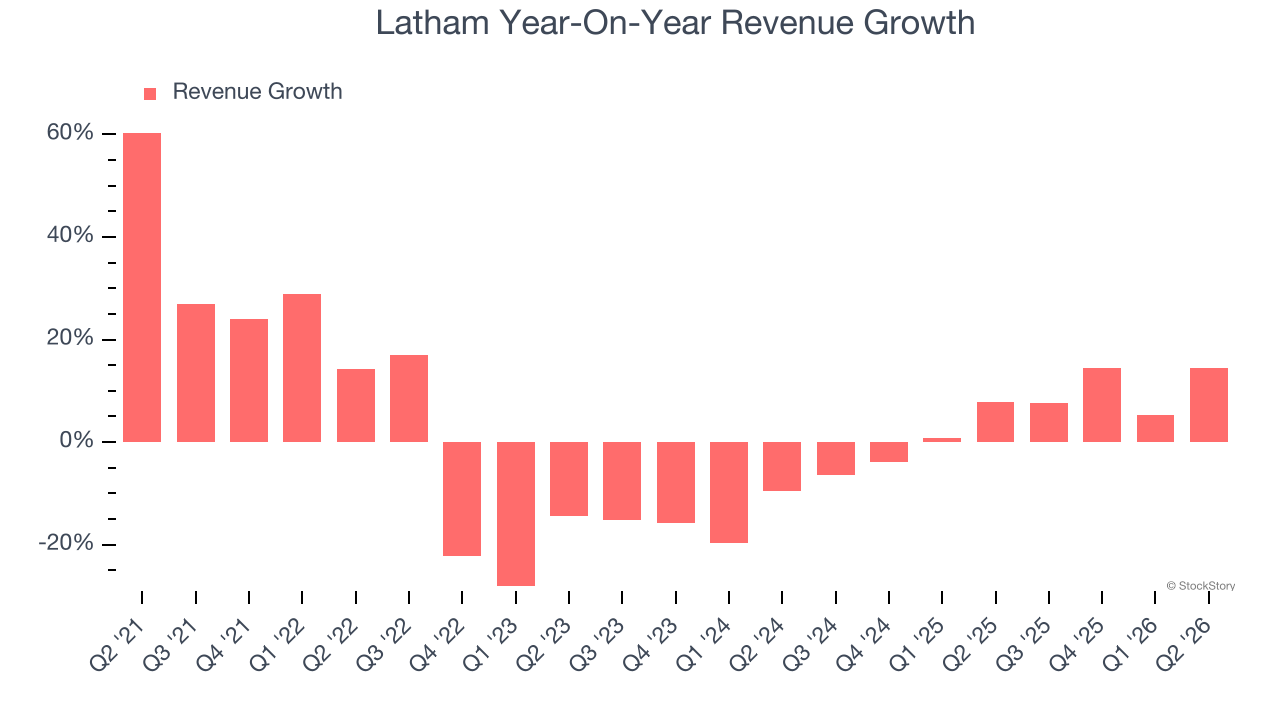
This quarter, Latham reported year-on-year revenue growth of 14.4%, and its $197.5 million of revenue exceeded Wall Street’s estimates by 4.8%.
Looking ahead, sell-side analysts expect revenue to grow 6.1% over the next 12 months, similar to its two-year rate. Although this projection implies its newer products and services will spur better top-line performance, it is still below average for the sector.
ONE MORE THING: 3 Hidden Platforms Growing 3X Faster than Amazon, Google, and PayPal. Amazon, Google, and Meta all followed the same playbook: Dominate an ignored market. Build an unbeatable moat. Scale until you’re unstoppable.
These three platforms are running that exact playbook right now. The early investors in Amazon made fortunes. The early investors in these could do the same. Get All 3 Stocks Here for FREE.
Operating Margin
Operating margin is an important measure of profitability as it shows the portion of revenue left after accounting for all core expenses — everything from the cost of goods sold to advertising and wages. It’s also useful for comparing profitability across companies with different levels of debt and tax rates because it excludes interest and taxes.
Latham’s operating margin has been trending up over the last 12 months and averaged 4.5% over the last two years. The company’s higher efficiency is a breath of fresh air, but its suboptimal cost structure means it still sports inadequate profitability for a consumer discretionary business.
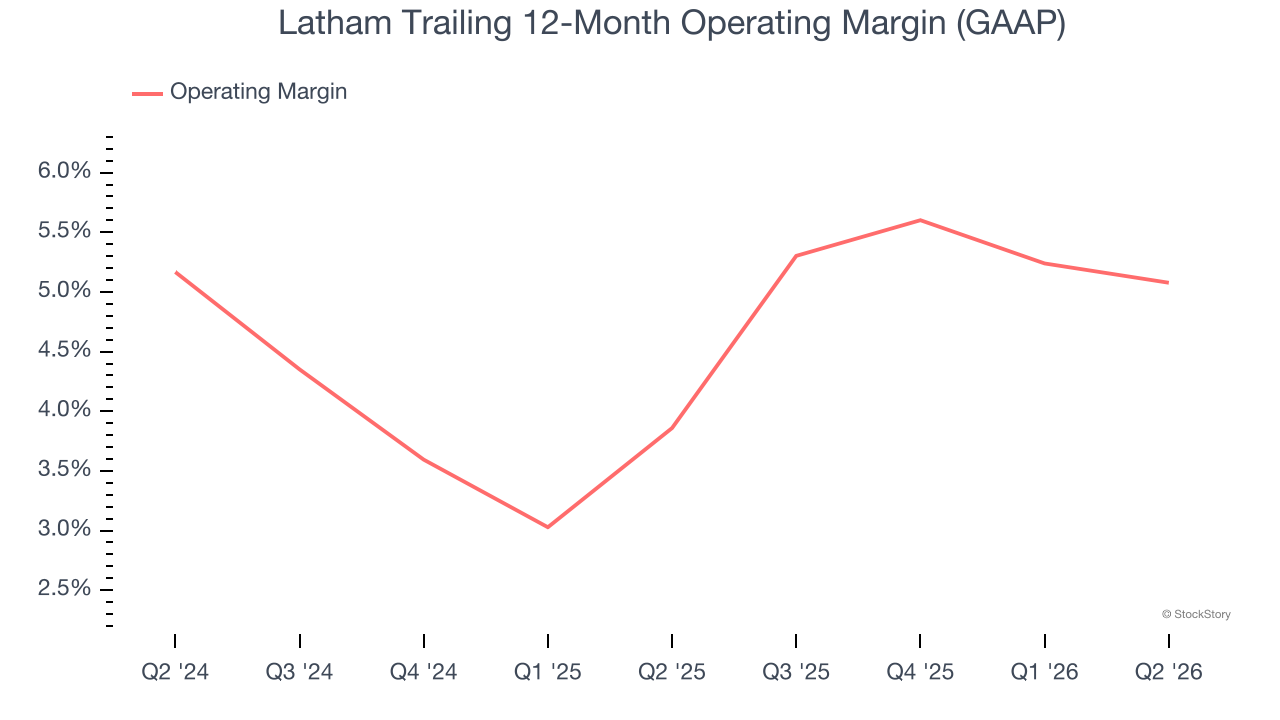
This quarter, Latham generated an operating margin profit margin of 12.7%, down 1.6 percentage points year on year. This reduction is quite minuscule and indicates the company’s overall cost structure has been relatively stable.
Earnings Per Share
We track the long-term change in earnings per share (EPS) for the same reason as long-term revenue growth. Compared to revenue, however, EPS highlights whether a company’s growth is profitable.
Latham’s full-year EPS flipped from negative to positive over the last five years. This is encouraging and shows it’s at a critical moment in its life.
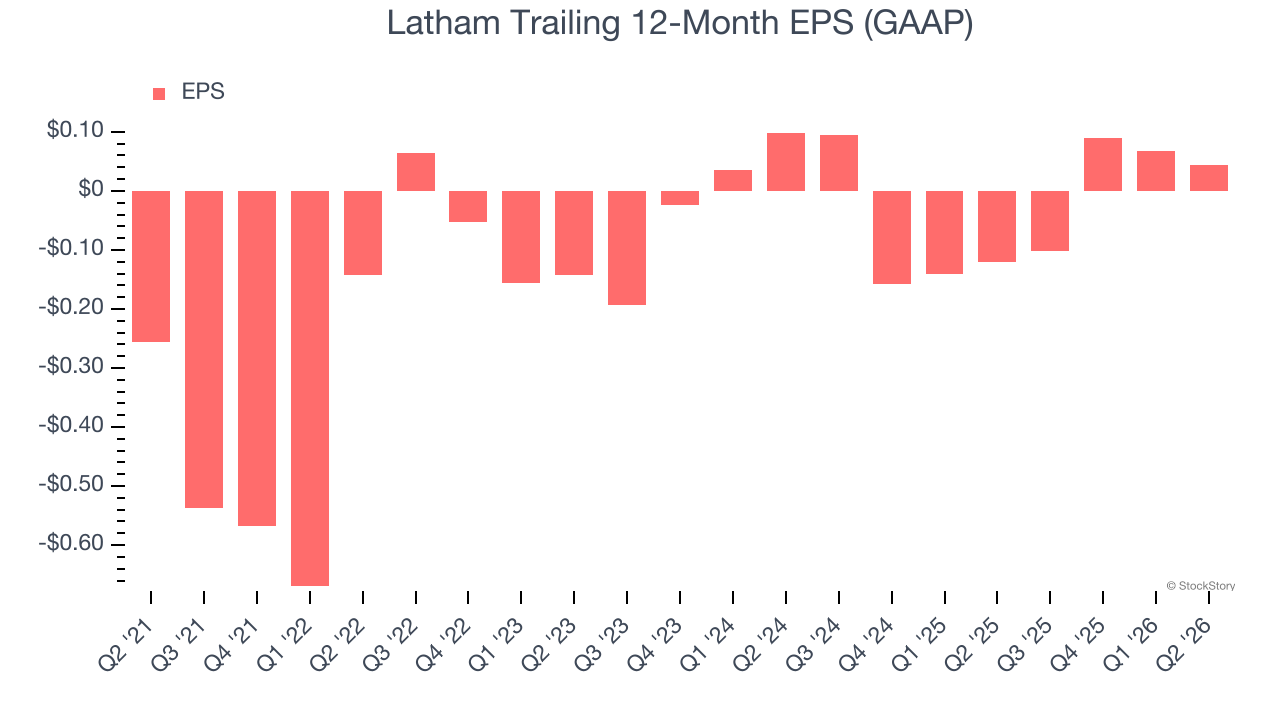
In Q2, Latham reported EPS of $0.11, down from $0.13 in the same quarter last year. This print missed analysts’ estimates. Over the next 12 months, Wall Street expects Latham’s full-year EPS to grow 284% from $0.04 to $0.17.
Key Takeaways from Latham’s Q2 Results
We were impressed by Latham’s optimistic full-year revenue guidance, which blew past analysts’ expectations. We were also glad its revenue outperformed Wall Street’s estimates. On the other hand, its EPS missed and its EBITDA fell short of Wall Street’s estimates. Overall, we think this was still a decent quarter with some key metrics above expectations. The stock traded up 13.7% to $6.48 immediately after reporting.
Latham may have had a good quarter, but does that mean you should invest right now? When making that decision, it’s important to consider its valuation, business qualities, as well as what has happened in the latest quarter. We cover that in our actionable full research report which you can read here (it’s free).