

Packaged bakery food company Flowers Foods (NYSE:FLO) missed Wall Street’s revenue expectations in Q2 CY2026, with sales falling 4% year on year to $1.19 billion. The company’s full-year revenue guidance of $5.11 billion at the midpoint came in 1.2% below analysts’ estimates. Its non-GAAP profit of $0.21 per share was 5.8% below analysts’ consensus estimates.
Is now the time to buy Flowers Foods? Find out by accessing our full research report, it’s free.
Flowers Foods (FLO) Q2 CY2026 Highlights:
- Revenue: $1.19 billion vs analyst estimates of $1.23 billion (4% year-on-year decline, 3.2% miss)
- Adjusted EPS: $0.21 vs analyst expectations of $0.22 (5.8% miss)
- Adjusted EBITDA: $111.3 million vs analyst estimates of $118.1 million (9.3% margin, 5.8% miss)
- The company dropped its revenue guidance for the full year to $5.11 billion at the midpoint from $5.22 billion, a 2.1% decrease
- Management lowered its full-year Adjusted EPS guidance to $0.80 at the midpoint, a 5.9% decrease
- EBITDA guidance for the full year is $467 million at the midpoint, below analyst estimates of $475.7 million
- Operating Margin: 5.7%, down from 7.9% in the same quarter last year
- Free Cash Flow Margin: 9.2%, up from 8% in the same quarter last year
- Sales Volumes fell 5.8% year on year (-2.4% in the same quarter last year)
- Market Capitalization: $1.58 billion
"Given our first-half performance and the current category environment, we are updating our full-year outlook to reflect a more cautious view for the balance of 2026. While near-term conditions remain challenging, we are confident that the actions underway will strengthen our top-line trajectory and better position our portfolio to meet evolving consumer demand."
Company Overview
With Wonder Bread as its premier brand, Flowers Foods (NYSE:FLO) is a packaged foods company that focuses on bakery products such as breads, buns, and cakes.
Revenue Growth
A company’s long-term sales performance can indicate its overall quality. Even a bad business can shine for one or two quarters, but a top-tier one grows for years.
With $5.22 billion in revenue over the past 12 months, Flowers Foods carries some recognizable products but is a mid-sized consumer staples company. Its size could bring disadvantages compared to larger competitors benefiting from better brand awareness and economies of scale.
As you can see below, Flowers Foods’s sales grew at a sluggish 1.4% compounded annual growth rate over the last three years as consumers bought less of its products. We’ll explore what this means in the “Volume Growth” section.
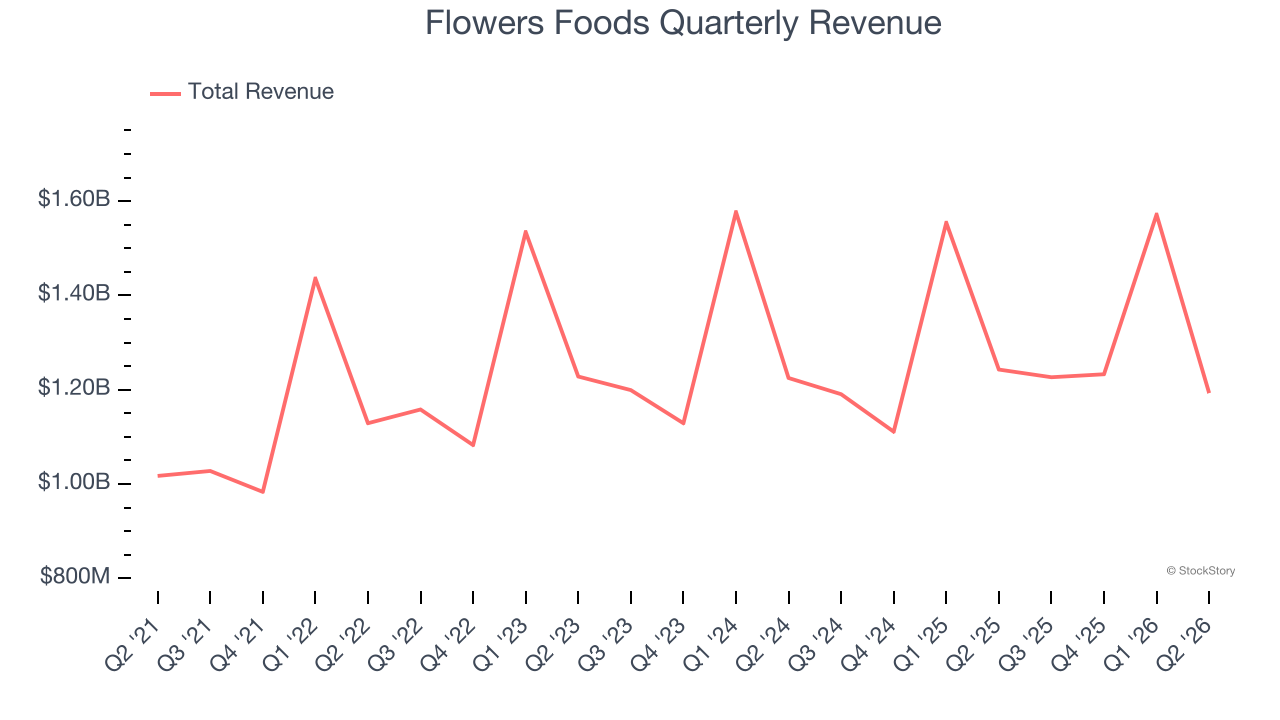
This quarter, Flowers Foods missed Wall Street’s estimates and reported a rather uninspiring 4% year-on-year revenue decline, generating $1.19 billion of revenue.
Looking ahead, sell-side analysts expect revenue to remain flat over the next 12 months, a slight deceleration versus the last three years. This projection doesn’t excite us and suggests its products will face some demand challenges.
ALSO WORTH WATCHING: Nvidia’s Quiet Partner. Nvidia’s chips cost a hundred grand. The connectors that make them work cost even more. One company makes them all.
Every AI server needs specialized infrastructure the chip companies don’t make. High-speed cables. Power connectors. Thermal sensors. This 90-year-old company built a monopoly on it. The AI boom just started. This stock is still flying under the radar. Claim The Stock Ticker Here for FREE.
Volume Growth
Revenue growth can be broken down into changes in price and volume (the number of units sold). While both are important, volume is the lifeblood of a successful staples business as there’s a ceiling to what consumers will pay for everyday goods; they can always trade down to non-branded products if the branded versions are too expensive.
Flowers Foods’s average quarterly sales volumes have shrunk by 2.7% over the last two years. This decrease isn’t ideal because the quantity demanded for consumer staples products is typically stable. 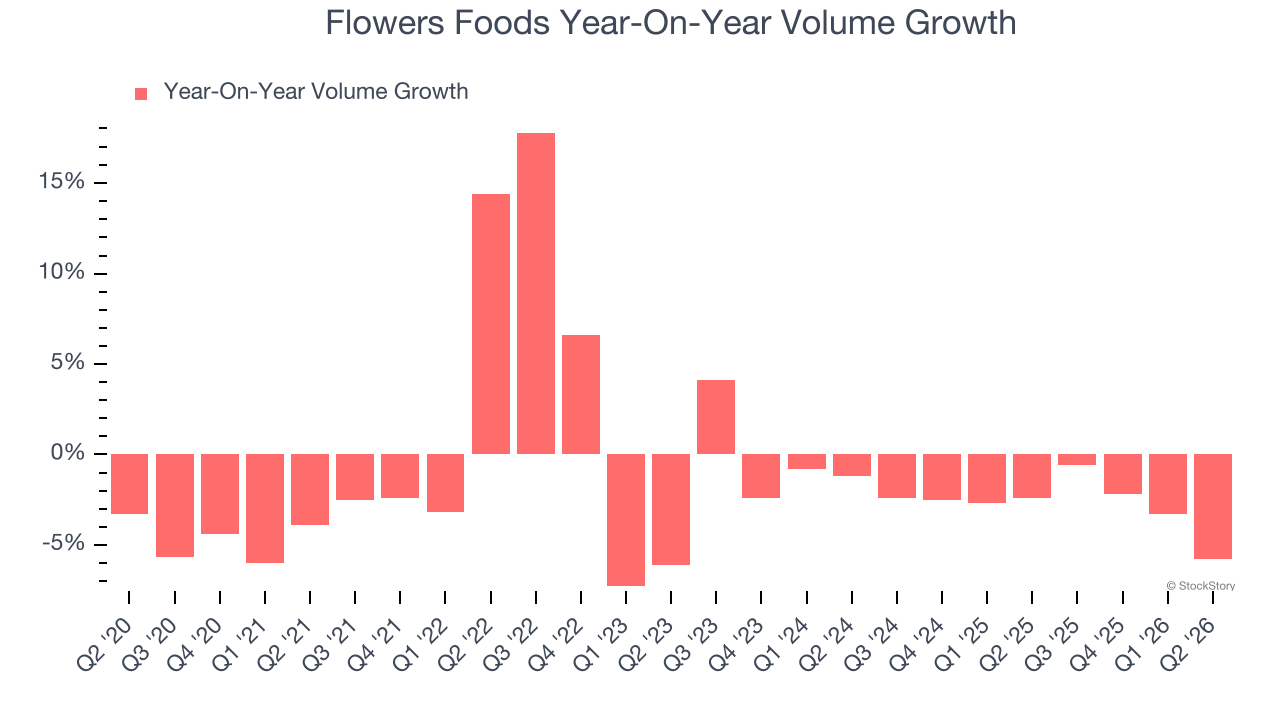
In Flowers Foods’s Q2 2026, sales volumes dropped 5.8% year on year. This result represents a further deceleration from its historical levels, showing the business is struggling to move its products.
Key Takeaways from Flowers Foods’s Q2 Results
It was encouraging to see Flowers Foods beat analysts’ gross margin expectations this quarter. On the other hand, its EBITDA missed and its revenue fell short of Wall Street’s estimates. Overall, this was a weaker quarter. The stock traded down 4.8% to $6.78 immediately after reporting.
Flowers Foods’s latest earnings report disappointed. One quarter doesn’t define a company’s quality, so let’s explore whether the stock is a buy at the current price. What happened in the latest quarter matters, but not as much as longer-term business quality and valuation, when deciding whether to invest in this stock. We cover that in our actionable full research report which you can read here (it’s free).