

The end of the earnings season is always a good time to take a step back and see who shined (and who didn’t). Let’s take a look at how vertical software stocks fared in Q1, starting with Upstart (NASDAQ:UPST).
Software is eating the world, and while a large number of solutions such as project management or video conferencing software can be useful to a wide array of industries, some have very specific needs. As a result, vertical software, which addresses industry-specific workflows, is growing and fueled by the pressures to improve productivity, whether it be for a life sciences, education, or banking company.
The 14 vertical software stocks we track reported a satisfactory Q1. As a group, revenues beat analysts’ consensus estimates by 2.2% while next quarter’s revenue guidance was 0.6% below.
Amidst this news, share prices of the companies have had a rough stretch. On average, they are down 8.8% since the latest earnings results.
Weakest Q1: Upstart (NASDAQ:UPST)
Using over 2,500 data variables and trained on nearly 82 million repayment events, Upstart (NASDAQ:UPST) is an AI-powered lending platform that uses machine learning to help banks and credit unions more accurately assess borrower risk for personal loans, auto loans, and home equity lines of credit.
Upstart reported revenues of $308.2 million, up 44.4% year on year. This print exceeded analysts’ expectations by 1.7%. Despite the top-line beat, it was still a softer quarter for the company with a significant miss of analysts’ EBITDA estimates and full-year revenue guidance slightly missing analysts’ expectations.
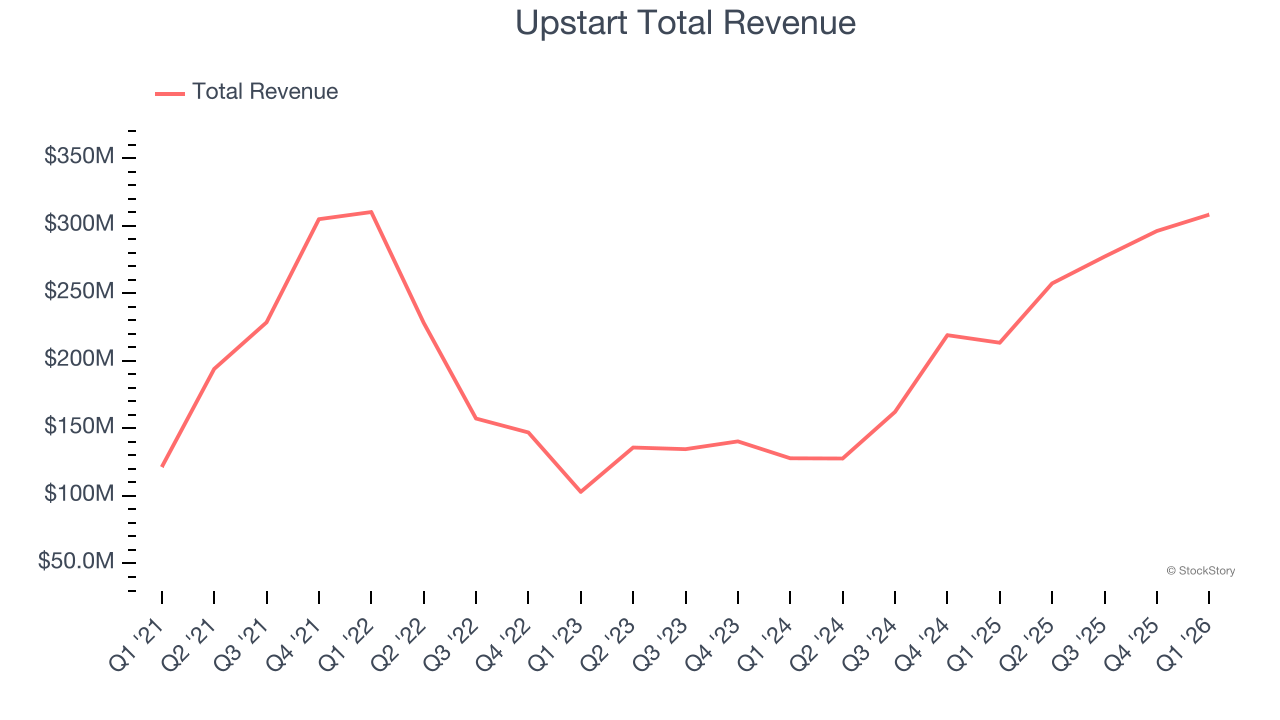
Upstart achieved the fastest revenue growth of the whole group. Unsurprisingly, the stock is up 3.7% since reporting and currently trades at $32.32.
Is now the time to buy Upstart? Access our full analysis of the earnings results here, it’s free.
Best Q1: Adobe (NASDAQ:ADBE)
Originally named after Adobe Creek that ran behind co-founder John Warnock's house, Adobe (NASDAQ:ADBE) develops software products used for digital content creation, document management, and marketing solutions across desktop, mobile, and cloud platforms.
Adobe reported revenues of $6.62 billion, up 12.7% year on year, outperforming analysts’ expectations by 2.6%. The business had an exceptional quarter with an impressive beat of analysts’ billings estimates and EPS guidance for next quarter exceeding analysts’ expectations.
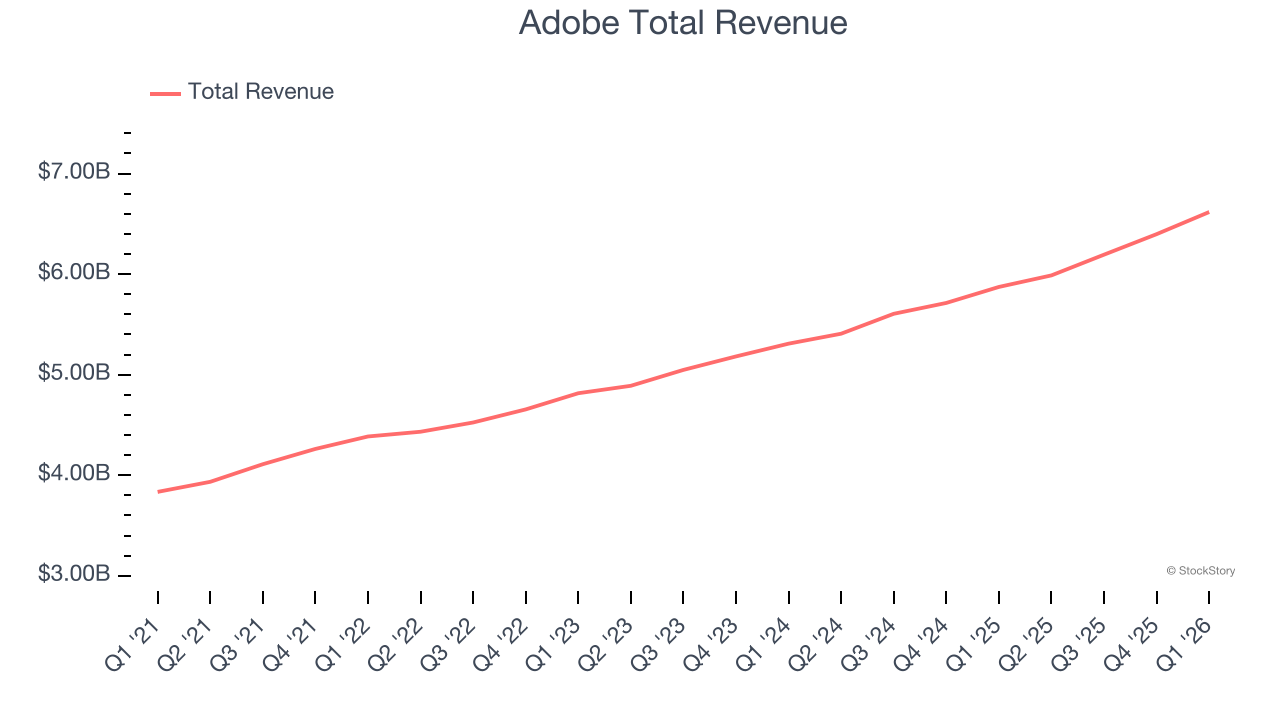
Adobe achieved the highest guidance raise and highest full-year guidance raise among its peers. Although it had a fine quarter compared to its peers, the market seems unhappy with the results as the stock is down 10.8% since reporting. It currently trades at $195.25.
Is now the time to buy Adobe? Access our full analysis of the earnings results here, it’s free.
Doximity (NYSE:DOCS)
With over 80% of U.S. physicians as members of its digital community, Doximity (NYSE:DOCS) operates a digital platform that enables physicians and other healthcare professionals to collaborate, stay current with medical news, manage their careers, and conduct virtual patient visits.
Doximity reported revenues of $145.4 million, up 5.1% year on year, in line with analysts’ expectations. It was a softer quarter as it posted full-year guidance of slowing revenue growth and full-year EBITDA guidance missing analysts’ expectations.
Doximity delivered the slowest revenue growth and weakest full-year guidance update in the group. As expected, the stock is down 12.2% since the results and currently trades at $20.53.
Read our full analysis of Doximity’s results here.
Autodesk (NASDAQ:ADSK)
Starting with AutoCAD in the 1980s and evolving into a comprehensive design ecosystem, Autodesk (NASDAQ:ADSK) provides software solutions for architecture, engineering, construction, manufacturing, and entertainment industries to design, simulate, and visualize projects.
Autodesk reported revenues of $1.93 billion, up 18.4% year on year. This print beat analysts’ expectations by 2.2%. Overall, it was a strong quarter as it also produced a solid beat of analysts’ billings estimates and EPS guidance for next quarter beating analysts’ expectations.
The stock is down 19.6% since reporting and currently trades at $193.75.
Read our full, actionable report on Autodesk here, it’s free.
Agilysys (NASDAQ:AGYS)
With a tech stack that powers everything from check-in to checkout at some of the world's top hospitality venues, Agilysys (NASDAQ:AGYS) develops and provides cloud-based and on-premise software solutions for hotels, resorts, casinos, and restaurants to manage operations and enhance guest experiences.
Agilysys reported revenues of $82.95 million, up 11.7% year on year. This number topped analysts’ expectations by 1.7%. It was a very strong quarter as it also recorded an impressive beat of analysts’ EBITDA estimates and full-year guidance of robust revenue growth.
The stock is up 22.7% since reporting and currently trades at $86.11.
Read our full, actionable report on Agilysys here, it’s free.
Market Update
Late in 2025 into early 2026, there was hand-wringing around artificial intelligence. For software companies, the fear was that AI would erode pricing power and compress margins as new tools made it easier to replicate what once required expensive enterprise platforms. Crypto investors had their own version of the same anxiety: if AI agents could trade, allocate capital, and manage wallets autonomously, what exactly was the long-term value of today’s crypto infrastructure?
These concerns triggered a noticeable rotation away from these sectors and into safer havens. But markets rarely dwell on one narrative for long. Spring 2026 came, and the focus shifted abruptly from technological disruption to geopolitical risk. The US’ conflict with Iran became the dominant driver of market psychology, and when geopolitics takes center stage, the script changes quickly. Investors stop debating growth rates and start worrying about oil supply, inflation, and global stability.
Want to invest in winners with rock-solid fundamentals? Check out our 9 Best Market-Beating Stocks and add them to your watchlist. These companies are poised for growth regardless of the political or macroeconomic climate.
StockStory’s analyst team — all seasoned professional investors — uses quantitative analysis and automation to deliver market-beating insights faster and with higher quality.