

Household products company Reynolds (NASDAQ:REYN) reported Q1 CY2026 results topping the market’s revenue expectations, with sales up 7.2% year on year to $877 million. The company expects next quarter’s revenue to be around $933.3 million, close to analysts’ estimates. Its non-GAAP profit of $0.28 per share was 14.5% above analysts’ consensus estimates.
Is now the time to buy Reynolds? Find out by accessing our full research report, it’s free.
Reynolds (REYN) Q1 CY2026 Highlights:
- Revenue: $877 million vs analyst estimates of $822.5 million (7.2% year-on-year growth, 6.6% beat)
- Adjusted EPS: $0.28 vs analyst estimates of $0.24 (14.5% beat)
- Adjusted EBITDA: $131 million vs analyst estimates of $121.6 million (14.9% margin, 7.7% beat)
- Revenue Guidance for Q2 CY2026 is $933.3 million at the midpoint, roughly in line with what analysts were expecting
- Management reiterated its full-year Adjusted EPS guidance of $1.60 at the midpoint
- EBITDA guidance for the full year is $667.5 million at the midpoint, in line with analyst expectations
- Operating Margin: 11.2%, up from 9.3% in the same quarter last year
- Free Cash Flow Margin: 3.1%, up from 2.1% in the same quarter last year
- Organic Revenue rose 7% year on year (beat)
- Sales Volumes rose 2% year on year (-4% in the same quarter last year)
- Market Capitalization: $4.49 billion
Company Overview
Best known for its aluminum foil, Reynolds (NASDAQ:REYN) is a household products company whose products focus on food storage, cooking, and waste.
Revenue Growth
Examining a company’s long-term performance can provide clues about its quality. Any business can put up a good quarter or two, but the best consistently grow over the long haul.
With $3.78 billion in revenue over the past 12 months, Reynolds carries some recognizable products but is a mid-sized consumer staples company. Its size could bring disadvantages compared to larger competitors benefiting from better brand awareness and economies of scale.
As you can see below, Reynolds struggled to increase demand as its $3.78 billion of sales for the trailing 12 months was close to its revenue three years ago. This is mainly because it failed to grow its volumes.
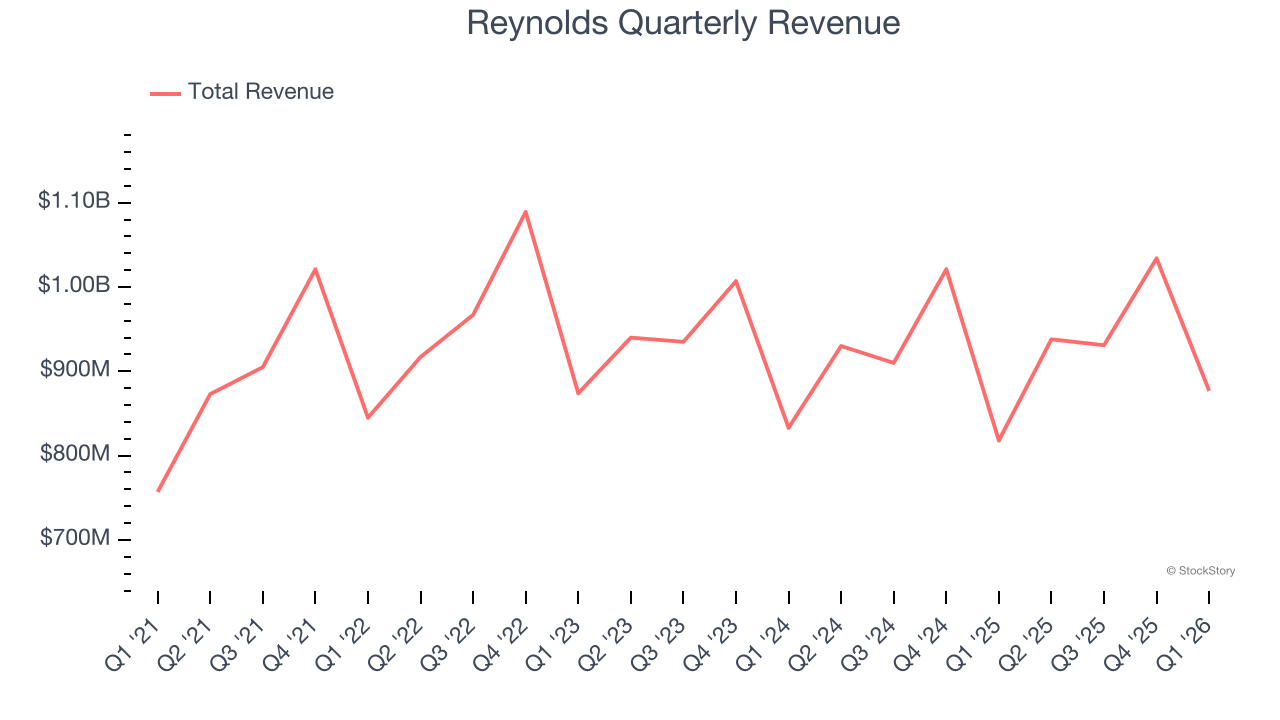
This quarter, Reynolds reported year-on-year revenue growth of 7.2%, and its $877 million of revenue exceeded Wall Street’s estimates by 6.6%. Company management is currently guiding for flat sales next quarter.
Looking further ahead, sell-side analysts expect revenue to decline by 1.2% over the next 12 months, similar to its three-year rate. This projection doesn't excite us and implies its newer products will not lead to better top-line performance yet.
ONE MORE THING: 3 Hidden Platforms Growing 3X Faster than Amazon, Google, and PayPal. Amazon, Google, and Meta all followed the same playbook: Dominate an ignored market. Build an unbeatable moat. Scale until you’re unstoppable.
These three platforms are running that exact playbook right now. The early investors in Amazon made fortunes. The early investors in these could do the same. Get All 3 Stocks Here for FREE.
Volume Growth
Revenue growth can be broken down into changes in price and volume (the number of units sold). While both are important, volume is the lifeblood of a successful staples business as there’s a ceiling to what consumers will pay for everyday goods; they can always trade down to non-branded products if the branded versions are too expensive.
To analyze whether Reynolds generated its growth (or lack thereof) from changes in price or volume, we can compare its volume growth to its organic revenue growth, which excludes non-fundamental impacts on company financials like mergers and currency fluctuations.
Over the last two years, Reynolds’s quarterly sales volumes have, on average, stayed about the same. This is normal for a consumer staples company, where demand typically doesn’t see much volatility. Its stable sales volumes combined with its flat organic sales also imply the company didn’t change the prices for its products.
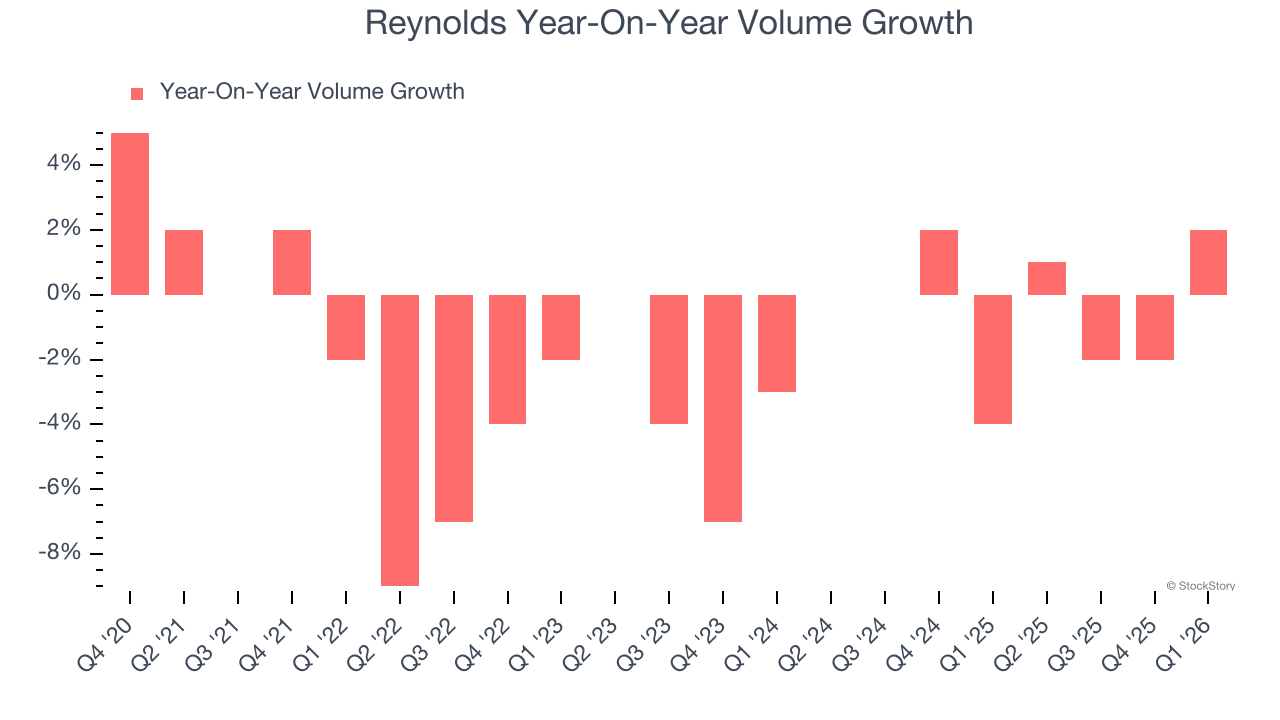
In Reynolds’s Q1 2026, sales volumes jumped 2% year on year. This result was a well-appreciated turnaround from its historical levels, showing the company is heading in the right direction.
Key Takeaways from Reynolds’s Q1 Results
We were impressed by how significantly Reynolds blew past analysts’ EBITDA expectations this quarter. We were also excited its organic revenue outperformed Wall Street’s estimates by a wide margin. Overall, we think this was still a solid quarter with some key areas of upside. The stock traded up 4.1% to $22.17 immediately following the results.
Reynolds put up rock-solid earnings, but one quarter doesn’t necessarily make the stock a buy. Let’s see if this is a good investment. When making that decision, it’s important to consider its valuation, business qualities, as well as what has happened in the latest quarter. We cover that in our actionable full research report which you can read here (it’s free).