

Regional banking firm Texas Capital Bancshares (NASDAQ:TCBI) announced better-than-expected revenue in Q1 CY2026, with sales up 15.5% year on year to $324 million. Its non-GAAP profit of $1.58 per share was 12.4% above analysts’ consensus estimates.
Is now the time to buy Texas Capital Bank? Find out by accessing our full research report, it’s free.
Texas Capital Bank (TCBI) Q1 CY2026 Highlights:
- Net Interest Income: $254.7 million vs analyst estimates of $254.3 million (7.9% year-on-year growth, in line)
- Net Interest Margin: 3.4% vs analyst estimates of 3.4% (7.6 basis point beat)
- Revenue: $324 million vs analyst estimates of $318 million (15.5% year-on-year growth, 1.9% beat)
- Efficiency Ratio: 65.9% vs analyst estimates of 66.3% (44 basis point beat)
- Adjusted EPS: $1.58 vs analyst estimates of $1.41 (12.4% beat)
- Tangible Book Value per Share: $75.67 vs analyst estimates of $77.66 (11.3% year-on-year growth, 2.6% miss)
- Market Capitalization: $4.53 billion
DALLAS, April 23, 2026 (GLOBE NEWSWIRE) -- “Our first quarter results reflect the increasing relevance of our platform and the breadth of capabilities we can now deliver for clients across our markets,” said Rob C. Holmes, Chairman, President & CEO.
Company Overview
Founded during the Texas banking renaissance of the 1990s with an entrepreneurial spirit, Texas Capital Bancshares (NASDAQ:TCBI) is a financial services firm that provides banking, wealth management, and investment banking services to businesses and individuals across Texas and beyond.
Sales Growth
In general, banks make money from two primary sources. The first is net interest income, which is interest earned on loans, mortgages, and investments in securities minus interest paid out on deposits. The second source is non-interest income, which can come from bank account, credit card, wealth management, investing banking, and trading fees. Regrettably, Texas Capital Bank’s revenue grew at a sluggish 4.3% compounded annual growth rate over the last five years. This fell short of our benchmark for the banking sector and is a poor baseline for our analysis.
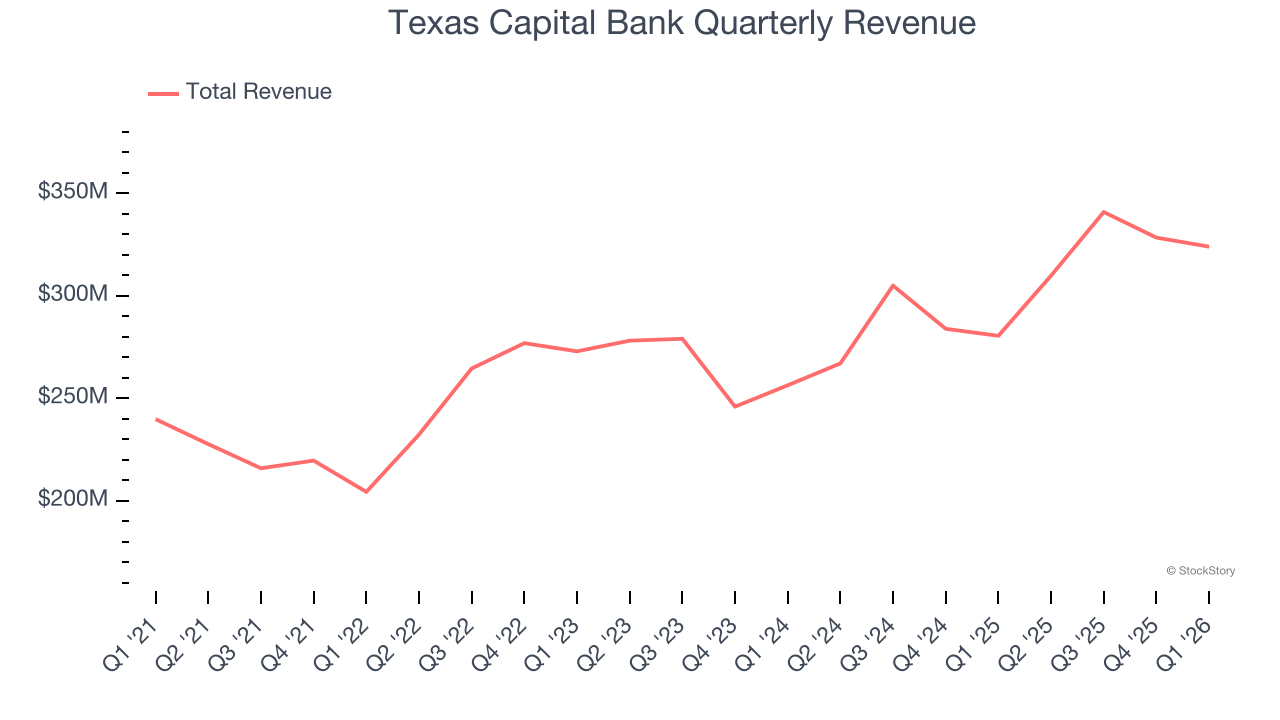
Long-term growth is the most important, but within financials, a half-decade historical view may miss recent interest rate changes and market returns. Texas Capital Bank’s annualized revenue growth of 10.9% over the last two years is above its five-year trend, suggesting some bright spots. 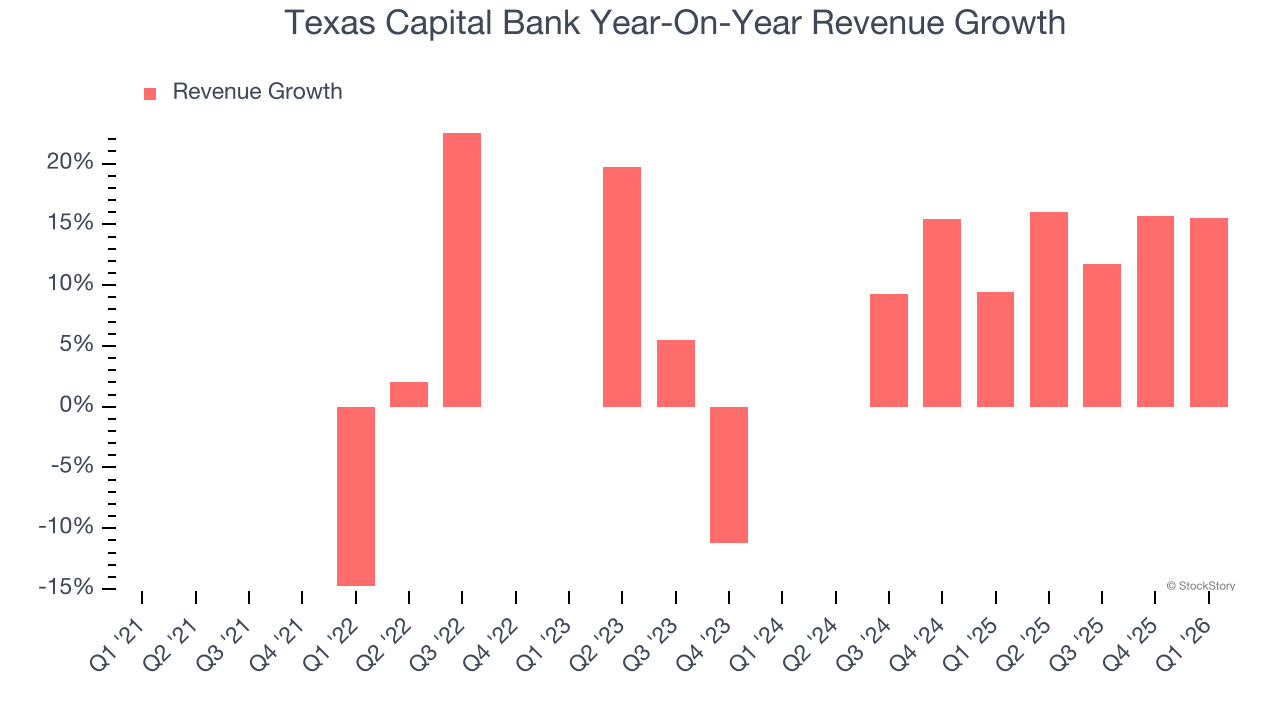 Note: Quarters not shown were determined to be outliers, impacted by outsized investment gains/losses that are not indicative of the recurring fundamentals of the business.
This quarter, Texas Capital Bank reported year-on-year revenue growth of 15.5%, and its $324 million of revenue exceeded Wall Street’s estimates by 1.9%.
Net interest income made up 84.4% of the company’s total revenue during the last five years, meaning Texas Capital Bank barely relies on non-interest income to drive its overall growth.
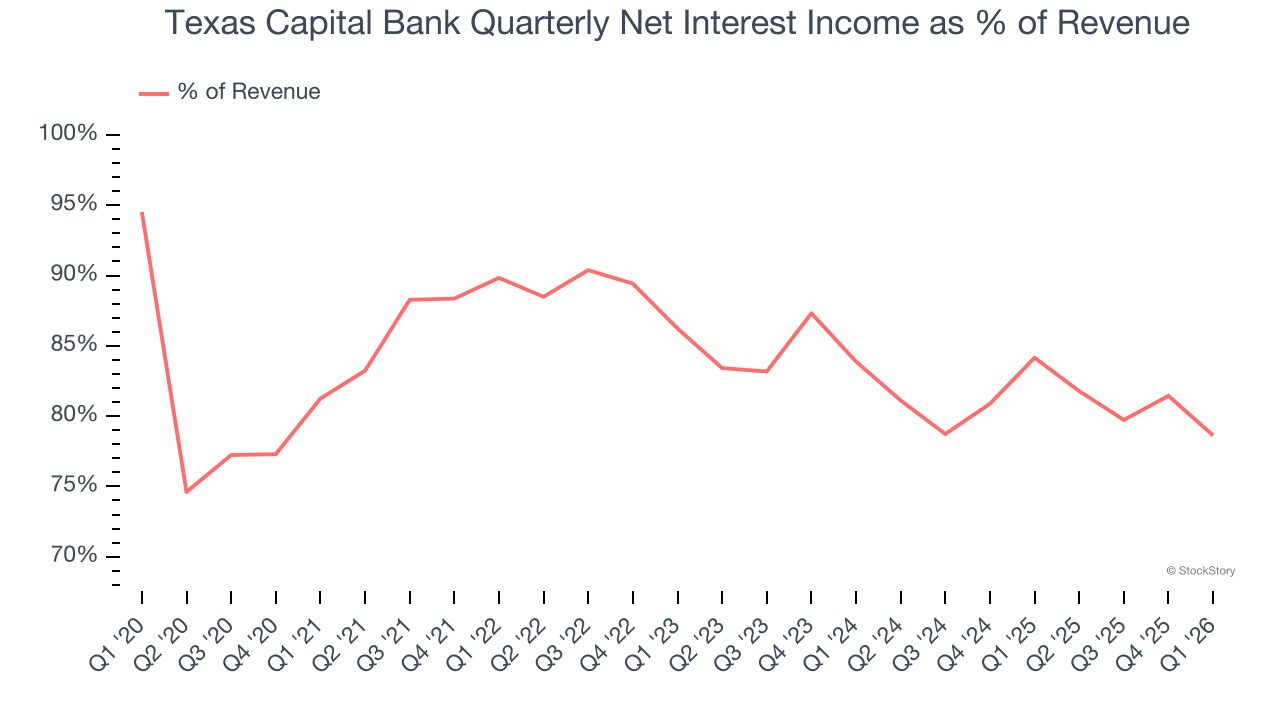
Our experience and research show the market cares primarily about a bank’s net interest income growth as non-interest income is considered a lower-quality and non-recurring revenue source.
ALSO WORTH WATCHING: Nvidia’s Quiet Partner. Nvidia’s chips cost a hundred grand. The connectors that make them work cost even more. One company makes them all.
Every AI server needs specialized infrastructure the chip companies don’t make. High-speed cables. Power connectors. Thermal sensors. This 90-year-old company built a monopoly on it. The AI boom just started. This stock is still flying under the radar. Claim The Stock Ticker Here for FREE.
Tangible Book Value Per Share (TBVPS)
The balance sheet drives banking profitability since earnings flow from the spread between borrowing and lending rates. As such, valuations for these companies concentrate on capital strength and sustainable equity accumulation potential.
Because of this, tangible book value per share (TBVPS) emerges as the critical performance benchmark. By excluding intangible assets with uncertain liquidation values, this metric captures real, liquid net worth per share. On the other hand, EPS is often distorted by mergers and flexible loan loss accounting. TBVPS provides clearer performance insights.
Texas Capital Bank’s TBVPS grew at an impressive 7.3% annual clip over the last five years. TBVPS growth has also accelerated recently, growing by 11.3% annually over the last two years from $61.06 to $75.67 per share.
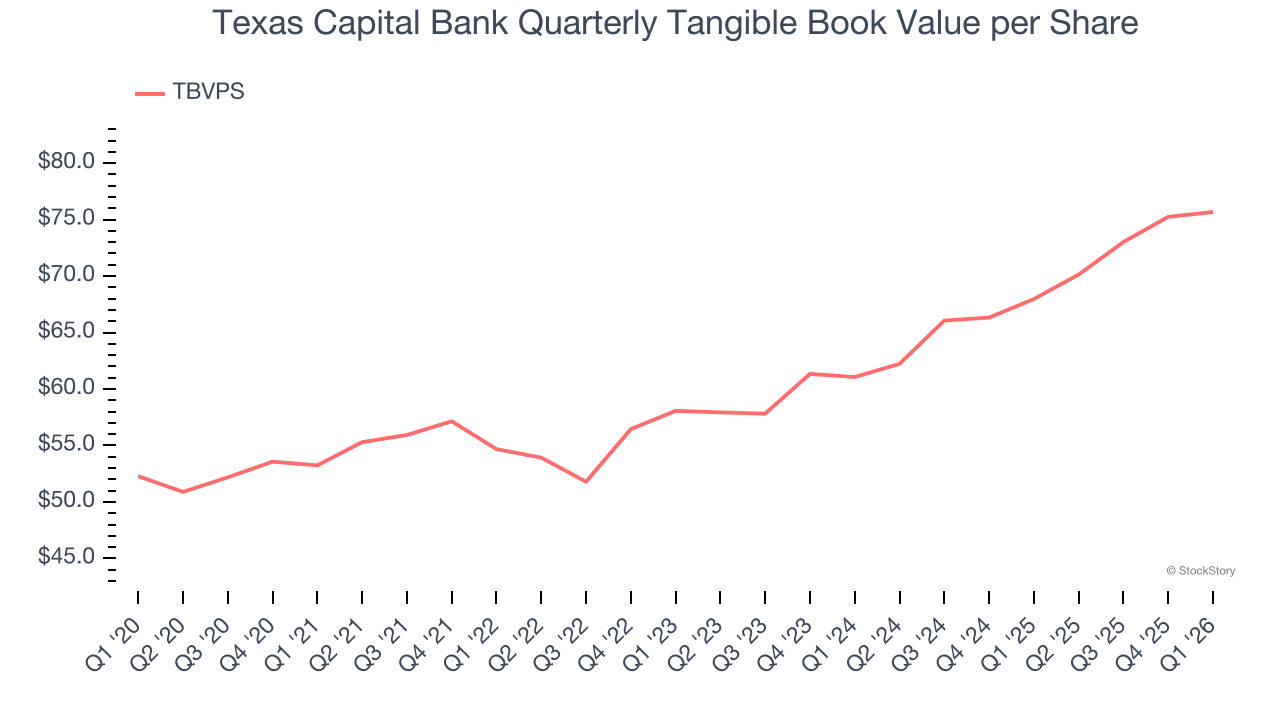
Over the next 12 months, Consensus estimates call for Texas Capital Bank’s TBVPS to grow by 13.8% to $86.08, decent growth rate.
Key Takeaways from Texas Capital Bank’s Q1 Results
It was good to see Texas Capital Bank beat analysts’ EPS expectations this quarter. We were also happy its revenue outperformed Wall Street’s estimates. On the other hand, its tangible book value per share missed. Overall, this print had some key positives. The stock remained flat at $102.70 immediately following the results.
So do we think Texas Capital Bank is an attractive buy at the current price? What happened in the latest quarter matters, but not as much as longer-term business quality and valuation, when deciding whether to invest in this stock. We cover that in our actionable full research report which you can read here (it’s free).