

As the Q4 earnings season comes to a close, it’s time to take stock of this quarter’s best and worst performers in the research tools & consumables industry, including Revvity (NYSE:RVTY) and its peers.
The life sciences subsector specializing in research tools and consumables enables scientific discoveries across academia, biotechnology, and pharmaceuticals. These firms supply a wide range of essential laboratory products, ensuring a recurring revenue stream through repeat purchases and replenishment. Their business models benefit from strong customer loyalty, a diversified product portfolio, and exposure to both the research and clinical markets. However, challenges include high R&D investment to maintain technological leadership, pricing pressures from budget-conscious institutions, and vulnerability to fluctuations in research funding cycles. Looking ahead, this subsector stands to benefit from tailwinds such as growing demand for tools supporting emerging fields like synthetic biology and personalized medicine. There is also a rise in automation and AI-driven solutions in laboratories that could create new opportunities to sell tools and consumables. Nevertheless, headwinds exist. These companies tend to be at the mercy of supply chain disruptions and sensitivity to macroeconomic conditions that impact funding for research initiatives.
The 10 research tools & consumables stocks we track reported a satisfactory Q4. As a group, revenues beat analysts’ consensus estimates by 1.2% while next quarter’s revenue guidance was in line.
Amidst this news, share prices of the companies have had a rough stretch. On average, they are down 20.4% since the latest earnings results.
Revvity (NYSE:RVTY)
Formerly known as PerkinElmer until its rebranding in 2023, Revvity (NYSE:RVTY) provides health science technologies and services that support the complete workflow from discovery to development and diagnosis to cure.
Revvity reported revenues of $772.1 million, up 5.8% year on year. This print exceeded analysts’ expectations by 1.1%. Overall, it was a strong quarter for the company with full-year revenue guidance slightly topping analysts’ expectations and a narrow beat of analysts’ organic revenue estimates.
"We finished 2025 on a strong note by delivering results that were solidly ahead of our expectations," said Prahlad Singh, president and chief executive officer of Revvity.
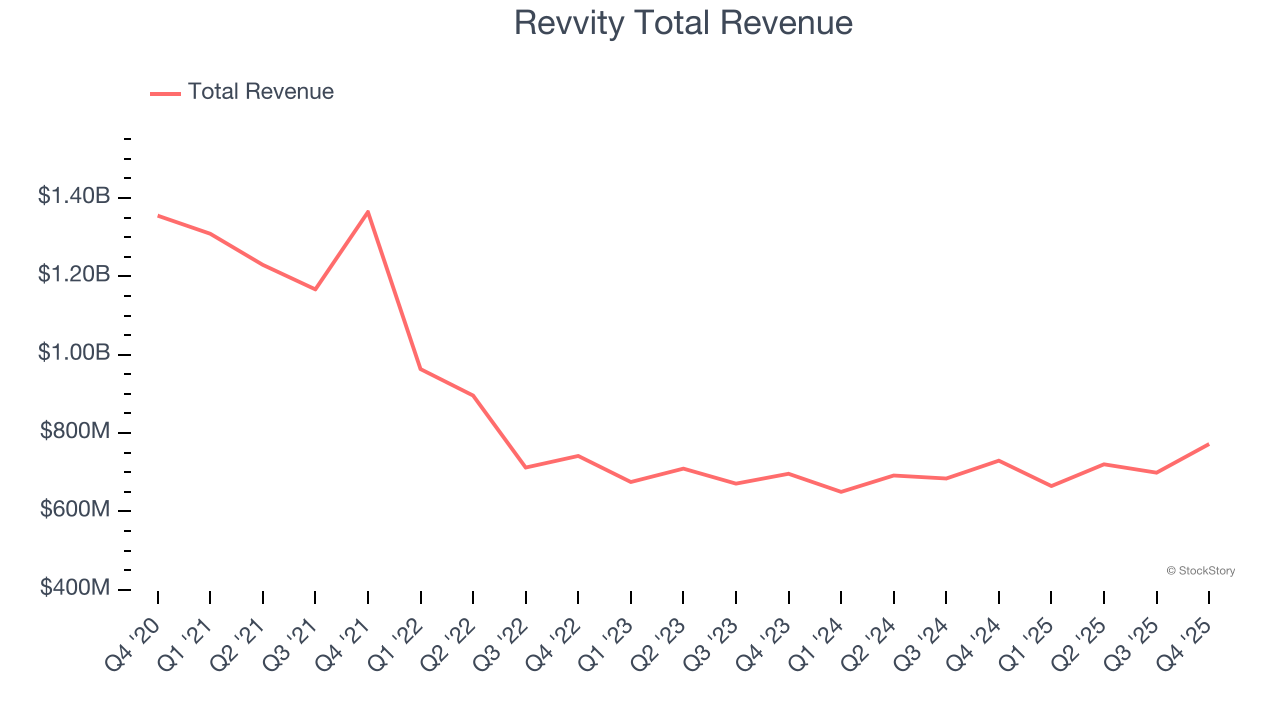
Revvity delivered the weakest full-year guidance update of the whole group. Unsurprisingly, the stock is down 22% since reporting and currently trades at $84.89.
Is now the time to buy Revvity? Access our full analysis of the earnings results here, it’s free.
Best Q4: Bio-Techne (NASDAQ:TECH)
With a catalog of hundreds of thousands of specialized biological products used in laboratories worldwide, Bio-Techne (NASDAQ:TECH) develops and manufactures specialized reagents, instruments, and services that help researchers study biological processes and enable diagnostic testing and cell therapy development.
Bio-Techne reported revenues of $295.9 million, flat year on year, outperforming analysts’ expectations by 2%. The business had a strong quarter with a solid beat of analysts’ organic revenue estimates and a decent beat of analysts’ revenue estimates.
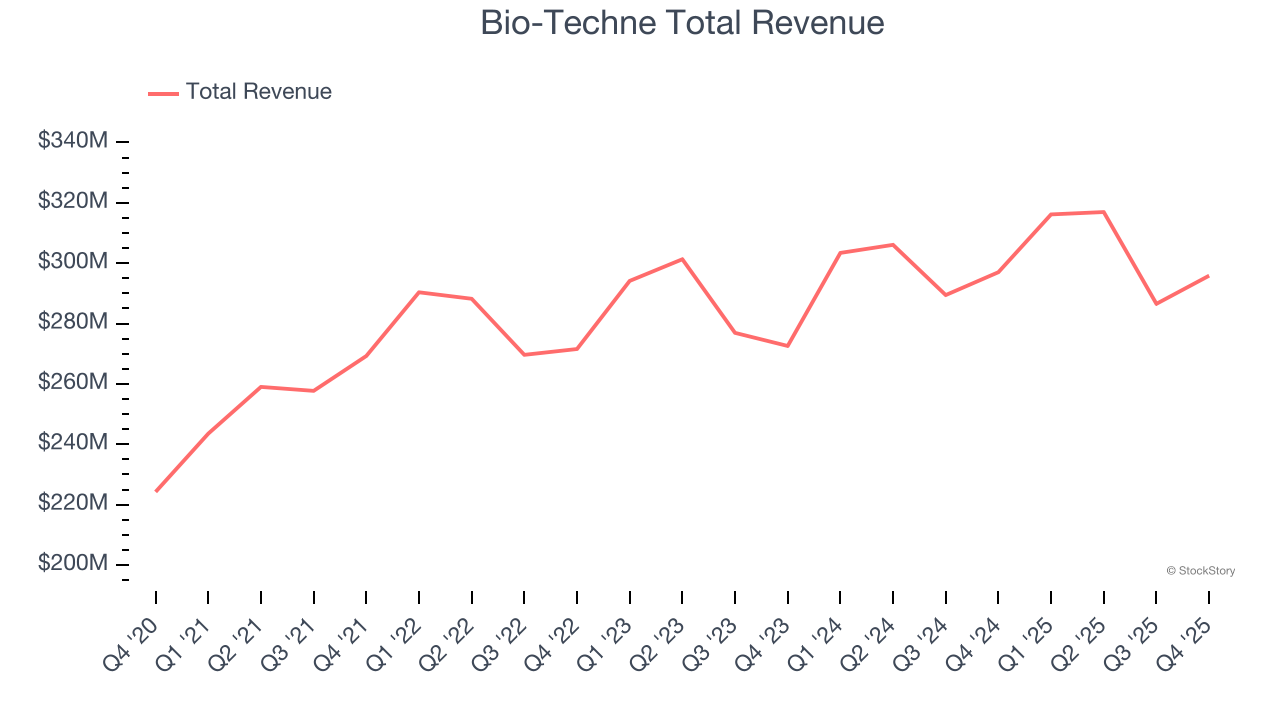
Although it had a fine quarter compared its peers, the market seems unhappy with the results as the stock is down 21.4% since reporting. It currently trades at $50.81.
Is now the time to buy Bio-Techne? Access our full analysis of the earnings results here, it’s free.
Weakest Q4: Mettler-Toledo (NYSE:MTD)
With roots dating back to the precision balance innovations of Swiss engineer Erhard Mettler, Mettler-Toledo (NYSE:MTD) manufactures precision weighing instruments, analytical equipment, and product inspection systems used in laboratories, industrial settings, and food retail.
Mettler-Toledo reported revenues of $1.13 billion, up 8.1% year on year, exceeding analysts’ expectations by 2.3%. Still, it was a slower quarter as it posted revenue guidance for next quarter missing analysts’ expectations significantly and a significant miss of analysts’ EPS guidance for next quarter estimates.
As expected, the stock is down 13.8% since the results and currently trades at $1,192.
Read our full analysis of Mettler-Toledo’s results here.
Agilent (NYSE:A)
Originally spun off from Hewlett-Packard in 1999 as its measurement and analytical division, Agilent Technologies (NYSE:A) provides analytical instruments, software, services, and consumables for laboratory workflows in life sciences, diagnostics, and applied chemical markets.
Agilent reported revenues of $1.80 billion, up 7% year on year. This number met analysts’ expectations. More broadly, it was a mixed quarter as it also logged revenue guidance for next quarter beating analysts’ expectations but revenue in line with analysts’ estimates.
Agilent had the weakest performance against analyst estimates among its peers. The stock is down 10.7% since reporting and currently trades at $111.37.
Read our full, actionable report on Agilent here, it’s free.
Danaher (NYSE:DHR)
Born from a real estate investment trust that transformed into a manufacturing powerhouse, Danaher (NYSE:DHR) is a global science and technology company that provides specialized equipment, software, and services for biotechnology, life sciences, and diagnostics.
Danaher reported revenues of $6.84 billion, up 4.6% year on year. This result was in line with analysts’ expectations. However, it was a mixed quarter as it failed to impress in some other areas of the business.
The stock is down 18.9% since reporting and currently trades at $191.20.
Read our full, actionable report on Danaher here, it’s free.
Market Update
Late in 2025 into early 2026, there was hand wringing around artificial intelligence. For software companies, the fear was that AI would erode pricing power and compress margins as new tools made it easier to replicate what once required expensive enterprise platforms. Crypto investors had their own version of the same anxiety: if AI agents could trade, allocate capital, and manage wallets autonomously, what exactly was the long-term value of today’s crypto infrastructure?
These concerns triggered a noticeable rotation away from these sectors and into safer havens. But markets rarely dwell on one narrative for long. Spring 2026 came, and the focus shifted abruptly from technological disruption to geopolitical risk. The US’ conflict with Iran became the dominant driver of market psychology, and when geopolitics takes center stage, the script changes quickly. Investors stop debating growth rates and start worrying about oil supply, inflation, and global stability.
Want to invest in winners with rock-solid fundamentals? Check out our Hidden Gem Stocks and add them to your watchlist. These companies are poised for growth regardless of the political or macroeconomic climate.
StockStory’s analyst team — all seasoned professional investors — uses quantitative analysis and automation to deliver market-beating insights faster and with higher quality.