

Aerospace and defense company Mercury Systems (NASDAQ:MRCY) announced better-than-expected revenue in Q4 CY2025, with sales up 4.4% year on year to $232.9 million. Its non-GAAP profit of $0.16 per share was significantly above analysts’ consensus estimates.
Is now the time to buy Mercury Systems? Find out by accessing our full research report, it’s free.
Mercury Systems (MRCY) Q4 CY2025 Highlights:
- Revenue: $232.9 million vs analyst estimates of $210.9 million (4.4% year-on-year growth, 10.4% beat)
- Adjusted EPS: $0.16 vs analyst estimates of $0.06 (significant beat)
- Adjusted EBITDA: $30.02 million vs analyst estimates of $21.25 million (12.9% margin, 41.2% beat)
- Operating Margin: -4.6%, in line with the same quarter last year
- Free Cash Flow Margin: 19.6%, down from 36.7% in the same quarter last year
- Backlog: $1.5 billion at quarter end, up 7.1% year on year
- Market Capitalization: $5.64 billion
“We delivered second quarter fiscal 2026 results that were ahead of our expectations, with solid year-over-year growth in backlog, revenue, and adjusted EBITDA, and robust free cash flow,” said Bill Ballhaus, Mercury’s Chairman and CEO.
Company Overview
Founded in 1981, Mercury Systems (NASDAQ:MRCY) specializes in providing processing subsystems and components for primarily defense applications.
Revenue Growth
Examining a company’s long-term performance can provide clues about its quality. Any business can put up a good quarter or two, but the best consistently grow over the long haul. Regrettably, Mercury Systems’s sales grew at a sluggish 2.3% compounded annual growth rate over the last five years. This fell short of our benchmarks and is a rough starting point for our analysis.
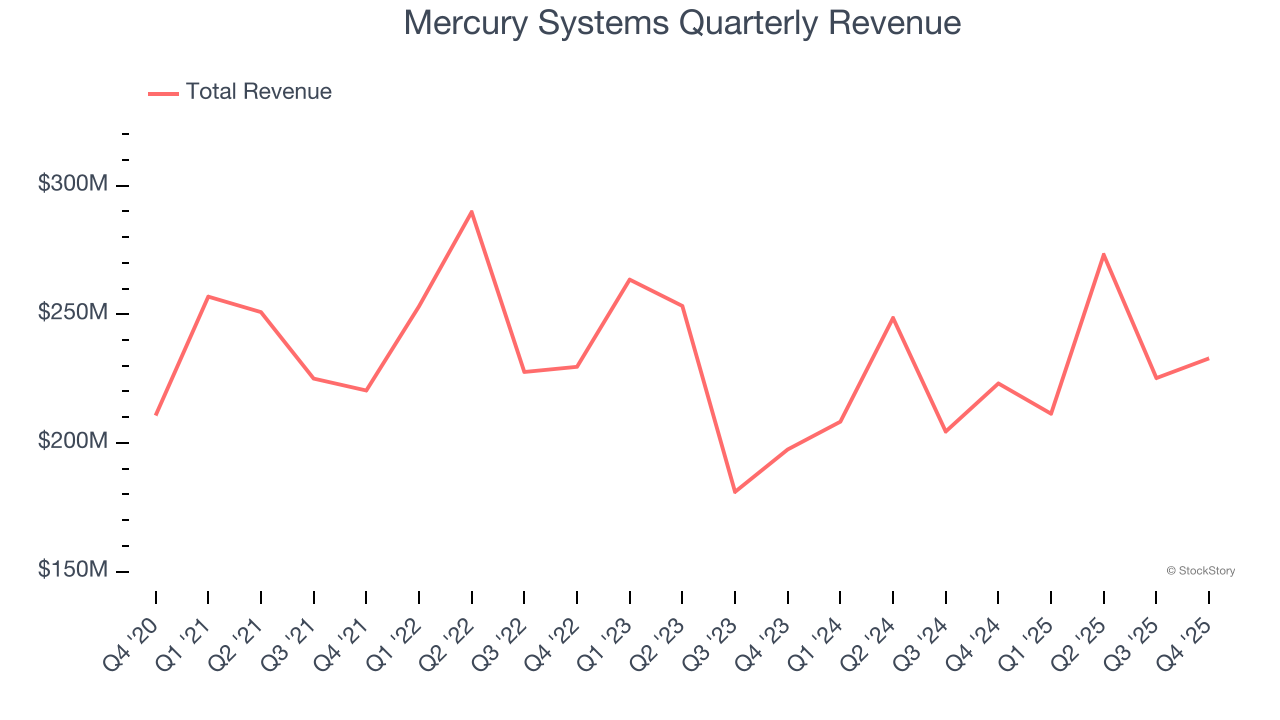
We at StockStory place the most emphasis on long-term growth, but within industrials, a half-decade historical view may miss cycles, industry trends, or a company capitalizing on catalysts such as a new contract win or a successful product line. Mercury Systems’s annualized revenue growth of 2.6% over the last two years aligns with its five-year trend, suggesting its demand was consistently weak. 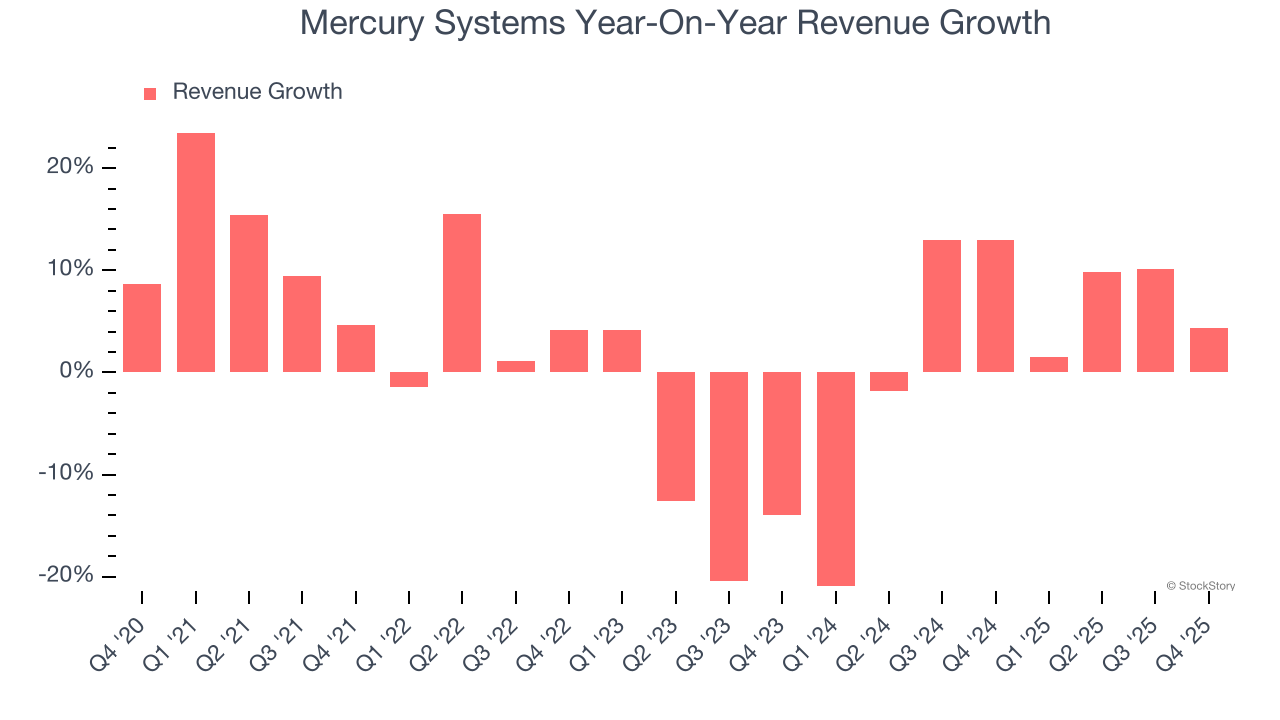
We can better understand the company’s revenue dynamics by analyzing its backlog, or the value of its outstanding orders that have not yet been executed or delivered. Mercury Systems’s backlog reached $1.5 billion in the latest quarter and averaged 5.6% year-on-year growth over the last two years. Because this number is better than its revenue growth, we can see the company accumulated more orders than it could fulfill and deferred revenue to the future. This could imply elevated demand for Mercury Systems’s products and services but raises concerns about capacity constraints. 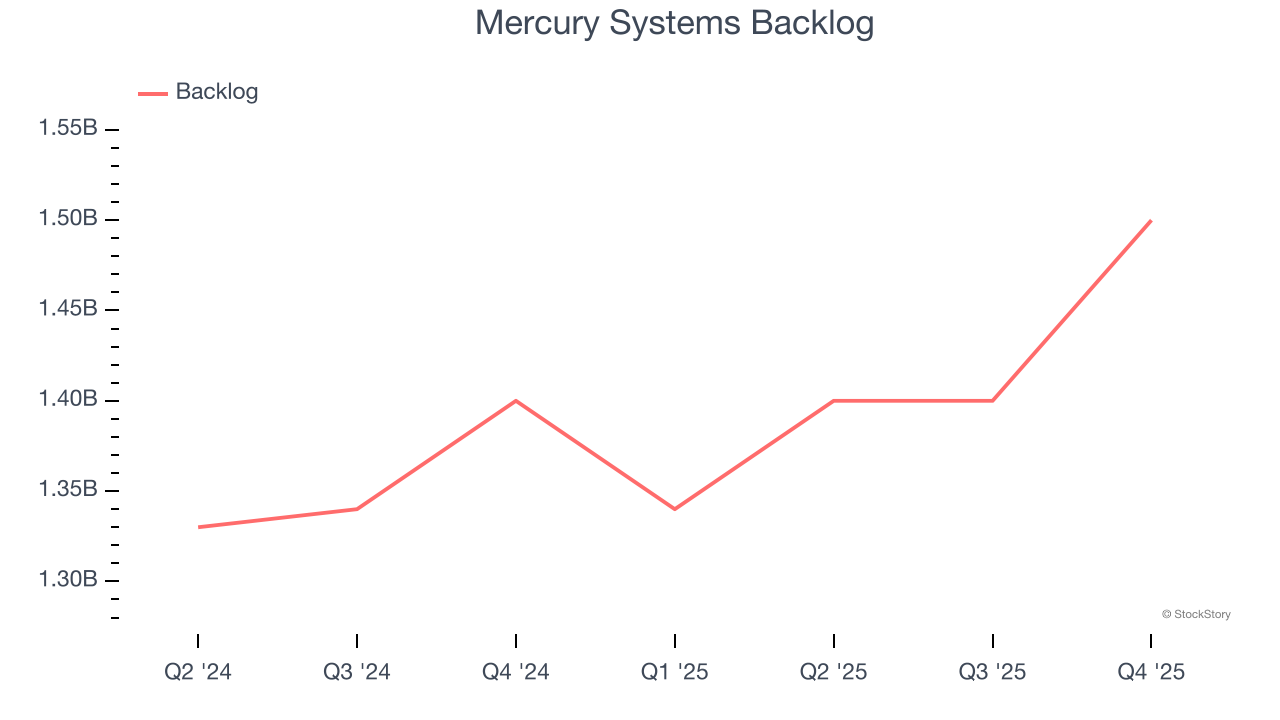
This quarter, Mercury Systems reported modest year-on-year revenue growth of 4.4% but beat Wall Street’s estimates by 10.4%.
Looking ahead, sell-side analysts expect revenue to grow 5.2% over the next 12 months. Although this projection implies its newer products and services will fuel better top-line performance, it is still below the sector average.
The 1999 book Gorilla Game predicted Microsoft and Apple would dominate tech before it happened. Its thesis? Identify the platform winners early. Today, enterprise software companies embedding generative AI are becoming the new gorillas. a profitable, fast-growing enterprise software stock that is already riding the automation wave and looking to catch the generative AI next.
Operating Margin
Mercury Systems’s high expenses have contributed to an average operating margin of negative 2.8% over the last five years. Unprofitable industrials companies require extra attention because they could get caught swimming naked when the tide goes out. It’s hard to trust that the business can endure a full cycle.
Analyzing the trend in its profitability, Mercury Systems’s operating margin decreased by 5.4 percentage points over the last five years. This raises questions about the company’s expense base because its revenue growth should have given it leverage on its fixed costs, resulting in better economies of scale and profitability. Mercury Systems’s performance was poor no matter how you look at it - it shows that costs were rising and it couldn’t pass them onto its customers.
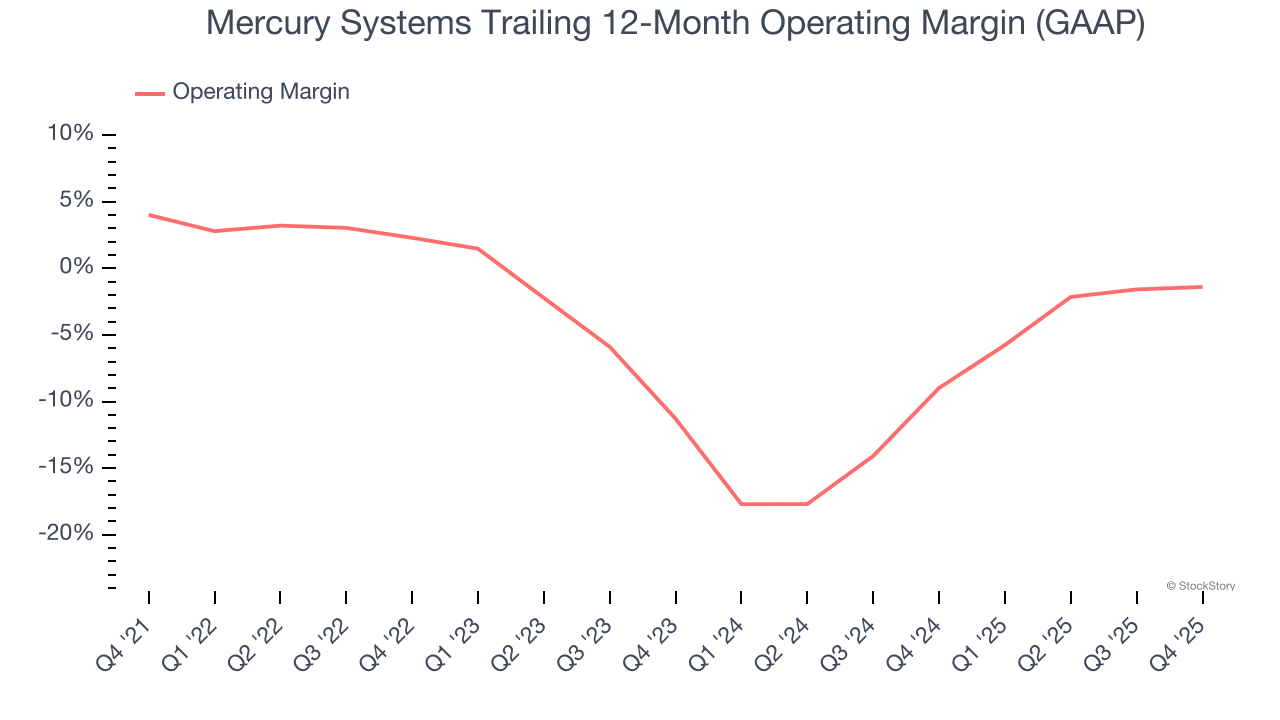
This quarter, Mercury Systems generated a negative 4.6% operating margin. The company's consistent lack of profits raise a flag.
Earnings Per Share
We track the long-term change in earnings per share (EPS) for the same reason as long-term revenue growth. Compared to revenue, however, EPS highlights whether a company’s growth is profitable.
Sadly for Mercury Systems, its EPS declined by 16.7% annually over the last five years while its revenue grew by 2.3%. This tells us the company became less profitable on a per-share basis as it expanded.
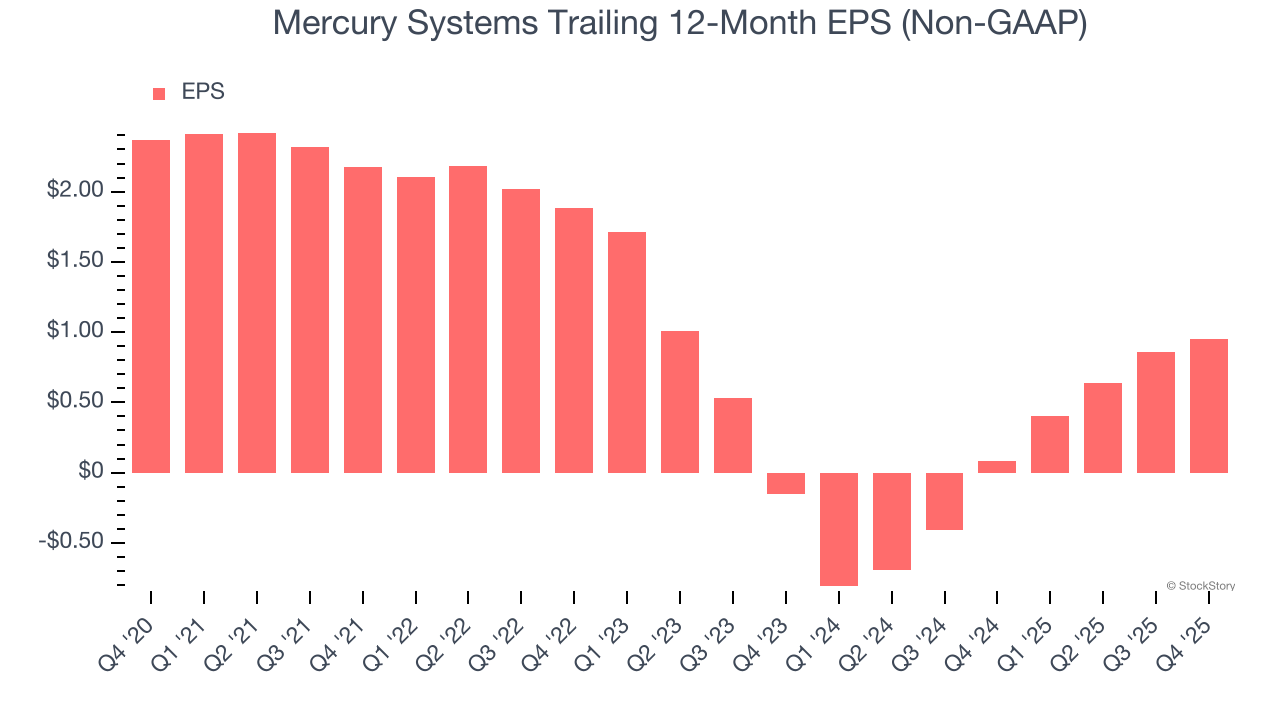
Diving into the nuances of Mercury Systems’s earnings can give us a better understanding of its performance. As we mentioned earlier, Mercury Systems’s operating margin was flat this quarter but declined by 5.4 percentage points over the last five years. Its share count also grew by 7.2%, meaning the company not only became less efficient with its operating expenses but also diluted its shareholders. 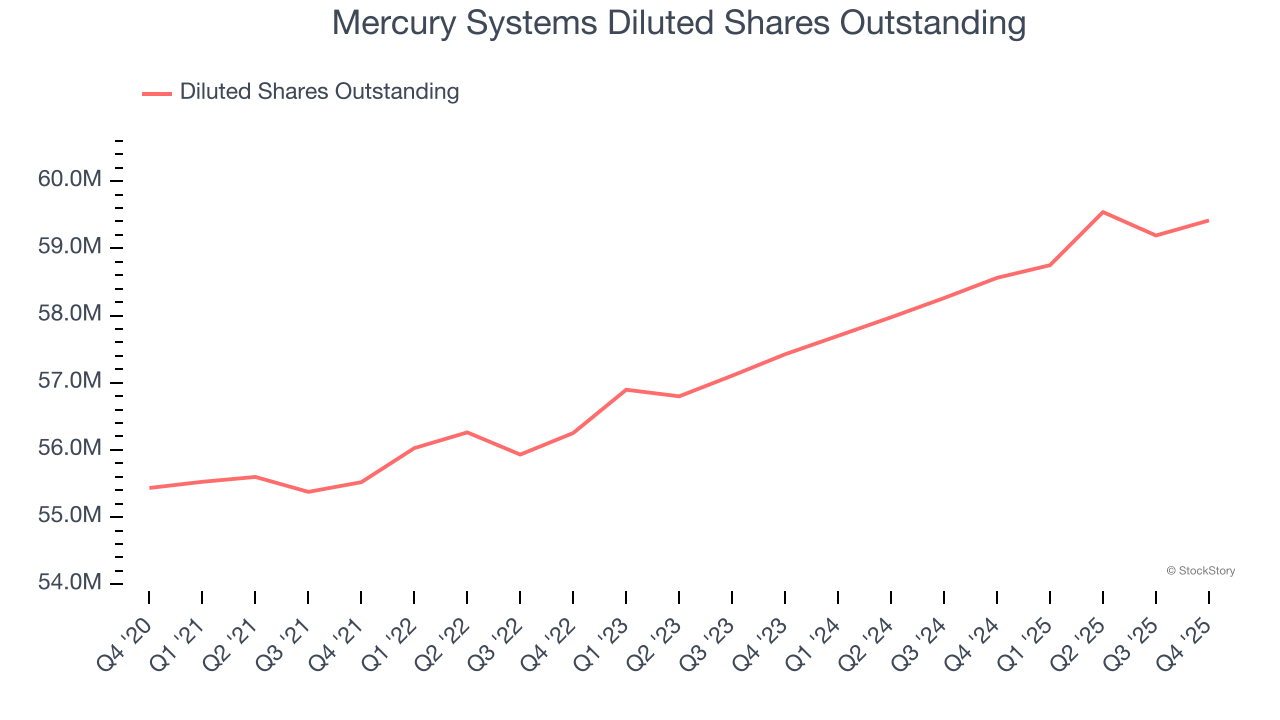
Like with revenue, we analyze EPS over a shorter period to see if we are missing a change in the business.
For Mercury Systems, its two-year annual EPS growth of 189% was higher than its five-year trend. This acceleration made it one of the faster-growing industrials companies in recent history.
In Q4, Mercury Systems reported adjusted EPS of $0.16, up from $0.07 in the same quarter last year. This print easily cleared analysts’ estimates, and shareholders should be content with the results. Over the next 12 months, Wall Street expects Mercury Systems’s full-year EPS of $0.95 to grow 24.9%.
Key Takeaways from Mercury Systems’s Q4 Results
It was good to see Mercury Systems beat analysts’ EPS expectations this quarter. We were also excited its EBITDA outperformed Wall Street’s estimates by a wide margin. Zooming out, we think this quarter featured some important positives. The stock remained flat at $98.96 immediately following the results.
So should you invest in Mercury Systems right now? We think that the latest quarter is only one piece of the longer-term business quality puzzle. Quality, when combined with valuation, can help determine if the stock is a buy. We cover that in our actionable full research report which you can read here (it’s free).