

Aerospace and defense company Redwire (NYSE:RDW) missed Wall Street’s revenue expectations in Q3 2026, but revenue rose 5.4% year on year to $109 million. On the other hand, the company’s outlook for the full year was close to analysts’ consensus estimates, with revenue guided to $475 million at the midpoint. Its non-GAAP loss of $0.06 per share was 35.1% above analysts’ consensus estimates.
For more on Redwire, read our free full research report.
Redwire (RDW) Q3 2026 highlights:
- Revenue $109 million vs S&P analysts’ consensus estimates of $126.6 million (5.4% year-on-year growth, 13.8% miss)
- Adjusted EPS -$0.06 vs S&P analysts’ consensus estimates of -$0.09 (35.1% beat)
- Adjusted EBITDA -$5.29 million (-4.9% margin, 106% year-on-year decline)
- Revenue guidance The company reconfirmed its revenue guidance for the full year of $475 million at the midpoint
- Adjusted EBITDA margin -4.9%, down from -2.5% in the same quarter last year
- Free cash flow -$66.35 million compared to -$26.86 million in the same quarter last year
- Backlog $619.7 million at quarter end, up 74.2% year on year
- Market capitalization $2.02 billion
“Redwire continued to see durable demand across our space and defense tech portfolio during the third quarter as evidenced by our record Backlog1 of $619.7 million, a nearly 75% increase year-over-year, and Book-to-Bill1 increasing to 1.73,” stated Peter Cannito, chairman, chief executive officer and president of Redwire. “Although revenue timing continues to be uneven, with another quarter of record gross margins expanding from 16.3% to 32.3% year-over-year, the quality of our revenue is improving as we deliver mission-critical products and solutions across multiple domains.”
Revenue growth
Reviewing a company’s long-term revenue performance reveals insights into its quality. Any business can post a good quarter or two, but many enduring ones grow for years. Redwire’s 28.5% annualized revenue growth over the last five years was strong. Its growth beat the average industrials company and shows its offerings resonate with customers.
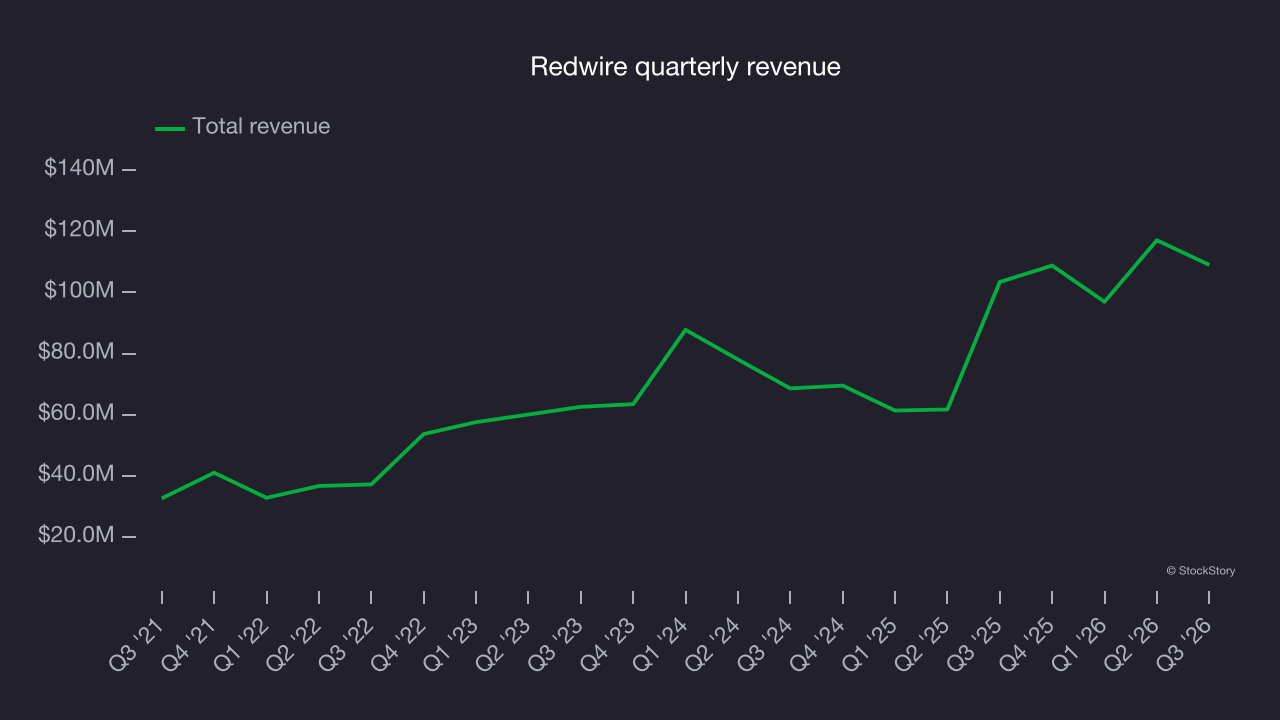
Long-term growth matters most, but within industrials, a half-decade historical view may miss cycles, industry trends or a company capitalizing on catalysts such as a new contract win or a successful product line. Redwire’s annualized revenue growth of 20.4% over the last two years is below its five-year trend, but the results still suggest healthy demand. 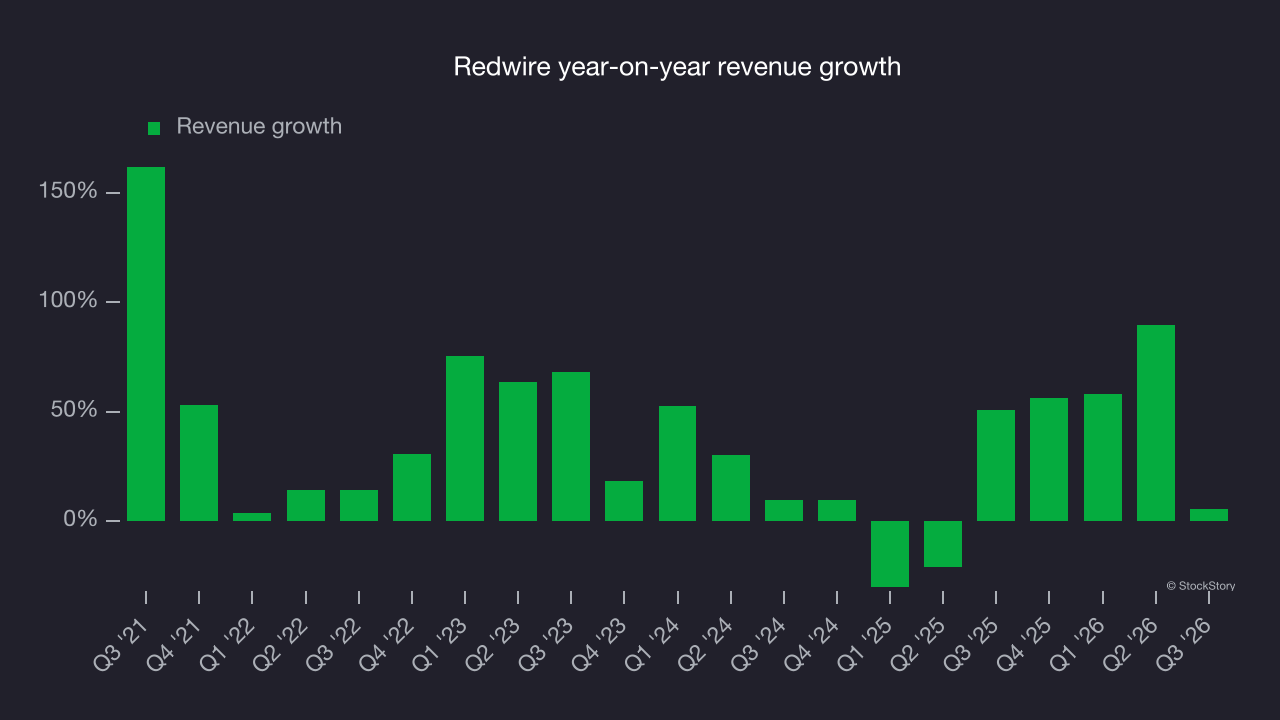
This quarter, Redwire’s revenue grew by 5.4% year on year to $109 million, missing Wall Street’s consensus estimates.
Looking ahead, sell-side analysts expect revenue to grow 24.7% over the next 12 months, according to S&P, an improvement versus the last two years. This strong projection suggests its newer products and services will drive better revenue performance.
Operating margin
Operating margin is one of the best measures of profitability because it tells us how much money a company takes home after procuring and manufacturing its products, marketing and selling those products and, most importantly, keeping them relevant through research and development.
Redwire’s high expenses have contributed to an average operating margin of negative 26.8% over the last five years. Unprofitable industrials companies require extra scrutiny because they can be vulnerable when business conditions deteriorate.
Redwire’s operating margin decreased by 9.2 percentage points over the last five years. This raises questions about the company’s expense base because its revenue growth should have given it leverage on its fixed costs, resulting in better economies of scale and profitability. Redwire’s performance was poor, indicating that costs were rising and it couldn’t pass them on to its customers.
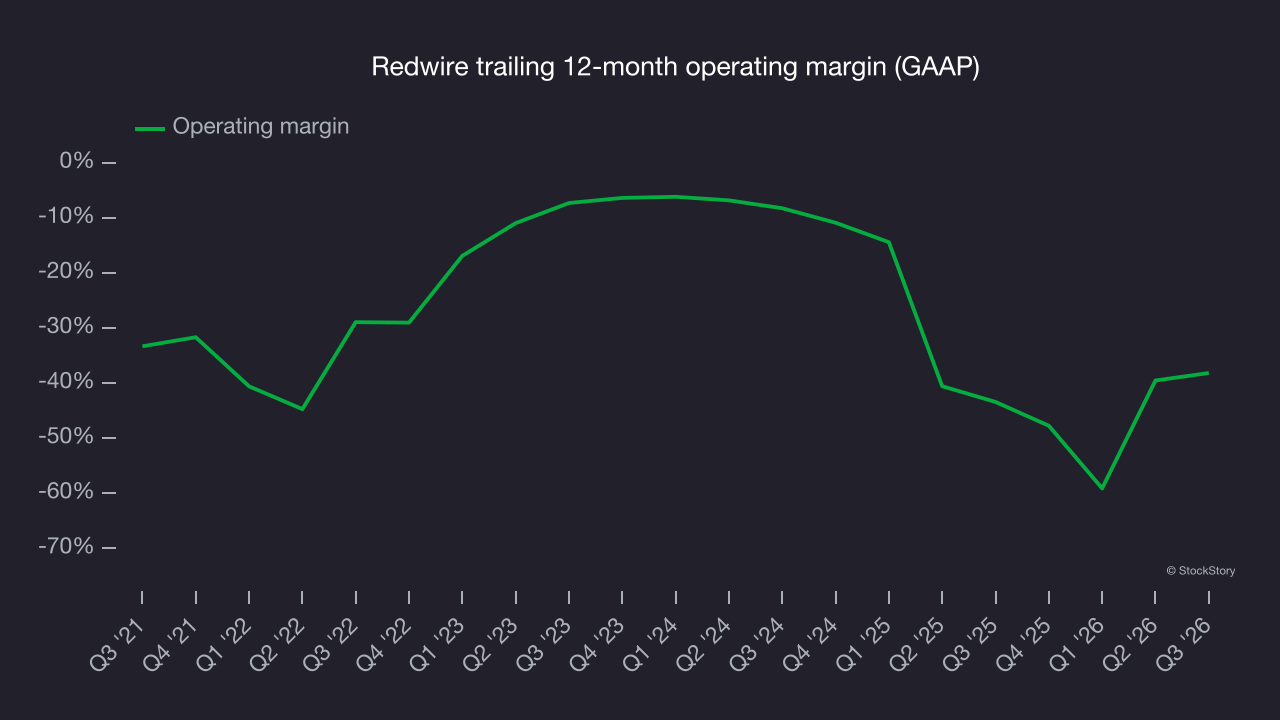
Redwire’s operating margin was negative 24.1% this quarter.
Earnings per share
Revenue trends explain a company’s historical growth, but the long-term change in earnings per share, or EPS, points to the profitability of that growth. For example, a company could inflate its revenue through excessive spending on advertising and promotions.
Redwire’s losses deepened over the last four years as its EPS dropped 1.9% annually. Falling EPS warrants caution, as diminishing earnings could imply changing secular trends and preferences. If conditions shift unexpectedly, Redwire’s low margin of safety could leave its stock price susceptible to large declines.
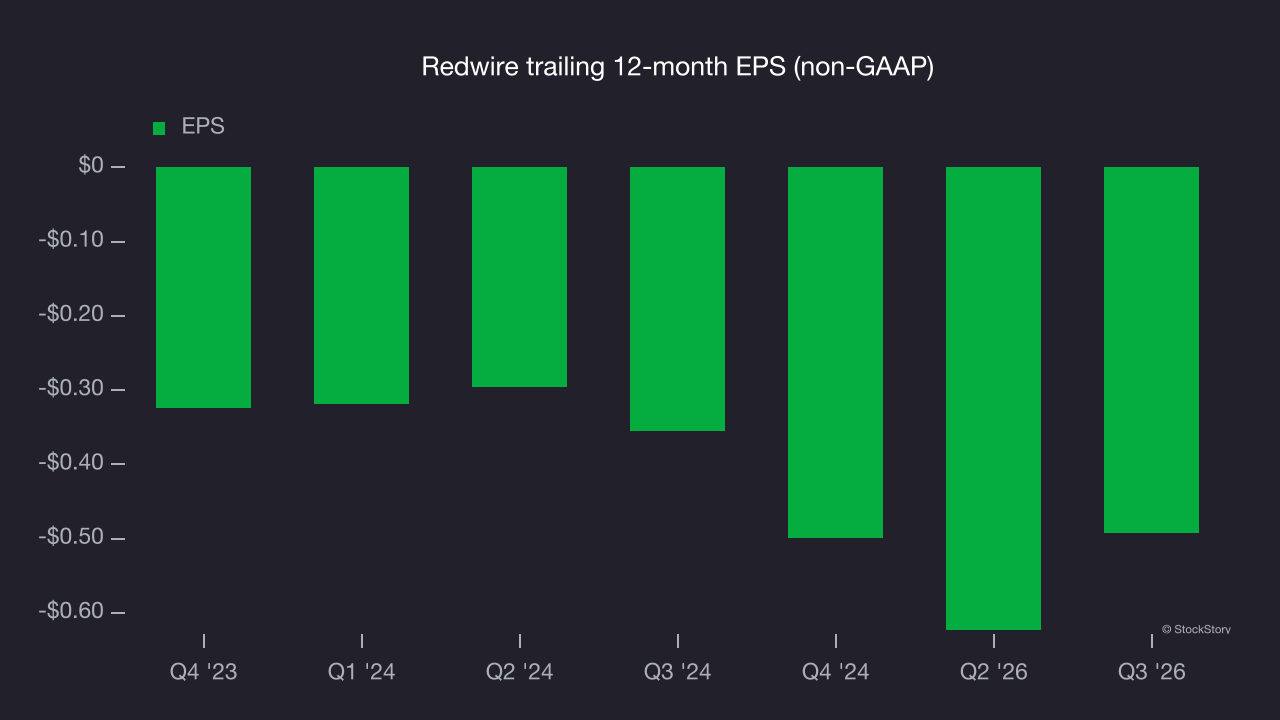
As with revenue, we analyze EPS over a shorter period to see if we are missing a change in the business.
For Redwire, its two-year annual EPS declines of 17.7% show it has continued to underperform. These results were poor.
In Q3, Redwire reported adjusted EPS of negative $0.06, up from negative $0.19 in the same quarter last year. This result was well above analysts’ consensus estimates, a positive for shareholders. Over the next 12 months, Wall Street expects Redwire to narrow its losses. Analysts forecast its full-year EPS will improve from negative $0.49 to negative $0.37, according to S&P.
Key takeaways from Redwire’s Q3 results
Redwire’s EPS beat analysts’ consensus estimates, but revenue missed and EBITDA fell short of Wall Street’s consensus. Those shortfalls made this a weaker quarter overall. Shares fell 3.4% to $7.47 immediately after the results.
Redwire’s latest quarter was underwhelming. One earnings report doesn’t define a company’s quality, though, so let’s examine whether the stock offers value at the current price. The latest quarter does matter, but not nearly as much as longer-term fundamentals and valuation when deciding if the stock is a buy. For more on Redwire, read the full research report here (it’s free).