

Digital advertising platform Magnite (NASDAQ:MGNI) beat Wall Street’s revenue expectations in Q3 2026, with revenue up 13.8% year on year to $204.2 million. Its non-GAAP profit of $0.33 per share was 16.9% above analysts’ consensus estimates.
For more on Magnite, read our full research report for free.
Magnite (MGNI) Q3 2026 highlights:
- Revenue $204.2 million vs S&P analysts’ consensus estimates of $199.8 million (13.8% year-on-year growth, 2.2% beat)
- Adjusted EPS $0.33 vs S&P analysts’ consensus estimates of $0.28 (16.9% beat)
- Adjusted EBITDA $83.36 million vs analysts’ consensus estimates of $70.14 million (40.8% margin, 18.8% beat)
- Operating margin 24.8%, up from 14% in the same quarter last year
- Free cash flow margin 39.3%, up from 36% in the same quarter last year
- Market capitalization $3.20 billion
“We delivered a very strong quarter, with the top line growing 20%, driven by CTV growing 39% and DV+ growing 5%, both significantly exceeding expectations. We outperformed political revenue expectations, mostly in CTV, and now expect full-year political spend to be nearly three times our initial forecast. CTV momentum remains broad-based, and the business now represents 53% of total contribution ex-TAC. Strong top-line execution translated into outstanding operating leverage, generating 46% Adjusted EBITDA growth with a 42% margin, prompting us to once again raise our full-year outlook across all key performance metrics,” said Michael G. Barrett, CEO of Magnite.
Revenue growth
A company’s long-term revenue performance can indicate its overall quality. Any business can have short-term success, but a top-tier one grows for years.
With $766.7 million in revenue over the past 12 months, Magnite is a small player in the business services space, which sometimes brings disadvantages compared to larger competitors benefiting from economies of scale and numerous distribution channels. On the positive side, it can grow faster because it has more room to expand.
Magnite’s revenue grew at a strong 14.5% compounded annual growth rate over the last five years. This shows demand for Magnite was higher than for many business services companies.
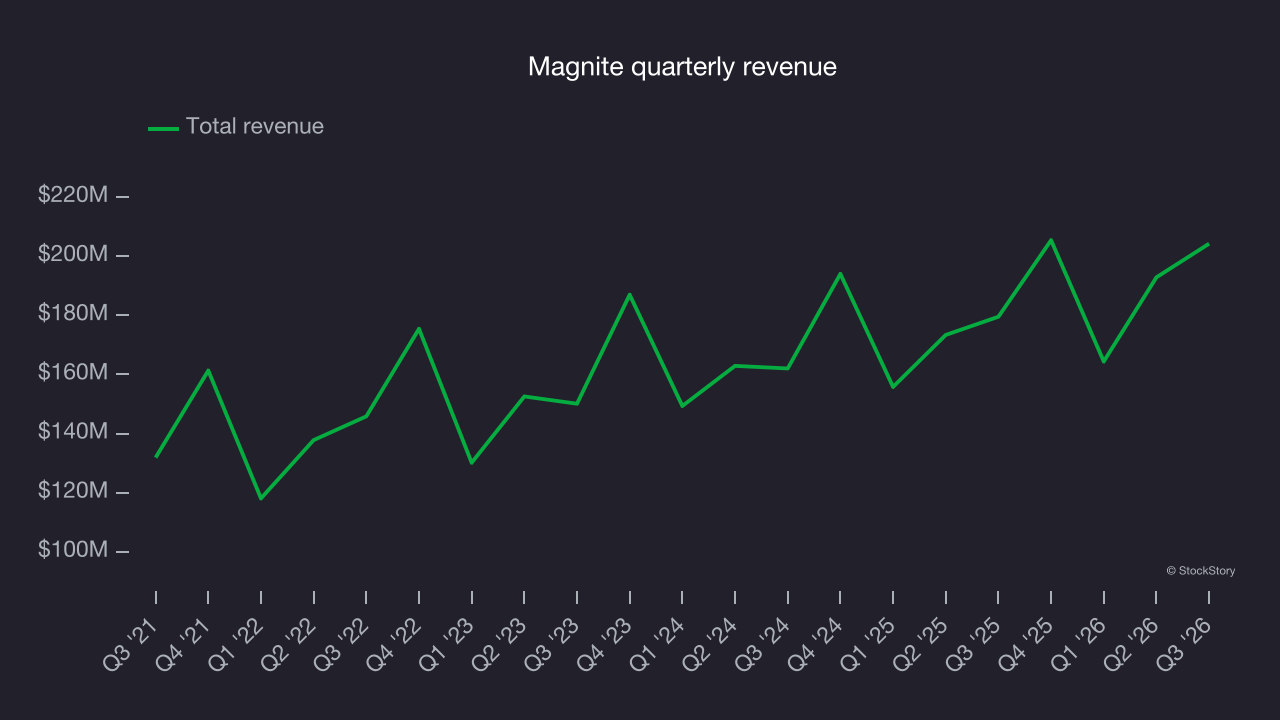
Long-term growth matters most, but within business services, a half-decade historical view may miss recent innovations or disruptive industry trends. Magnite’s annualized revenue growth of 7.7% over the last two years is below its five-year trend, but the results still suggest healthy demand. 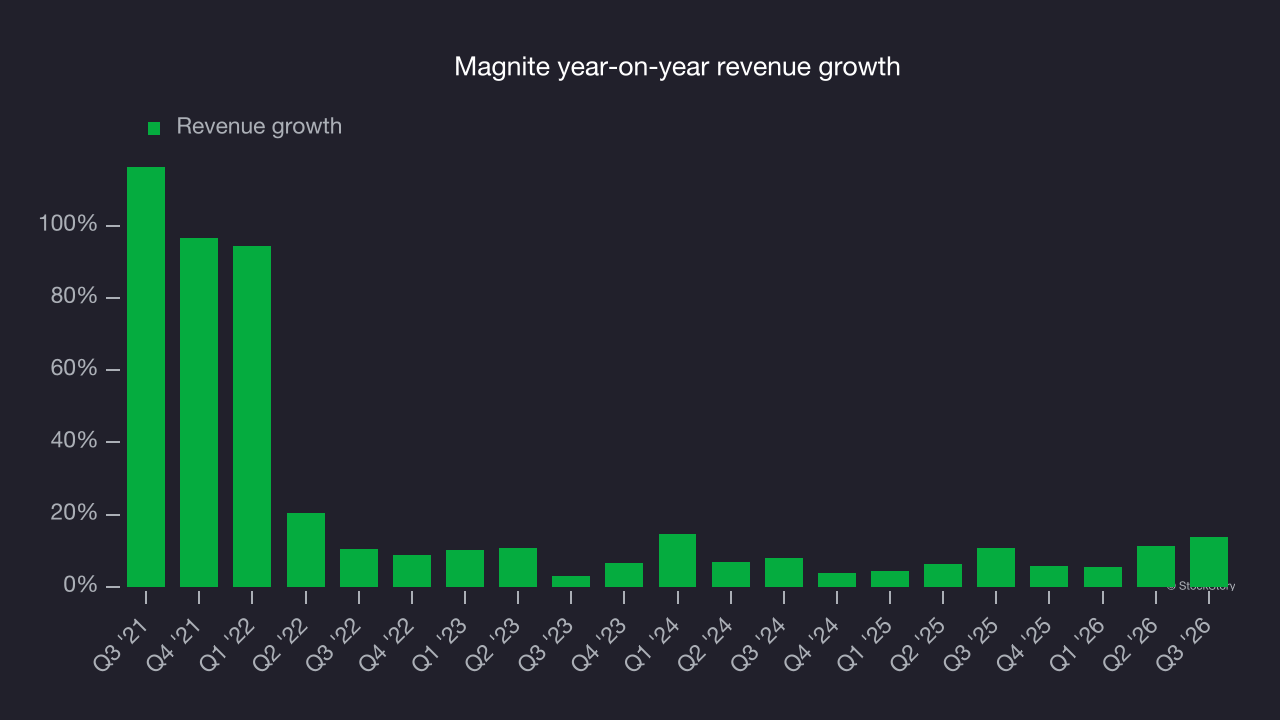
This quarter, Magnite reported year-on-year revenue growth of 13.8%, and its $204.2 million of revenue exceeded Wall Street’s consensus estimates by 2.2%.
Looking ahead, sell-side analysts expect revenue to grow 13.3% over the next 12 months, according to S&P, an improvement versus the last two years. This projection is noteworthy and suggests its newer products and services will fuel better top-line performance.
Adjusted operating margin
Adjusted operating margin is a key measure of profitability. Think of it as net income (the bottom line) excluding the impact of non-recurring expenses, taxes and interest on debt – metrics less connected to business fundamentals.
Magnite has done a decent job managing its cost base over the last five years. The company has produced an average adjusted operating margin of 10.1%, higher than the broader business services sector.
Looking at the trend in its profitability, Magnite’s adjusted operating margin rose by 31.3 percentage points over the last five years, as its revenue growth provided operating leverage.
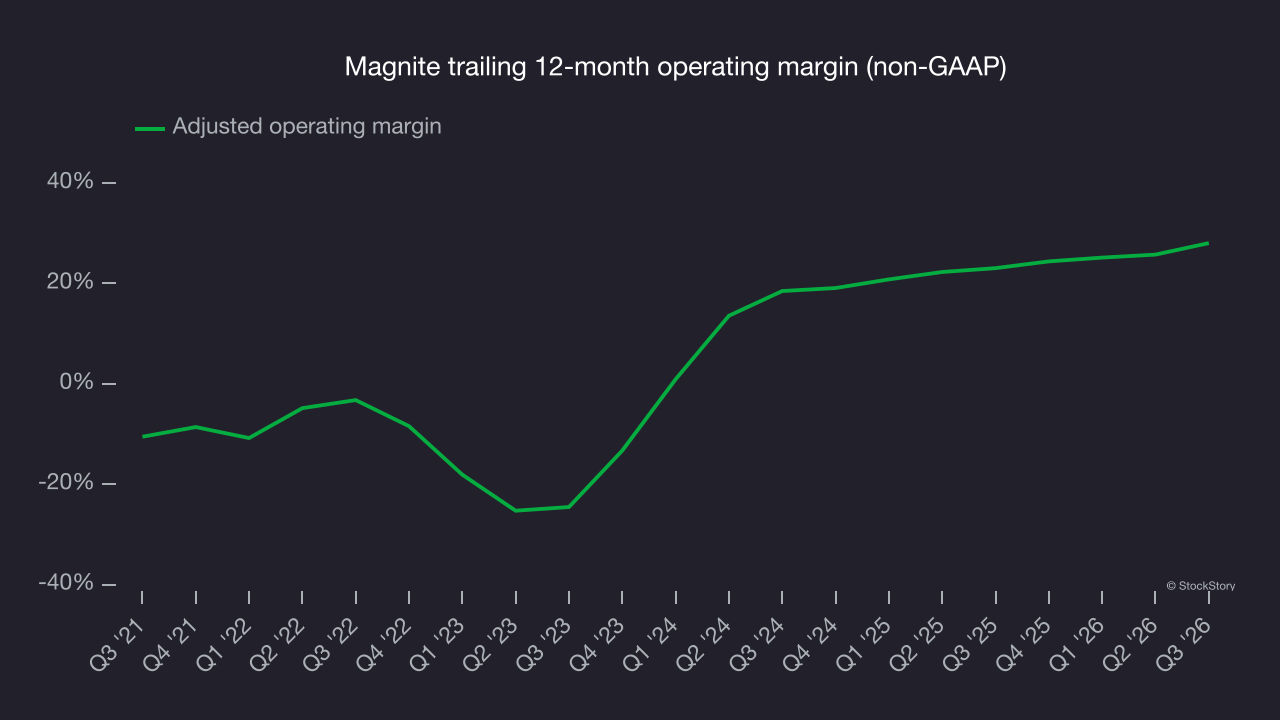
This quarter, Magnite generated an adjusted operating margin of 32.8%, up 8.8 percentage points year on year. This increase was a positive development and shows it was more efficient.
Earnings per share
We track the long-term change in earnings per share (EPS) for the same reason as long-term revenue growth. Compared to revenue, however, EPS highlights whether a company’s growth is profitable.
Magnite’s EPS grew at a 17.7% compounded annual growth rate over the last five years, higher than its 14.5% annualized revenue growth. This indicates the company became more profitable on a per-share basis as it expanded.
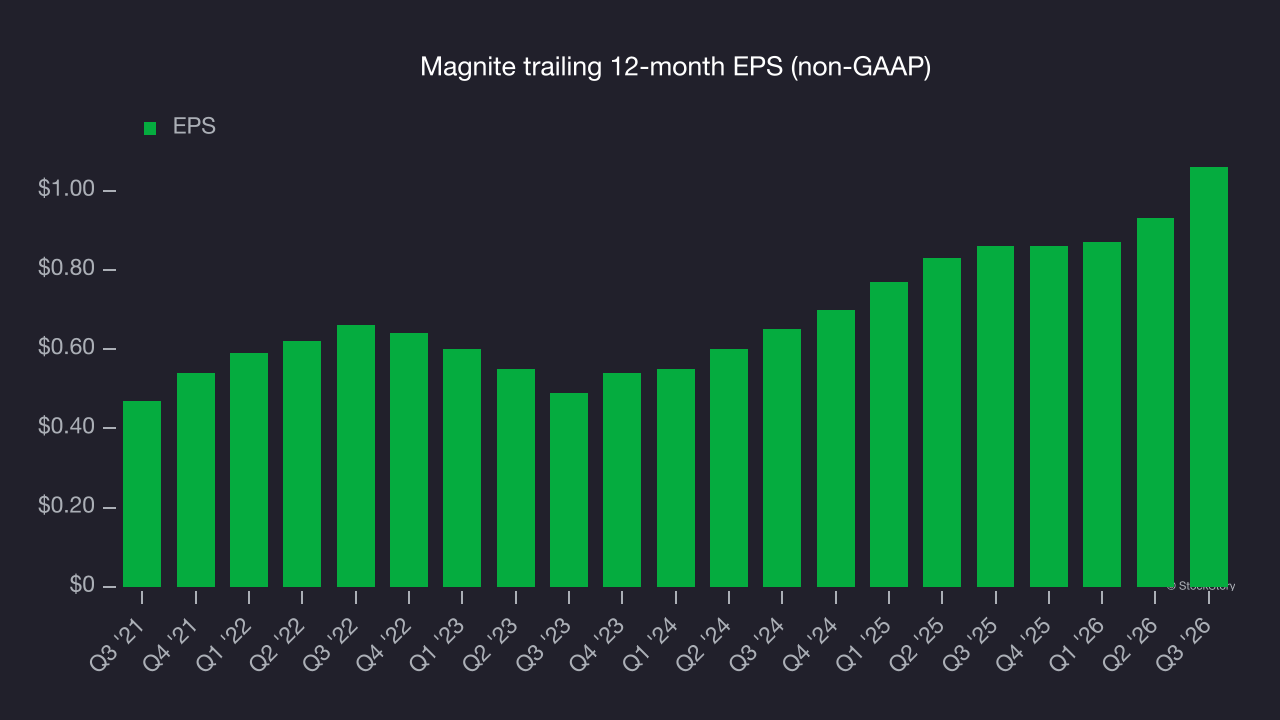
We can take a deeper look into Magnite’s earnings to better understand the drivers of its performance. As we mentioned earlier, Magnite’s adjusted operating margin expanded by 31.3 percentage points over the last five years. This was the most relevant factor (aside from the revenue impact) behind its higher earnings; interest expenses and taxes can also affect EPS but don’t tell us as much about a company’s fundamentals.
Like with revenue, we analyze EPS over a more recent period because it can provide insight into an emerging theme or development for the business.
For Magnite, its two-year annual EPS growth of 27.7% was higher than its five-year trend. That acceleration is a positive sign, particularly given the already high base.
In Q3, Magnite reported adjusted EPS of $0.33, up from $0.20 in the same quarter last year. This result came in well above analysts’ consensus estimates, a positive outcome for shareholders. Over the next 12 months, Wall Street expects Magnite’s full-year EPS to grow 16.9% from $1.06 to $1.24, according to S&P.
Key takeaways from Magnite’s Q3 results
Magnite delivered a strong Q3, with both EPS and revenue topping analysts’ consensus estimates. Shares soared 11.5% to $25.42 immediately after the results.
Magnite had a solid quarter, but deciding whether to buy the stock calls for a broader look at valuation, business quality and the latest earnings. Read our full research report here (it’s free).