

Beauty products company Coty (NYSE:COTY) reported calendar Q3 2026 (fiscal Q1 2027) results beating Wall Street’s revenue expectations, but revenue fell by 1.4% year on year to $1.56 billion. Its non-GAAP profit of $0.16 per share was 29.8% above analysts’ consensus estimates.
For more on Coty, read our free full research report.
Coty (COTY) Q3 CY2026 highlights:
- Revenue $1.56 billion vs S&P analysts’ consensus estimates of $1.53 billion (1.4% year-on-year decline, 1.7% beat)
- Adjusted EPS $0.16 vs S&P analysts’ consensus estimates of $0.12 (29.8% beat)
- Adjusted EBITDA $274.2 million vs analysts’ consensus estimates of $257.6 million (17.6% margin, 6.4% beat)
- Operating margin 11%, in line with the same quarter last year
- Free cash flow margin 5.4%, up from 0.7% in the same quarter last year
- Organic revenue fell 2% year on year (beat)
- Market capitalization $2.90 billion
"Our first quarter results were ahead of expectations on sales, adjusted EBITDA, and EPS, alongside a significant improvement in free cash flow, supported by the focus of Coty.Curated,” said Markus Strobel, Executive Chairman and Interim Chief Executive Officer. "Our like-for-like sales decline narrowed to 2%, broadly in line with the fourth quarter and a clear improvement from the declines of 6% and 4% in the first and second halves of fiscal 2026, reflecting improvements in key markets like the U.S., Asia Pacific, and Latin America. While our progress in the first quarter is encouraging, we have more work to do to translate green shoots into a broad-based recovery.
Revenue growth
A company’s long-term revenue performance can indicate its overall quality. Any business can report a good quarter or two, but many enduring ones grow for years.
With $5.78 billion in revenue over the past 12 months, Coty carries some recognizable products but is a mid-sized consumer staples company. Its size could bring disadvantages compared to larger competitors benefiting from better brand awareness and economies of scale.
Coty struggled to increase demand as its $5.78 billion in revenue for the trailing 12 months was close to its revenue three years ago. This shows demand was soft.
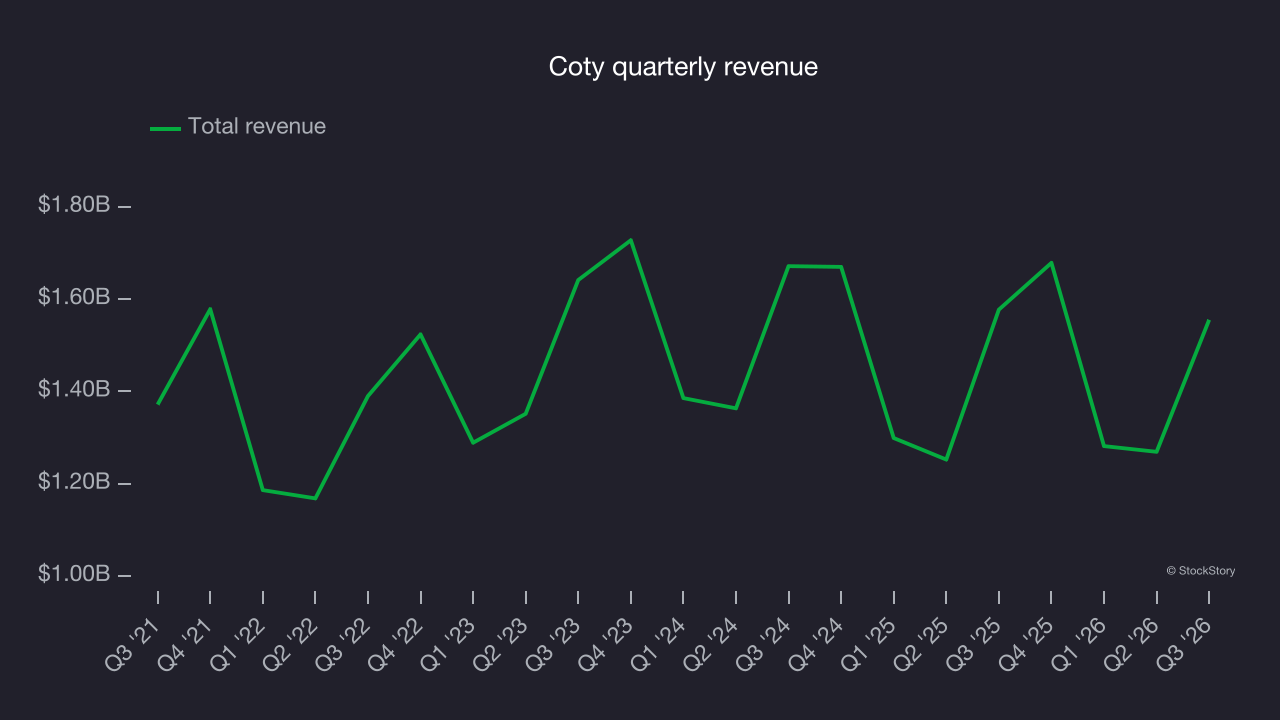
This quarter, Coty’s revenue fell by 1.4% year on year to $1.56 billion but beat Wall Street’s consensus estimates by 1.7%.
Looking ahead, sell-side analysts expect revenue to decline by 3.2% over the next 12 months, according to S&P, a deceleration versus the last three years. This projection is underwhelming and suggests its products will see some demand headwinds.
Organic revenue growth
When analyzing revenue growth, the key measure is organic revenue growth. This metric captures a business’s performance excluding one-time events such as mergers, acquisitions and divestitures as well as foreign currency fluctuations.
Coty’s demand has been falling over the last eight quarters, and on average, its organic revenue has declined by 4.3% year on year. 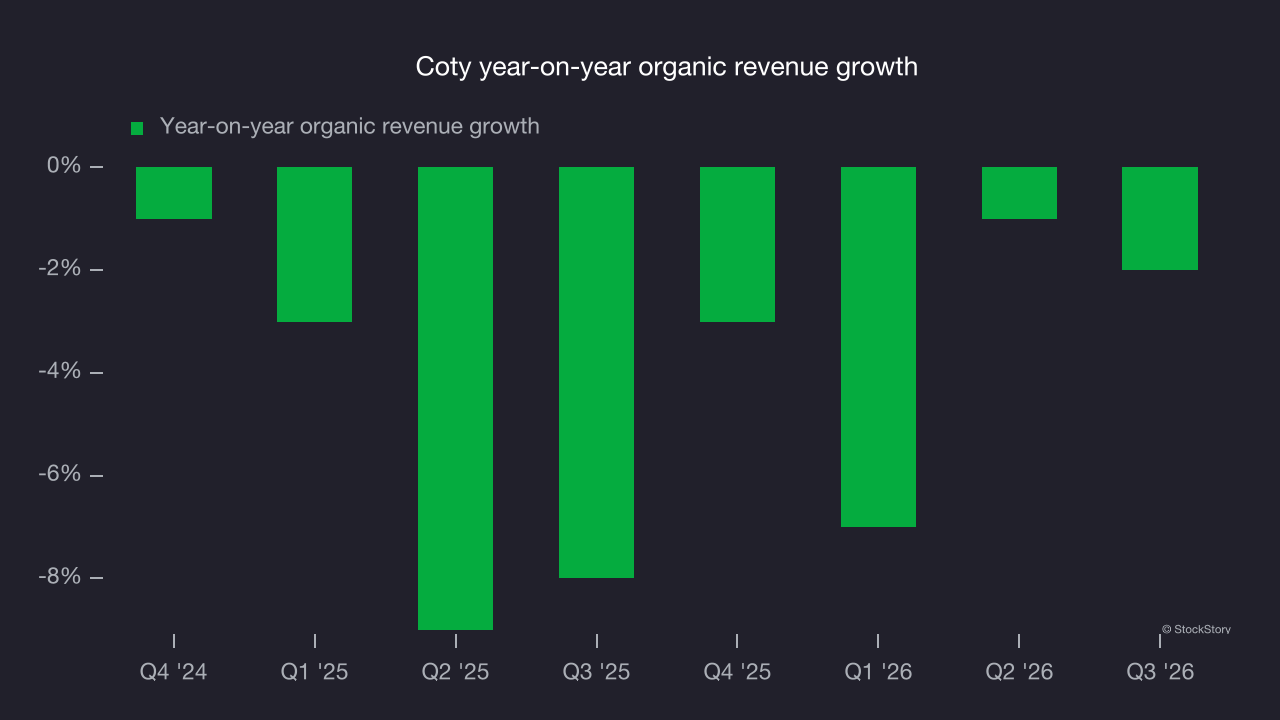
In the latest quarter, Coty’s organic revenue fell by 2% year on year. The decline was smaller than historical levels, a sign that demand trends were improving.
Key takeaways from Coty’s Q3 results
Coty delivered a solid quarter, with both EBITDA and EPS beating analysts’ consensus estimates. Shares edged higher 1.6% to $3.53 immediately after the results.
Coty may have had a good quarter, but that alone doesn’t determine whether the stock is a buy. The latest quarter is only one factor in assessing longer-term business quality. Quality, when combined with valuation, can help determine if the stock is a buy. For more on Coty, read our full research report here (it’s free).