

Materials and photonics company Coherent (NYSE:COHR) beat Wall Street’s revenue expectations in calendar Q3 2026 (fiscal Q1 2027), with revenue up 49.9% year on year to $2.37 billion. In addition, next quarter’s revenue guidance ($2.65 billion at the midpoint) was stronger than expected, coming in 4.4% above analysts’ consensus estimates. Its non-GAAP profit of $2.09 per share was 6% above analysts’ consensus estimates.
For more on Coherent, read our full research report for free.
Coherent (COHR) Q3 CY2026 highlights:
- Revenue $2.37 billion vs S&P analysts’ consensus estimates of $2.31 billion (49.9% year-on-year growth, 2.5% beat)
- Adjusted EPS $2.09 vs S&P analysts’ consensus estimates of $1.97 (6% beat)
- Adjusted operating income $550.3 million vs analysts’ consensus estimates of $526.4 million (23.2% margin, 4.5% beat)
- Revenue guidance $2.65 billion at the midpoint for Q4 CY2026, above analysts’ consensus estimates of $2.54 billion
- Adjusted EPS guidance $2.38 at the midpoint for Q4 CY2026, above analysts’ consensus estimates of $2.21
- Operating margin 15.9%, in line with the same quarter last year
- Free cash flow -$868.2 million compared to -$57.99 million in the same quarter last year
- Market capitalization $40.86 billion
“Q1 marked a strong start to fiscal 2027, with pro forma revenue up 56% year over year and non-GAAP EPS up 80%,” said Jim Anderson, CEO. “Our established businesses delivered strong growth, while new growth areas are beginning to ramp. As AI datacenters transition from copper to optical connectivity, Coherent’s broad photonics platform and manufacturing scale position us to help customers meet rising needs for bandwidth and energy efficiency. We expect fiscal 2027 pro forma revenue growth to exceed 60%.”
Revenue growth
Reviewing a company’s long-term revenue performance reveals insights into its quality. Any business can experience short-term success, but top-performing ones sustain growth for years.
With $7.91 billion in revenue over the past 12 months, Coherent is one of the larger companies in the business services industry and benefits from a well-known brand that influences purchasing decisions.
Coherent grew its revenue at a strong 20% compounded annual growth rate over the last five years, showing its demand was higher than that of many business services companies.
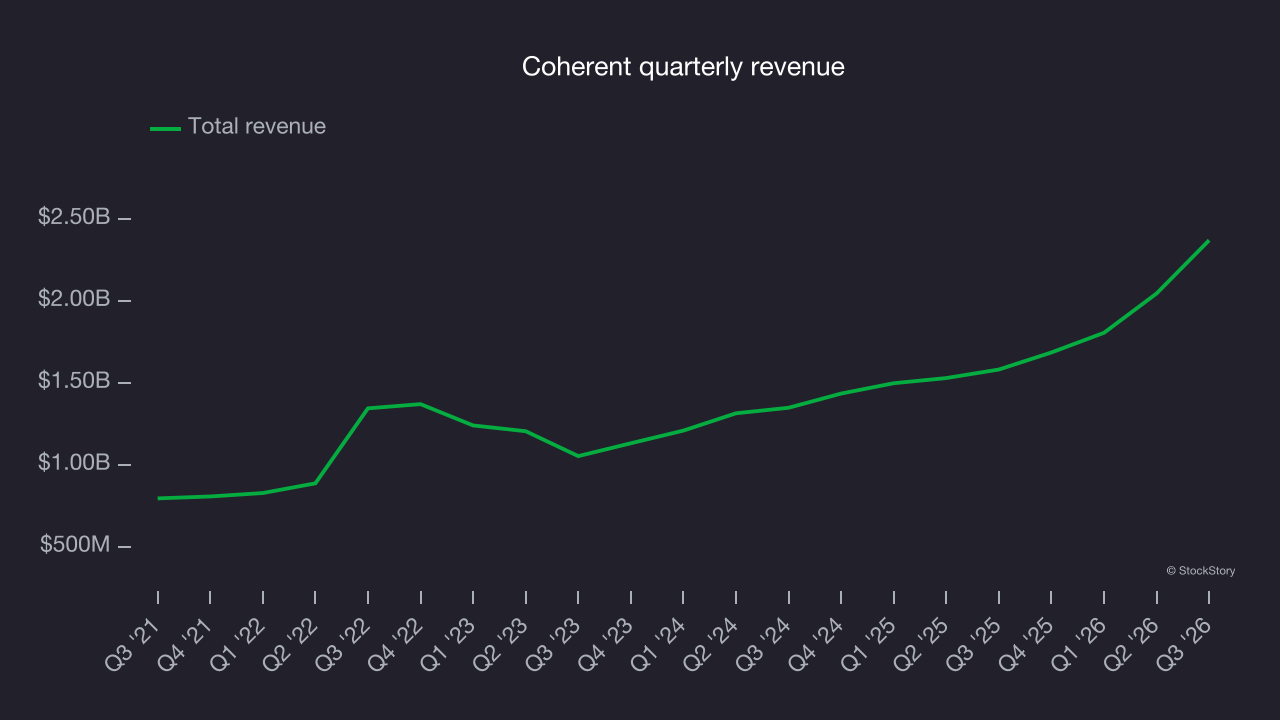
Long-term growth matters most, but within business services, a half-decade historical view may miss recent innovations or disruptive industry trends. Coherent’s annualized revenue growth of 25.7% over the last two years is above its five-year trend, suggesting its demand was strong and recently accelerated. 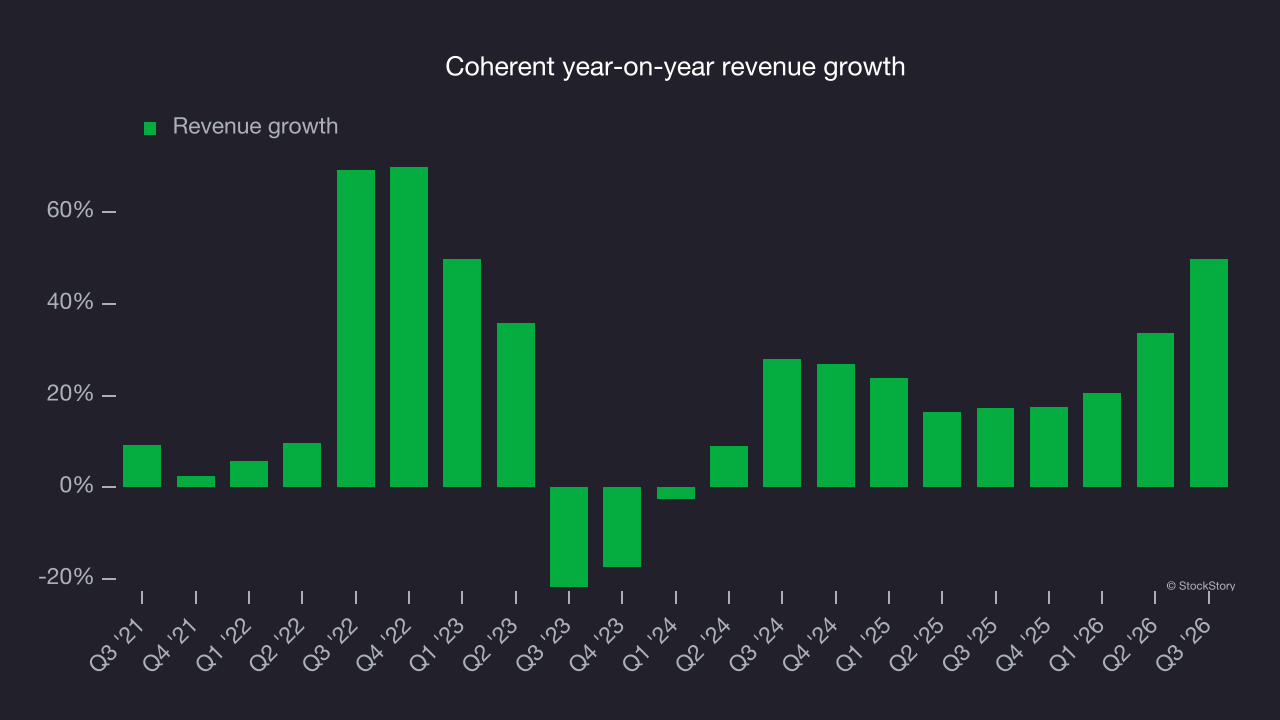
Coherent also breaks out the revenue for its most important segment, Networking. Over the last two years, Coherent’s Networking revenue (communications components and subsystems) averaged 61.1% year-on-year growth. This segment has outperformed its total revenue during the same period, lifting the company’s performance. 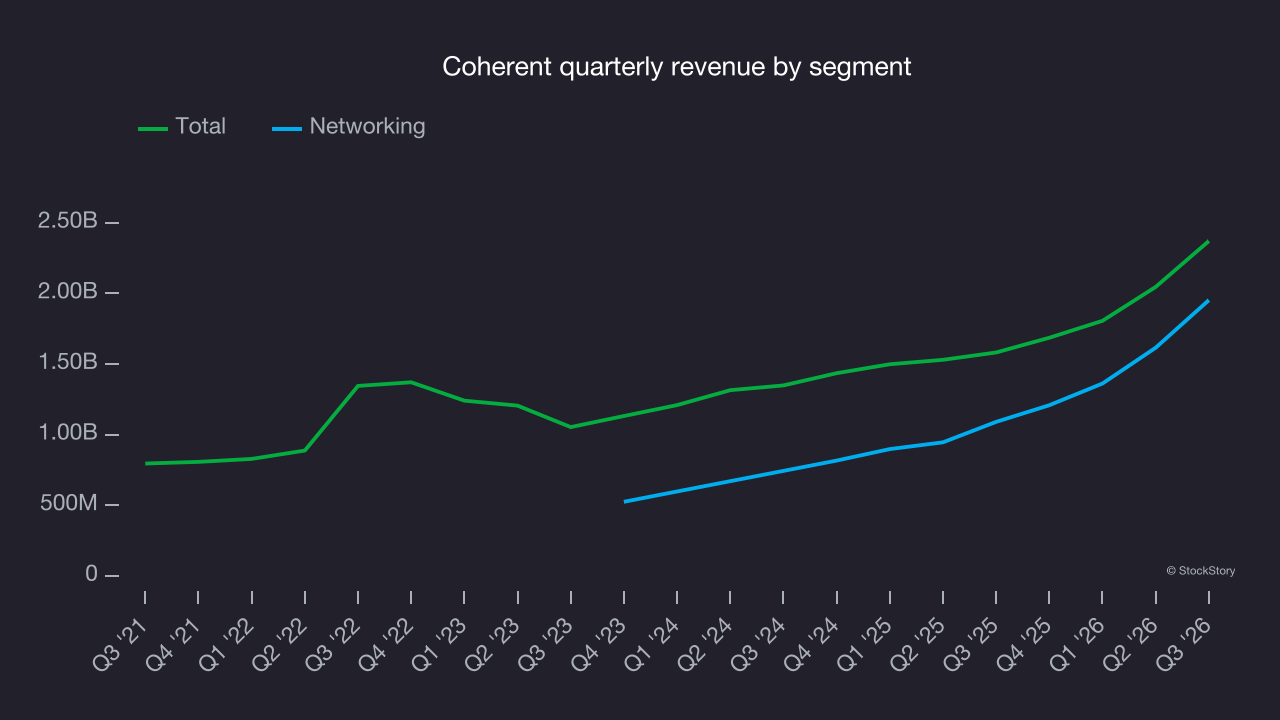
This quarter, Coherent reported strong year-on-year revenue growth of 49.9%, and its $2.37 billion of revenue beat Wall Street’s consensus estimates by 2.5%. Management is guiding for a 57.2% year-on-year increase in revenue next quarter.
Looking further ahead, sell-side analysts expect revenue to grow 46.2% over the next 12 months, according to S&P, an improvement versus the last two years. This strong projection suggests its newer products and services will drive better revenue performance.
Adjusted operating margin
Adjusted operating margin is a key measure of profitability. Think of it as net income (the bottom line) excluding the impact of non-recurring expenses, taxes and interest on debt – metrics less connected to business fundamentals.
Coherent has performed well over the last five years. It demonstrated strong profitability for a business services company, with an average adjusted operating margin of 18.7%.
Looking at the trend in its profitability, Coherent’s adjusted operating margin rose by 1.1 percentage points over the last five years, as its revenue growth gave it operating leverage.
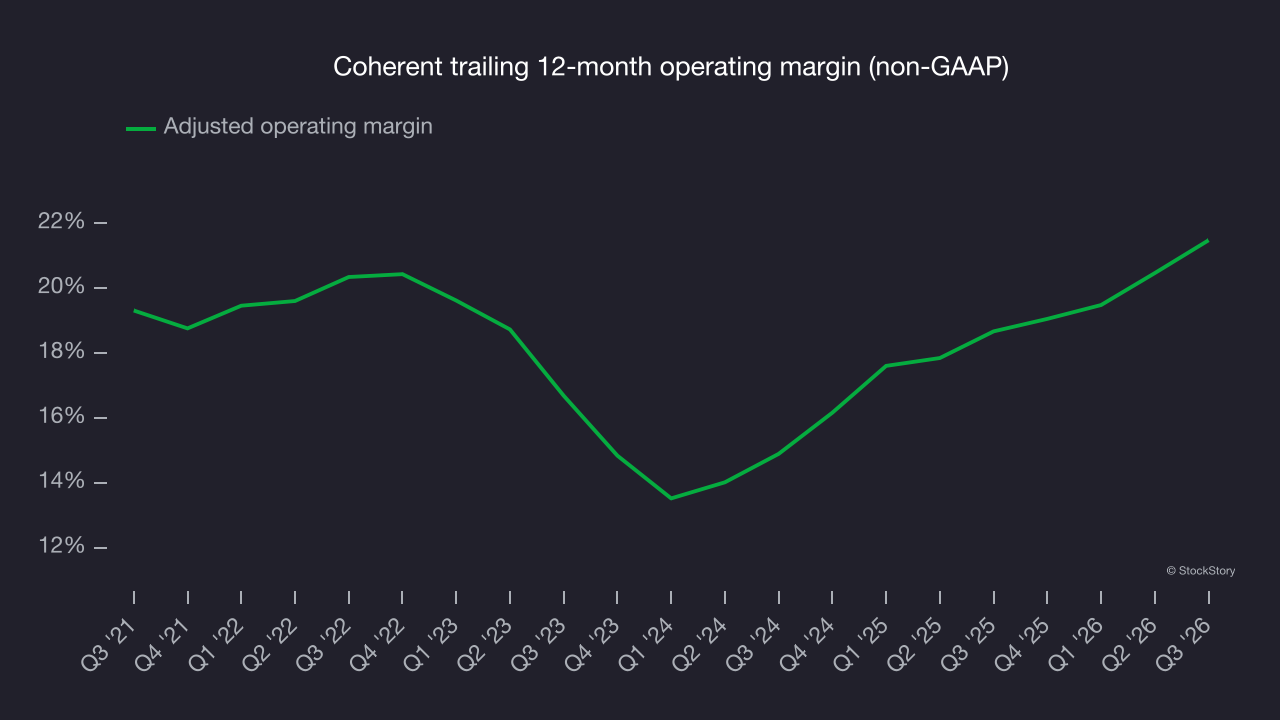
This quarter, Coherent generated an adjusted operating margin of 23.2%, up 3.7 percentage points year on year. This increase was a positive development and shows it was more efficient.
Earnings per share
We track the long-term change in earnings per share (EPS) for the same reason as long-term revenue growth. Compared to revenue, however, EPS highlights whether a company’s growth is profitable.
Coherent’s EPS grew at a strong 11.8% compounded annual growth rate over the last five years. Despite its adjusted operating margin improvement during that time, EPS growth trailed its 20% annualized revenue growth, indicating that non-fundamental factors such as interest and taxes affected its ultimate earnings.
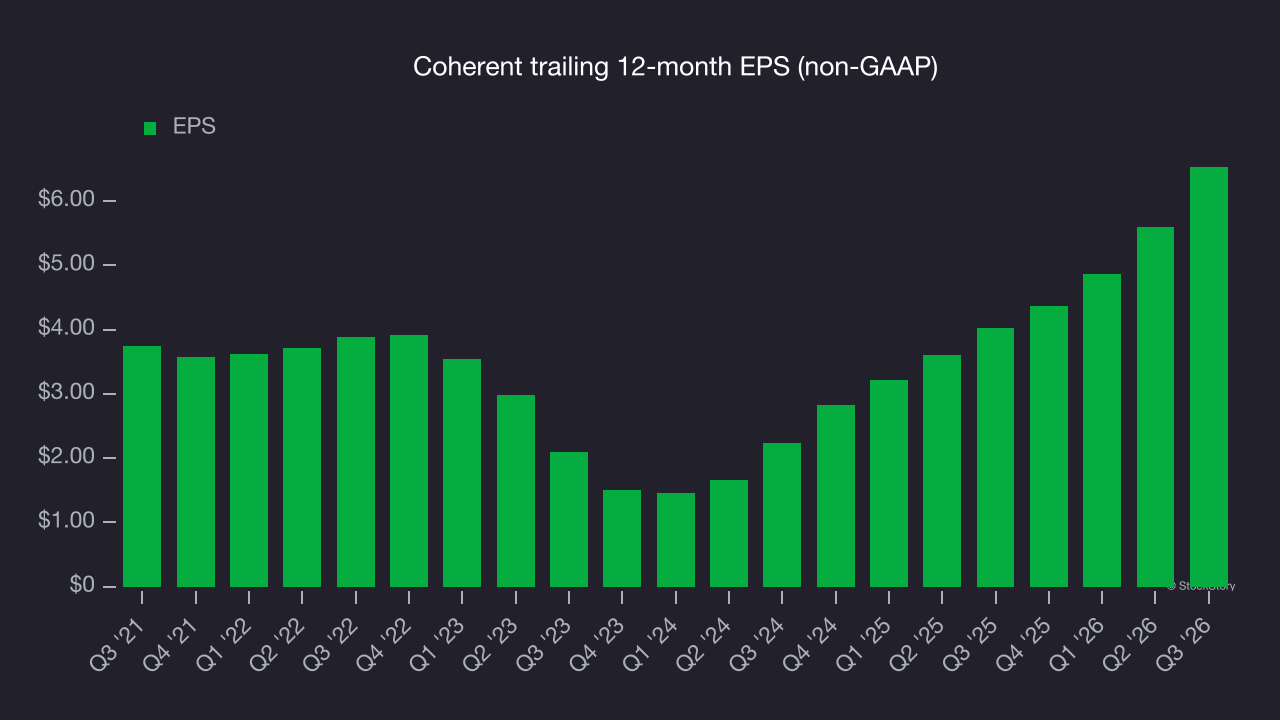
Diving into Coherent’s quality of earnings can give us a better understanding of its performance. A five-year view shows Coherent has diluted its shareholders, growing its share count by 74.4%. This dilution overshadowed its increased operational efficiency and has led to lower per share earnings. Taxes and interest expenses can also affect EPS but don’t tell us as much about a company’s fundamentals. 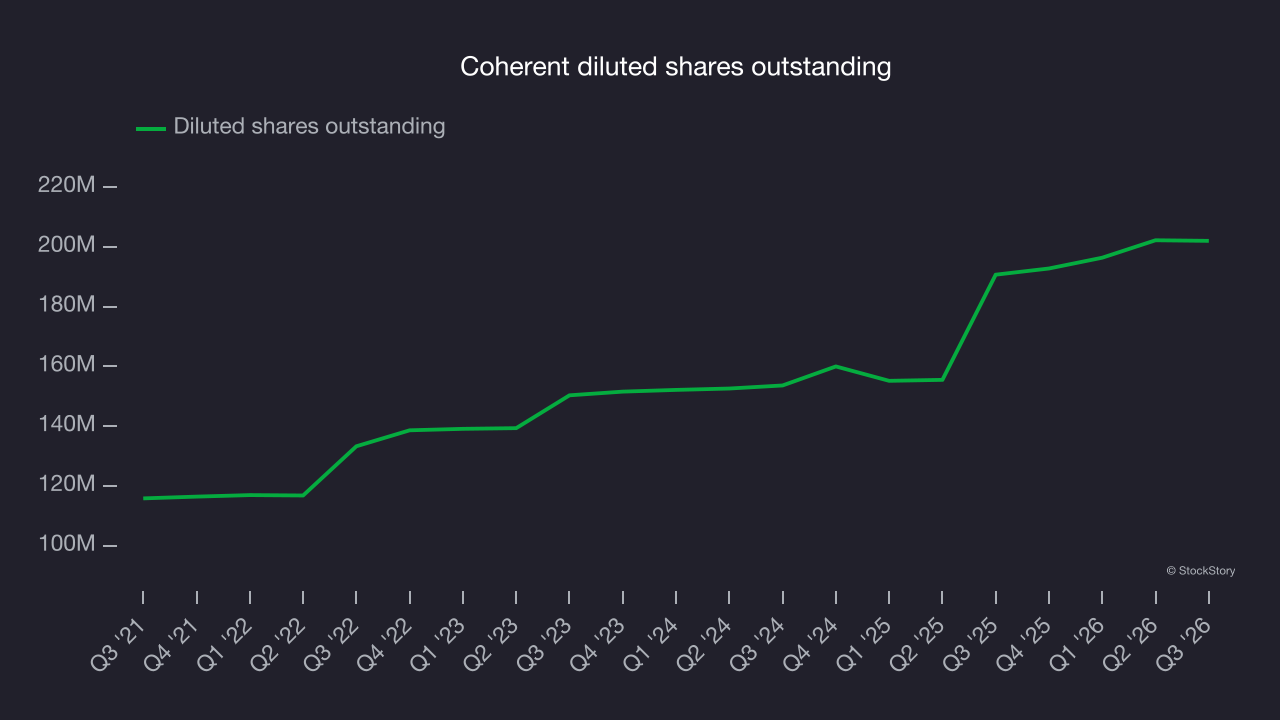
Like with revenue, we analyze EPS over a more recent period because it can provide insight into an emerging theme or development for the business.
For Coherent, its two-year annual EPS growth of 70.7% was higher than its five-year trend. That acceleration is notable, especially given the already high base.
In Q3, Coherent reported adjusted EPS of $2.09, up from $1.16 in the same quarter last year. This result beat analysts’ consensus estimates by 6%. Over the next 12 months, Wall Street expects Coherent’s full-year EPS to grow 59.5% from $6.53 to $10.42, according to S&P.
Key takeaways from Coherent’s Q3 results
Coherent’s outlook stood out in a solid quarter: EPS guidance for next quarter came in well above analysts’ consensus estimates, and revenue guidance also topped Wall Street’s consensus. Shares rose 4.8% to $204.92 immediately after the release.
Coherent had a solid quarter, but the investment case depends on the bigger picture. What happened in the latest quarter matters, but not as much as longer-term business quality and valuation when deciding whether to invest in this stock. For more on Coherent’s investment case, read the full research report here (it’s free).