

Lab services company Charles River Laboratories (NYSE:CRL) announced better-than-expected revenue in Q3 2026, but revenue fell by 2.2% year on year to $982.7 million. Its non-GAAP profit of $3.09 per share was 4% above analysts’ consensus estimates.
For more on Charles River Laboratories, read our full research report for free.
Charles River Laboratories (CRL) Q3 2026 highlights:
- Revenue $982.7 million vs S&P analysts’ consensus estimates of $960.5 million (2.2% year-on-year decline, 2.3% beat)
- Adjusted EPS $3.09 vs S&P analysts’ consensus estimates of $2.97 (4% beat)
- Adjusted EPS guidance Management raised its full-year adjusted EPS guidance to $11.45 at the midpoint, a 1.3% increase
- Operating margin 20.6%, up from 13.3% in the same quarter last year
- Free cash flow margin 21.1%, up from 17.7% in the same quarter last year
- Organic revenue rose 4.7% year on year (beat)
- Market capitalization $16.8 billion
Revenue growth
Examining a company’s long-term performance can provide clues about its quality. Even a bad business can perform well for one or two quarters, but a top-tier one grows for years. Over the last five years, Charles River Laboratories grew its revenue at a tepid 3% compounded annual growth rate, falling short of the healthcare sector benchmark.
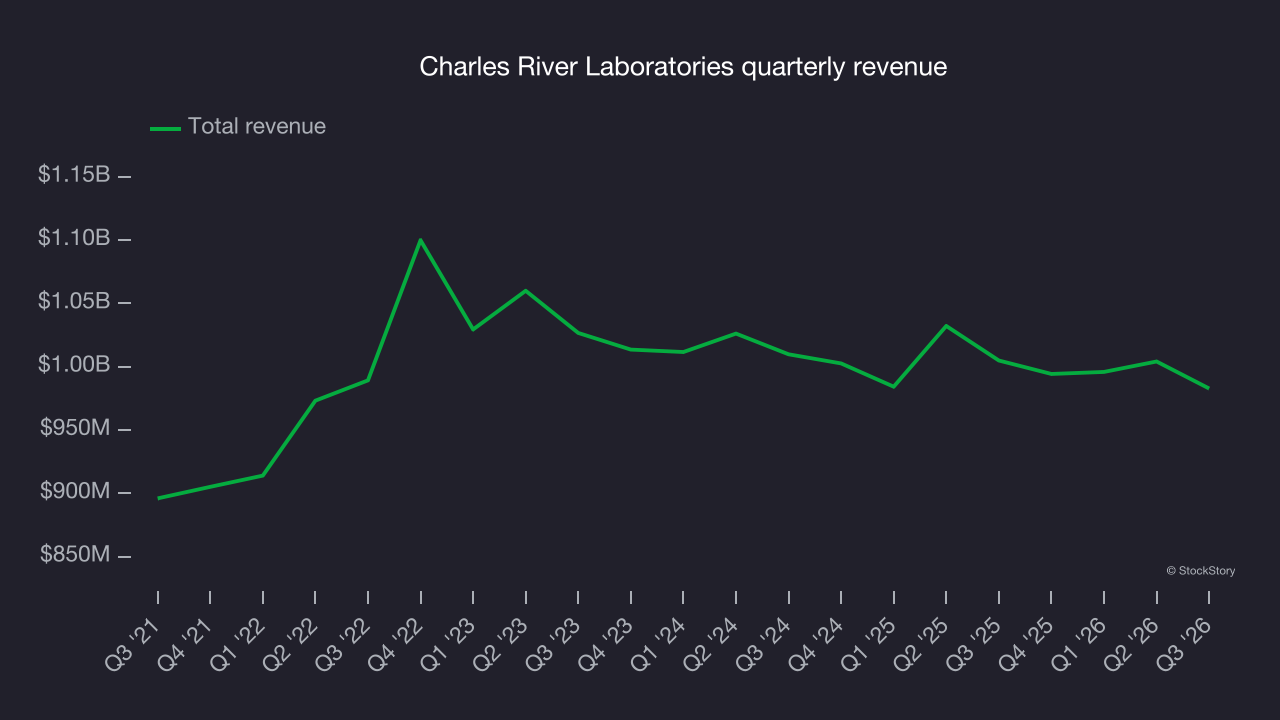
Long-term growth matters most, but within healthcare, a half-decade historical view may miss recent innovations or disruptive industry trends. Charles River Laboratories’s performance shows it grew in the past but relinquished its gains over the last two years, as its revenue fell by 1% annually. 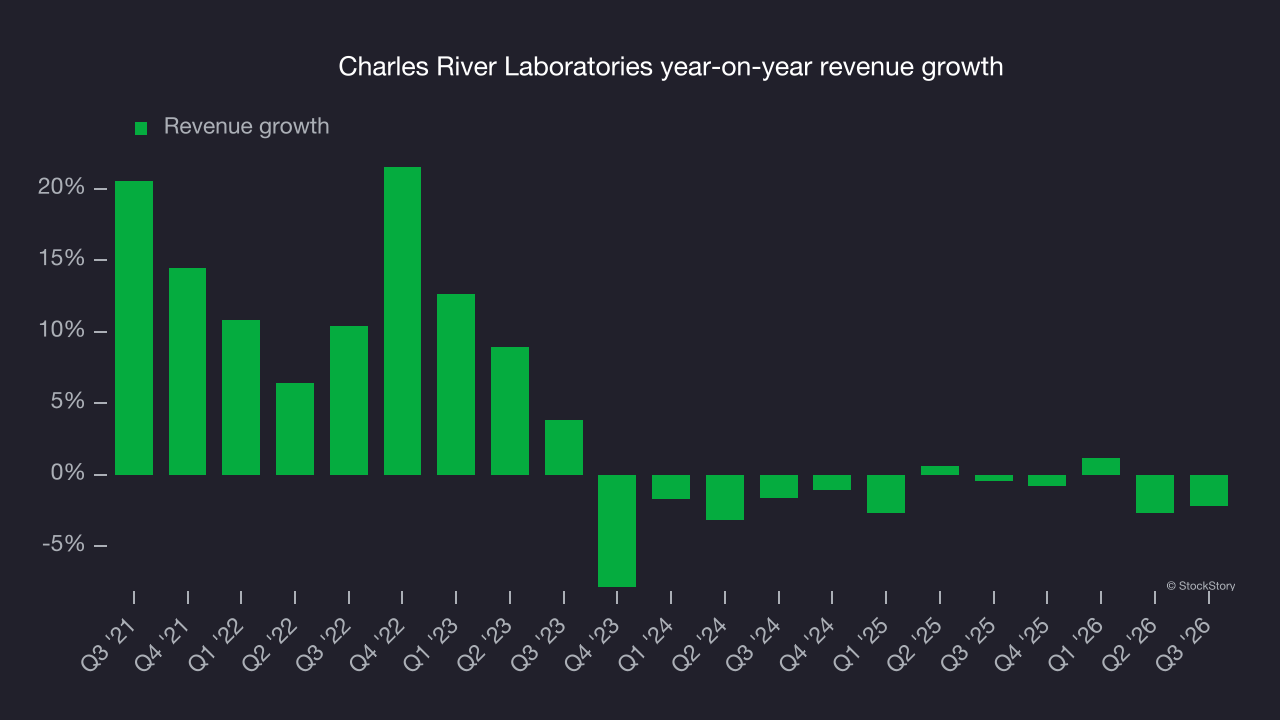
Charles River Laboratories also reports organic revenue, which strips out one-time events like acquisitions and currency fluctuations that don’t accurately reflect its fundamentals. Over the last two years, Charles River Laboratories’s organic revenue was flat. This was in line with its two-year revenue growth, indicating that core operations, not acquisitions and divestitures, drove most of its results. 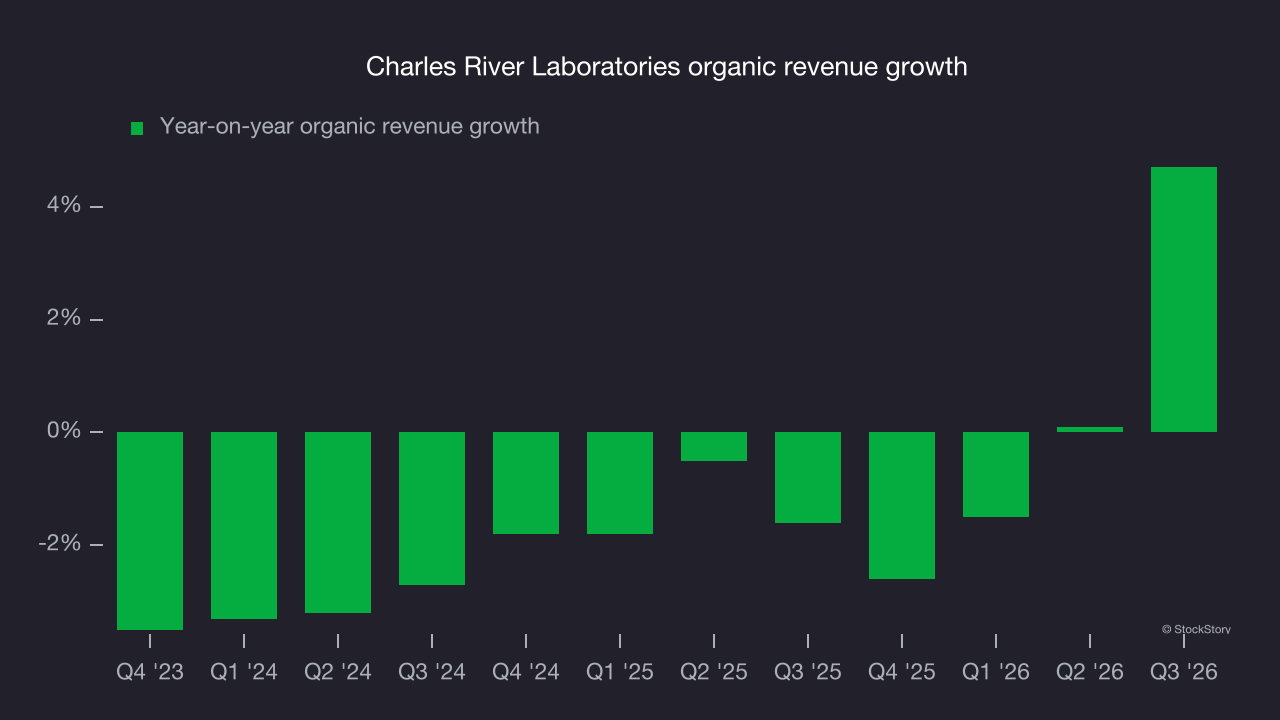
This quarter, Charles River Laboratories’s revenue fell by 2.2% year on year to $982.7 million but beat Wall Street’s consensus estimates by 2.3%.
Looking ahead, sell-side analysts expect revenue to remain flat over the next 12 months, according to S&P. This underwhelming projection suggests its newer products and services will not lead to better top-line performance yet.
Adjusted operating margin
Charles River Laboratories has been an efficient company over the last five years. It was one of the more profitable businesses in the healthcare sector, with an average adjusted operating margin of 20.2%.
Analyzing the trend in its profitability, Charles River Laboratories’s adjusted operating margin decreased by 1.7 percentage points over the last five years. This raises questions about the company’s expense base because its revenue growth should have given it leverage on its fixed costs, resulting in better economies of scale and profitability.
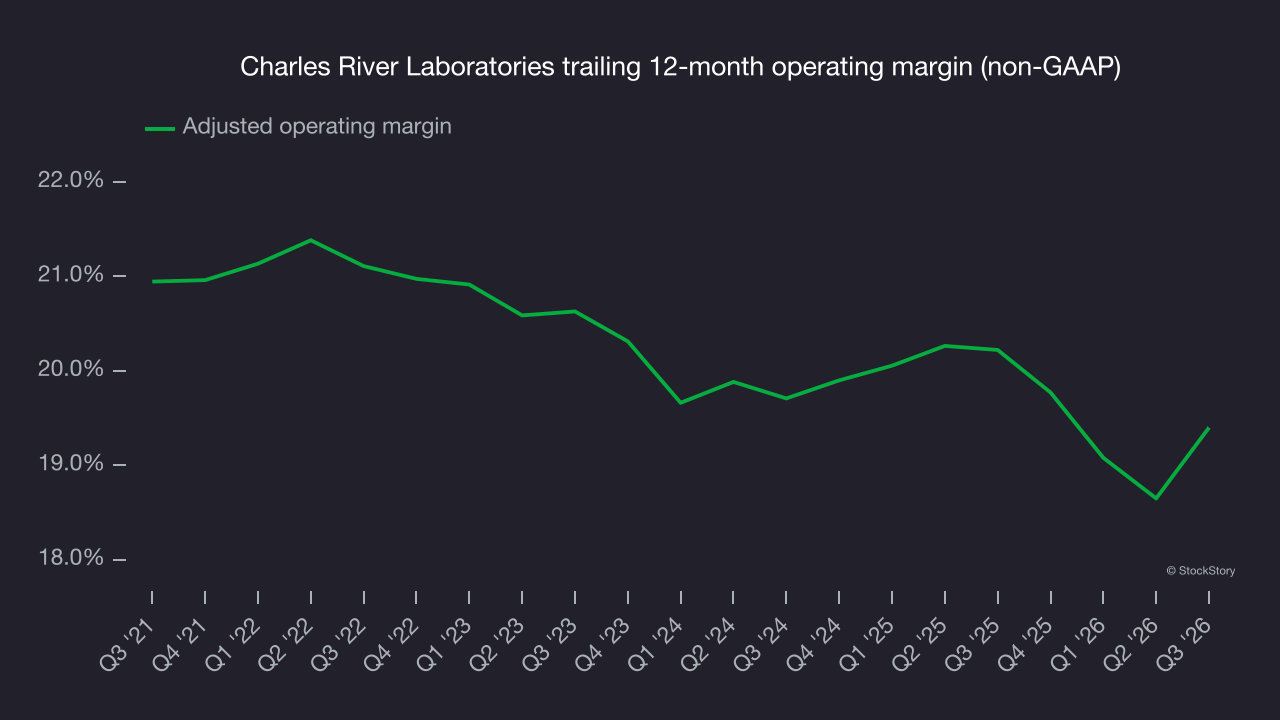
This quarter, Charles River Laboratories generated an adjusted operating margin of 22.7%, up 3.1 percentage points year on year. This increase was a positive development, especially since its revenue fell, showing it was more efficient because it scaled down its expenses.
Earnings per share
The long-term change in earnings per share, or EPS, matters for the same reason as long-term revenue growth. Compared to revenue, however, EPS highlights whether a company’s growth is profitable.
Charles River Laboratories’s flat EPS over the last five years was below its 3% annualized revenue growth. The difference stemmed from higher interest expenses or taxes, as the company improved its adjusted operating margin and repurchased its shares during this time.
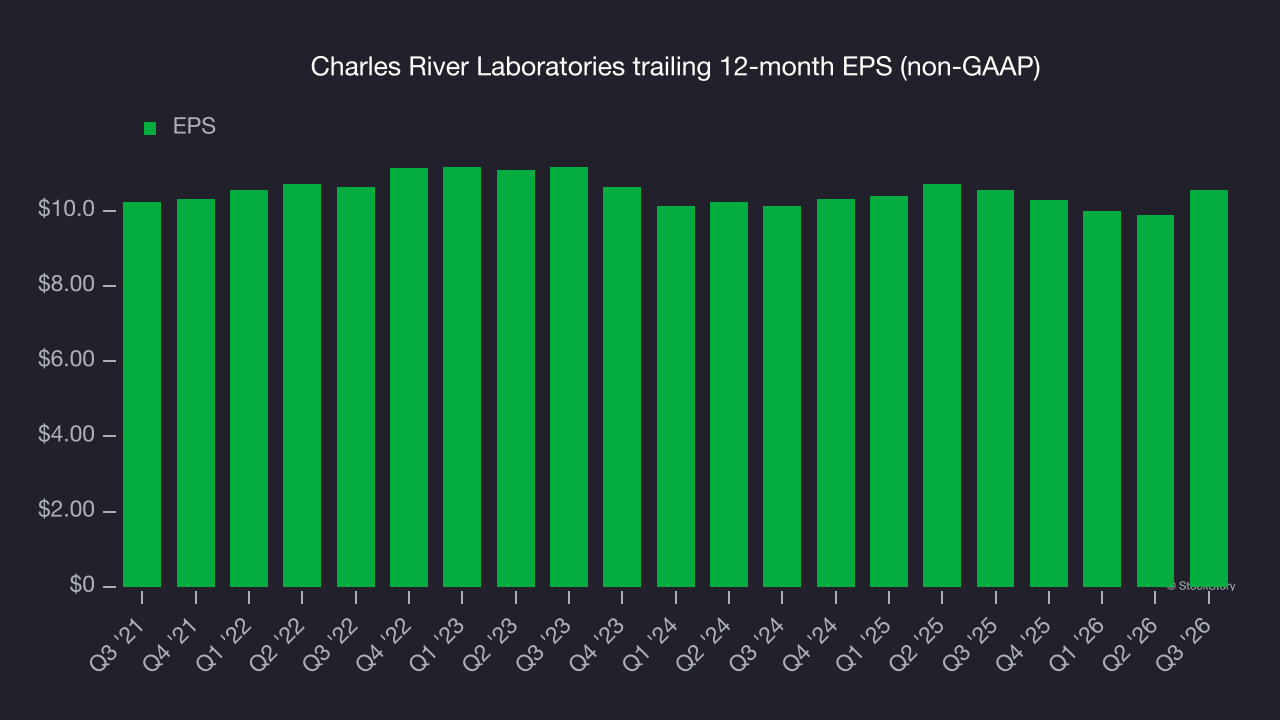
A closer look at Charles River Laboratories’s earnings helps explain its performance. As noted earlier, Charles River Laboratories’s adjusted operating margin expanded this quarter but declined by 1.7 percentage points over the last five years. This was the most relevant factor (aside from the revenue impact) behind its lower earnings; interest expenses and taxes can also affect EPS but don’t tell us as much about a company’s fundamentals.
In Q3, Charles River Laboratories reported adjusted EPS of $3.09, up from $2.43 in the same quarter last year. This result beat analysts’ consensus estimates by 4%. Over the next 12 months, Wall Street expects Charles River Laboratories’s full-year EPS to grow 18.9% from $10.56 to $12.56, according to S&P.
Key takeaways from Charles River Laboratories’s Q3 results
Charles River Laboratories delivered a decent quarter, with both organic revenue and total revenue topping analysts’ consensus estimates. Those beats were key positives in its Q3 results. Shares edged higher 1.3% to $356.50 immediately after the release.
Charles River Laboratories reported solid earnings, but one quarter doesn’t necessarily make the stock a buy. The latest quarter matters, but not nearly as much as longer-term fundamentals and valuation when deciding whether to invest. For more on those factors, read the full research report here (it’s free).