

Cloud communications provider 8x8 (NASDAQ:EGHT) reported calendar Q3 2026 (fiscal Q2 2027) results beating Wall Street’s revenue expectations, with revenue up 4.3% year on year to $192 million. Guidance for next quarter’s revenue was better than expected at $190 million at the midpoint, 0.7% above analysts’ consensus estimates. Its non-GAAP profit of $0.12 per share was 50% above analysts’ consensus estimates.
For more on 8x8, read our free full research report.
8x8 (EGHT) Q3 CY2026 highlights:
- Revenue $192 million vs S&P analysts’ consensus estimates of $187.6 million (4.3% year-on-year growth, 2.4% beat)
- Adjusted EPS $0.12 vs S&P analysts’ consensus estimates of $0.08 (50% beat)
- Adjusted EBITDA $24.91 million vs analysts’ consensus estimates of $21.71 million (13% margin, 14.8% beat)
- Revenue guidance The company slightly lifted its revenue guidance for the full year to $760 million at the midpoint from $755 million
- Adjusted EPS guidance Management raised its full-year adjusted EPS guidance to $0.38 at the midpoint, a 7% increase
- Operating margin 3.6%, in line with the same quarter last year
- Free cash flow margin 5.5%, down from 7.4% in the previous quarter
- Market capitalization $301.1 million
“We delivered our sixth consecutive quarter of year-over-year revenue growth, and our second quarter outperformance led us to raise our full-year outlook for revenue, profitability and operating cash flow,” said Samuel Wilson, Chief Executive Officer at 8x8, Inc. “We have a growing business and significant opportunities to build on it. AI is increasing the value of the conversations we already power, and our global voice network, unified platform and native AI development environment position us to capture that opportunity. Our focus is on turning these advantages into broader customer adoption, profitable growth and long-term shareholder value.”
Revenue growth
A company’s long-term revenue performance is one signal of its overall quality. Any business can have short-term success, but a top-tier one grows for years. Over the last five years, 8x8 grew its revenue at a weak 5.3% compounded annual growth rate, falling short of the software sector standard.
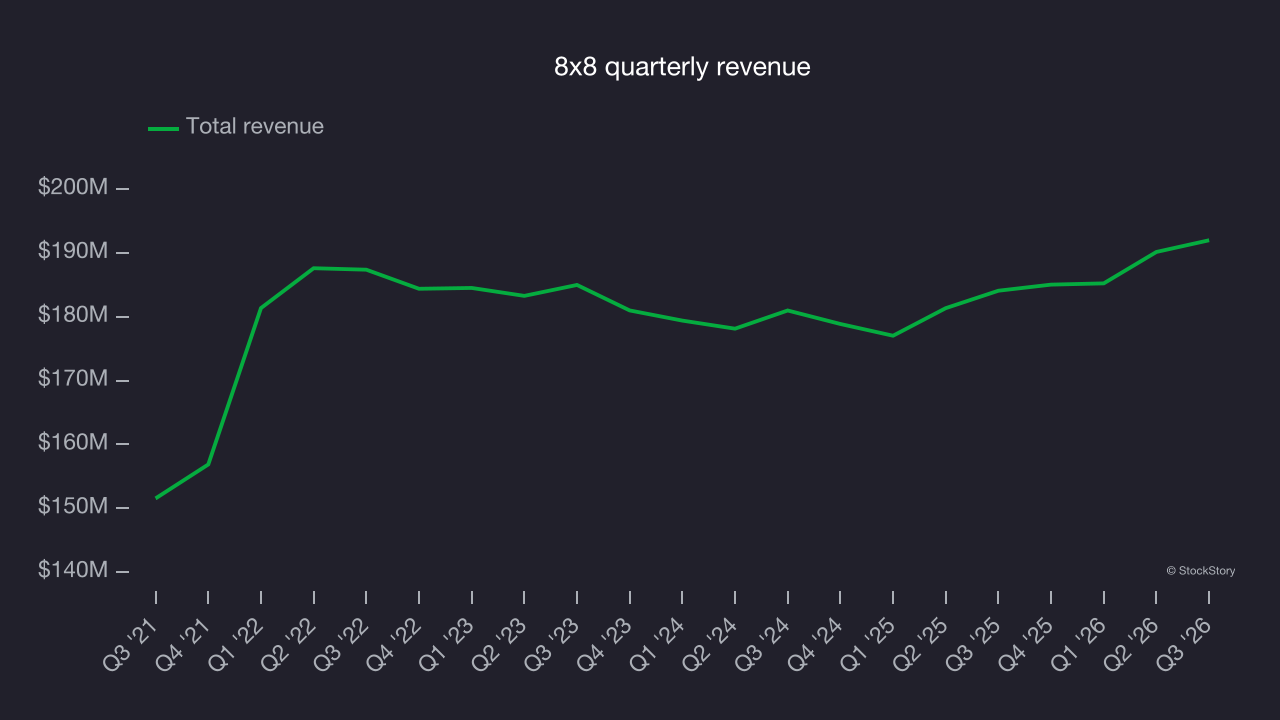
Long-term growth is the most important, but within software, a half-decade historical view may miss new innovations or demand cycles. 8x8’s recent performance shows its demand has slowed as its annualized revenue growth of 2.3% over the last two years was below its five-year trend. Decelerating revenue growth in the sector warrants caution, as it could signal changing consumer tastes aided by low switching costs. 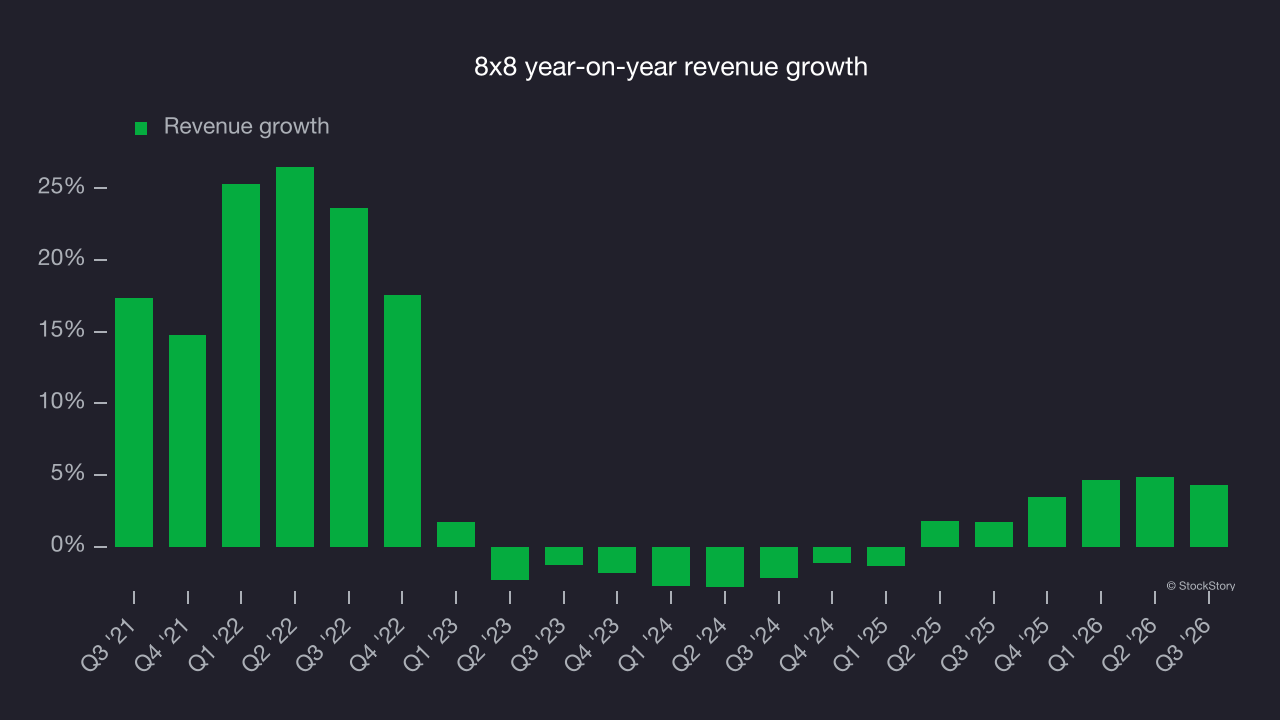
This quarter, 8x8 reported modest year-on-year revenue growth of 4.3% but beat Wall Street’s consensus estimates by 2.4%. Company management is guiding for a 2.7% year-on-year increase in revenue next quarter.
Looking further ahead, sell-side analysts expect revenue to grow 2.5% over the next 12 months, according to S&P, similar to its two-year rate. That uninspiring outlook suggests its newer products and services will not lead to better top-line performance yet.
Customer acquisition efficiency
The customer acquisition cost, or CAC, payback period represents the months required to recover the cost of acquiring a new customer. Essentially, it’s the break-even point for sales and marketing investments. A shorter CAC payback period is ideal, as it implies better returns on investment and business scalability.
It’s relatively expensive for 8x8 to acquire new customers as its CAC payback period was 500.2 months this quarter. The company’s slow recovery of its sales and marketing expenses indicates it operates in a highly competitive market and must invest to stand out, even if the return on that investment is low.
Key takeaways from 8x8’s Q3 results
8x8’s sizable adjusted operating income beat and full-year EPS guidance above Wall Street’s consensus estimates were key positives this quarter. But EPS guidance for next quarter missed consensus estimates, leaving the outlook mixed. Shares remained flat at $2.31 immediately after the results.
When assessing 8x8 at its current price, the latest quarter is only one piece of the longer-term business quality picture. Quality, combined with valuation, can help determine if the stock is a buy. Read more in our full research report here (it’s free).