

Fast-food company Yum! Brands (NYSE:YUM) reported Q3 2026 results beating Wall Street’s revenue expectations, with revenue up 3.8% year on year to $2.05 billion. Its non-GAAP profit of $1.56 per share was 6.9% above analysts’ consensus estimates.
For more on Yum! Brands, read our free full research report.
Yum! Brands (YUM) Q3 2026 highlights:
- Revenue $2.05 billion vs S&P analysts’ consensus estimates of $2.00 billion (3.8% year-on-year growth, 2.8% beat)
- Adjusted EPS $1.56 vs S&P analysts’ consensus estimates of $1.46 (6.9% beat)
- Operating margin 113% (inclusive of $1.7B one-time gain from Pizza Hut divestitures), an increase from 33.7% in the same quarter last year
- Free cash flow margin 18.9%, a decline from 22.7% in the same quarter last year
- Market capitalization $43.01 billion
Revenue growth
A company’s long-term performance is an indicator of its overall quality. Any business can report a good quarter or two, but the best consistently grow over the long term.
With $8.80 billion in revenue over the past 12 months, Yum! Brands is one of the most widely recognized restaurant chains and benefits from customer loyalty, an advantage many companies lack. Its scale also gives it negotiating leverage with suppliers, enabling it to source its ingredients at a lower cost.
Yum! Brands’s 7% annualized revenue growth over the last seven years was decent despite not opening many new restaurants, implying that growth was driven by higher revenue at existing, established dining locations.
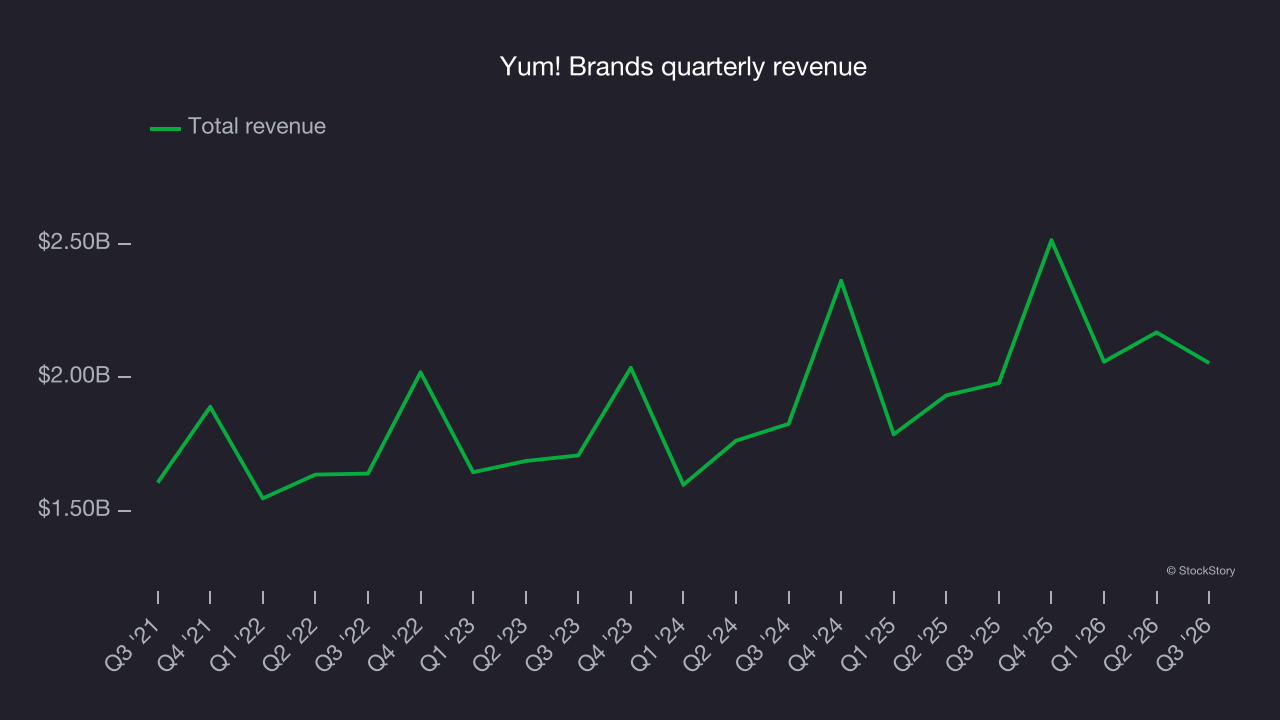
This quarter, Yum! Brands reported modest year-on-year revenue growth of 3.8% but beat Wall Street’s consensus estimates by 2.8%.
Looking ahead, sell-side analysts expect revenue to decline by 4% over the next 12 months, according to S&P, a deceleration versus the last seven years. This underwhelming projection implies its menu offerings will face some demand headwinds. Still, the company is performing well on other measures of financial health.
Restaurant performance
Same-store sales
The change in a company’s restaurant base only tells one side of the story. The other is the performance of its existing locations, which informs management teams whether they should expand or downsize their physical footprints. Same-store sales provide a deeper understanding of this issue because they measure organic growth at restaurants open for at least a year.
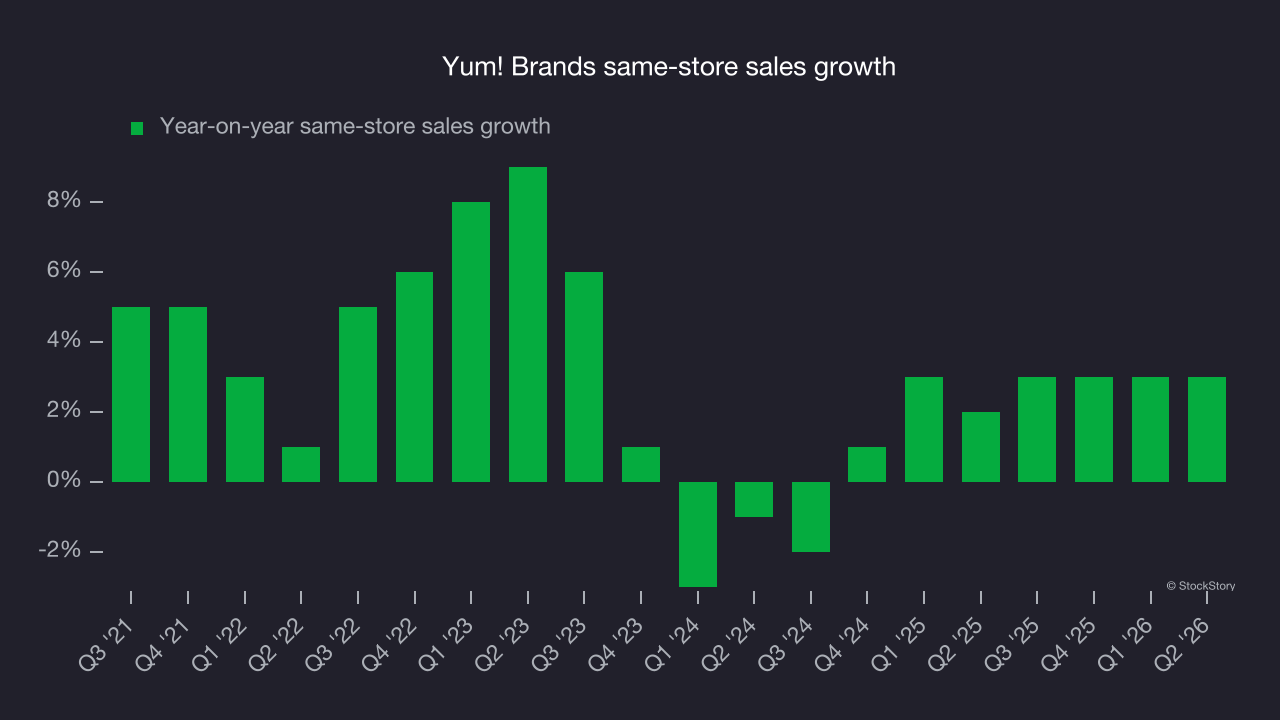
Yum! Brands’s demand rose over the last two years and slightly outpaced the industry. On average, the company’s same-store sales have grown by 2.6% per year. Given its flat restaurant base over the same period, this performance stems from a mixture of higher prices and increased foot traffic at existing locations.
Note that Yum! Brands reports its same-store sales intermittently, so some data points are missing in the chart below.
Key takeaways from Yum! Brands’s Q3 results
Yum! Brands delivered a solid quarter, with revenue topping analysts’ consensus estimates and EPS also coming in ahead of Wall Street’s consensus. Shares edged higher 1.8% to $160.30 immediately after the results.
Yum! Brands had a solid quarter, but one earnings result doesn’t necessarily make the stock a buy. What happened in the latest quarter matters, but not as much as longer-term business quality and valuation when deciding whether to invest in this stock. Read our full research report here (it’s free).