

Scientific instruments company Waters Corporation (NYSE:WAT) reported Q3 2026 results beating Wall Street’s revenue expectations, with revenue up 121% year on year to $1.77 billion. Guidance for next quarter’s revenue was better than expected at $1.81 billion at the midpoint, 1.1% above analysts’ consensus estimates. Its non-GAAP profit of $4.10 per share was 2.6% above analysts’ consensus estimates.
For more on Waters Corporation, read our free full research report.
Waters Corporation (WAT) Q3 2026 highlights:
- Revenue $1.77 billion vs S&P analysts’ consensus estimates of $1.75 billion (121% year-on-year growth, 0.7% beat)
- Adjusted EPS $4.10 vs S&P analysts’ consensus estimates of $4.00 (2.6% beat)
- Revenue guidance $1.81 billion at the midpoint for Q4 2026, above analysts’ consensus estimates of $1.79 billion
- Adjusted EPS guidance Management slightly raised its full-year adjusted EPS guidance to $14.65 at the midpoint
- Operating margin 7.2%, down from 24% in the same quarter last year
- Free cash flow margin 3.1%, down from 20.2% in the same quarter last year
- Organic revenue rose 9% year on year (beat)
- Market capitalization $44.17 billion
"Our team delivered exceptional results led by best-in-class consumables growth across both our Analytical Sciences and Biosciences divisions, as strong execution, new product innovation, and rising customer testing volume accelerated growth," said Dr. Udit Batra, President & Chief Executive Officer, Waters Corporation. "LC-MS instrument growth also strengthened, growing double-digits in constant currency, driven by robust instrument replacement trends, idiosyncratic growth drivers across GLP-1s, PFAS and India generics, and we continued to outperform the market with our leading solutions for complex biologics."
Revenue growth
A company’s long-term performance is an indicator of its overall quality. Any business can put up a good quarter or two, but the best consistently grow over the long haul. Waters Corporation’s revenue grew at a solid 15.4% compounded annual growth rate over the last five years. Its growth beat the average healthcare company and shows its offerings resonate with customers.
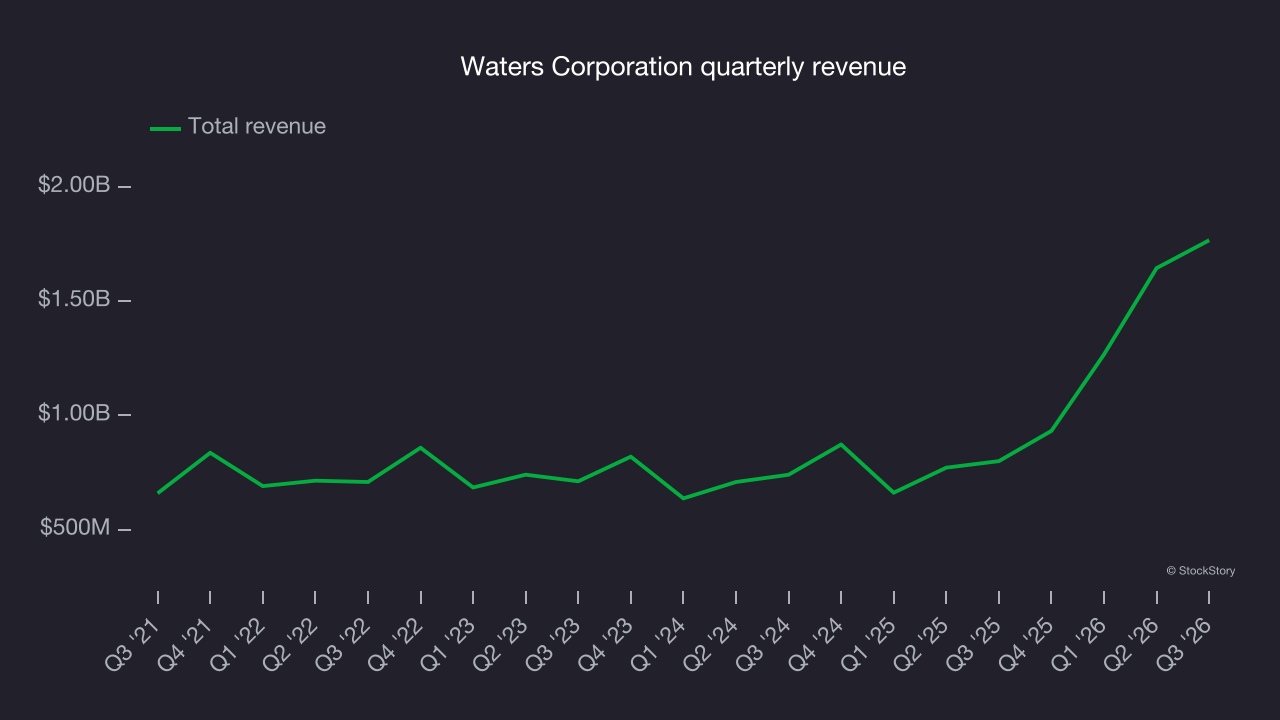
Long-term growth is the most important, but within healthcare, a half-decade historical view may miss new innovations or demand cycles. Waters Corporation’s annualized revenue growth of 39% over the last two years is above its five-year trend, suggesting its demand was strong and recently accelerated. 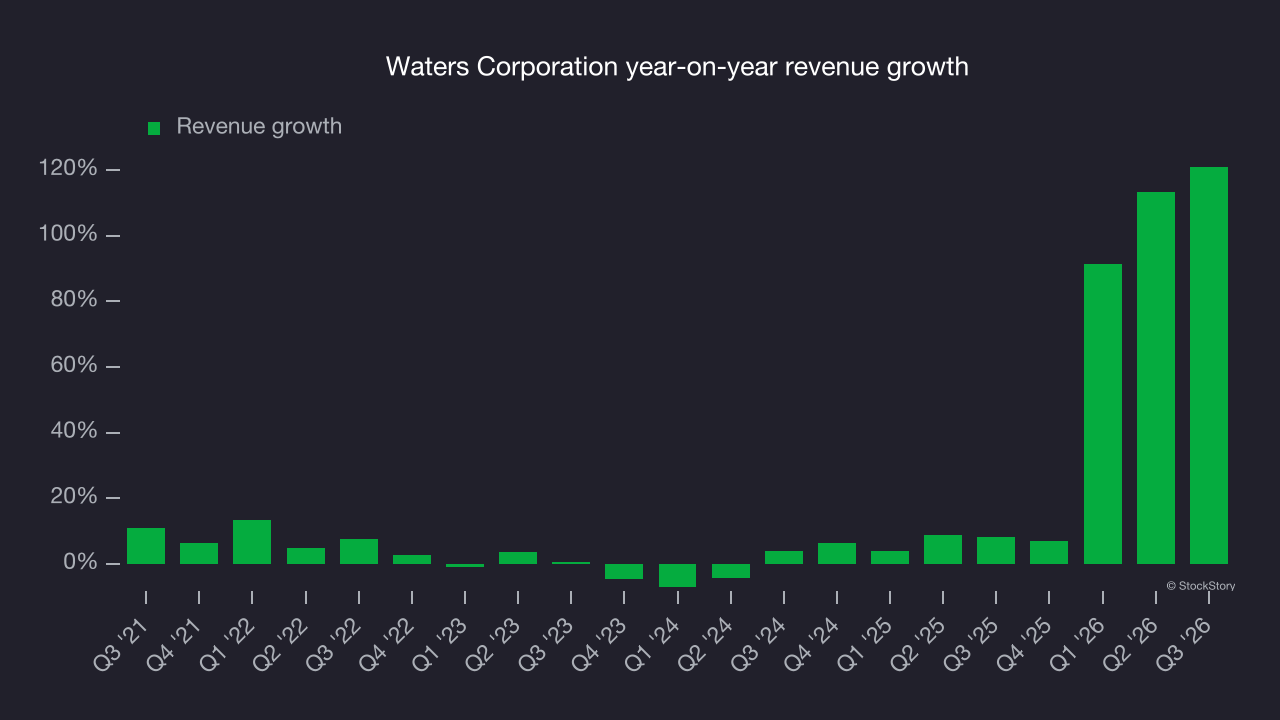
Analyzing the company’s organic revenue helps clarify its revenue dynamics by stripping out one-time events like acquisitions and currency fluctuations that don’t accurately reflect its fundamentals. Over the last two years, Waters Corporation’s organic revenue averaged 8.3% year-on-year growth. Total revenue growth outpaced organic growth over that period, indicating that some combination of acquisitions and foreign exchange rates boosted its headline results. 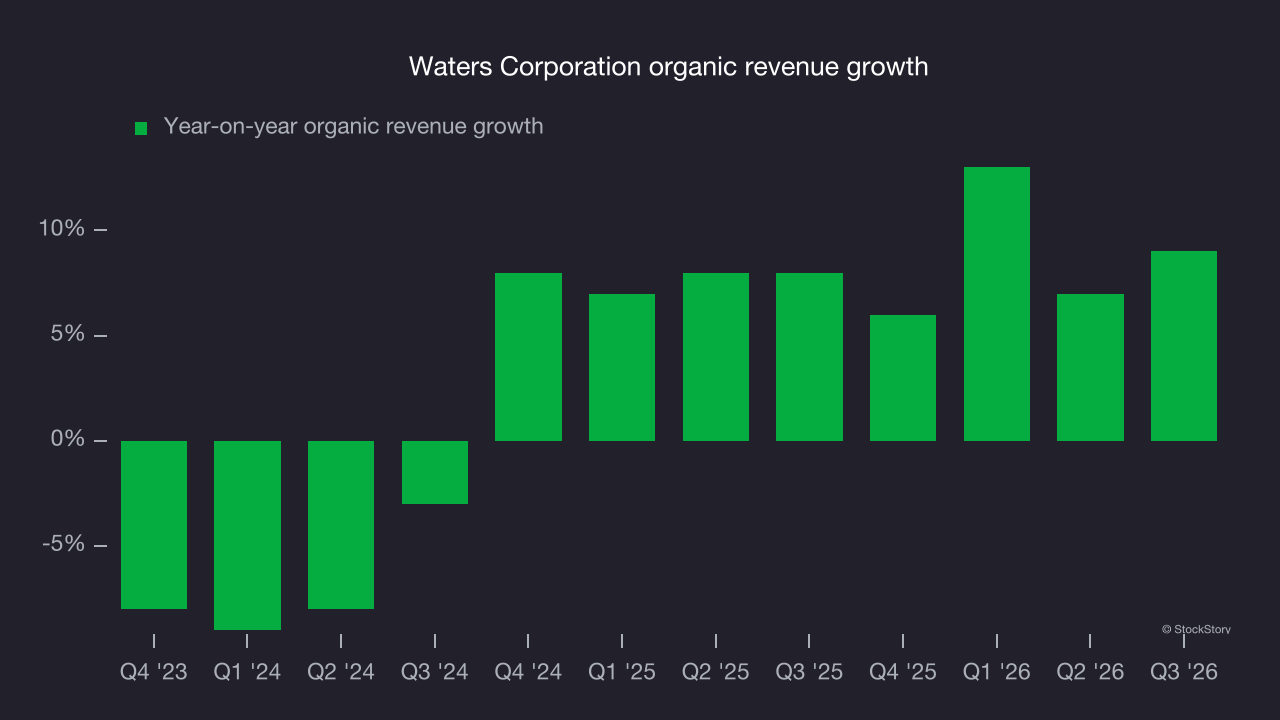
This quarter, Waters Corporation reported year-on-year revenue growth of 121%, and its $1.77 billion of revenue beat Wall Street’s consensus estimates by 0.7%. Management is guiding for a 94.1% year-on-year increase in revenue next quarter.
Looking further ahead, sell-side analysts expect revenue to grow 24.6% over the next 12 months, according to S&P, a deceleration versus the last two years. Despite the slowdown, this projection is noteworthy and implies the market expects its products and services to succeed.
Adjusted operating margin
Waters Corporation has been an efficient company over the last five years. It was one of the more profitable businesses in the healthcare sector, with an average adjusted operating margin of 27.5%.
Looking at the trend in its profitability, Waters Corporation’s adjusted operating margin decreased by 8.7 percentage points over the last five years. The company’s two-year trajectory also shows it failed to return to peak profitability as its margin fell by 9.5 percentage points. This was a poor performance, showing that its expenses were rising and it couldn’t pass those costs on to its customers.
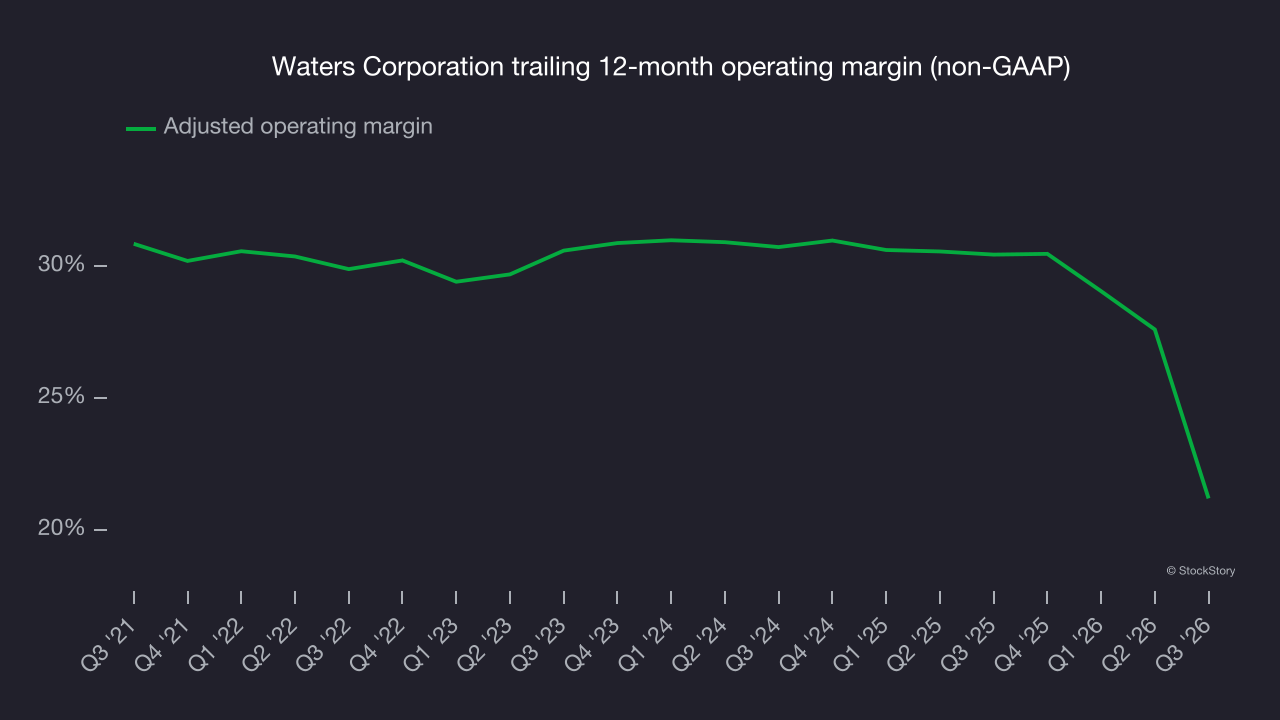
In Q3, Waters Corporation generated an adjusted operating margin of 8.5%, down 21.8 percentage points year on year. This contraction shows it was less efficient because its expenses grew faster than its revenue.
Earnings per share
Revenue trends explain a company’s historical growth, but the long-term change in earnings per share (EPS) points to the profitability of that growth. For example, a company could inflate its revenue through excessive spending on advertising and promotions.
Waters Corporation’s EPS grew at a decent 5.1% compounded annual growth rate over the last five years. However, this performance trailed its 15.4% annualized revenue growth, indicating the company became less profitable on a per-share basis as it expanded.
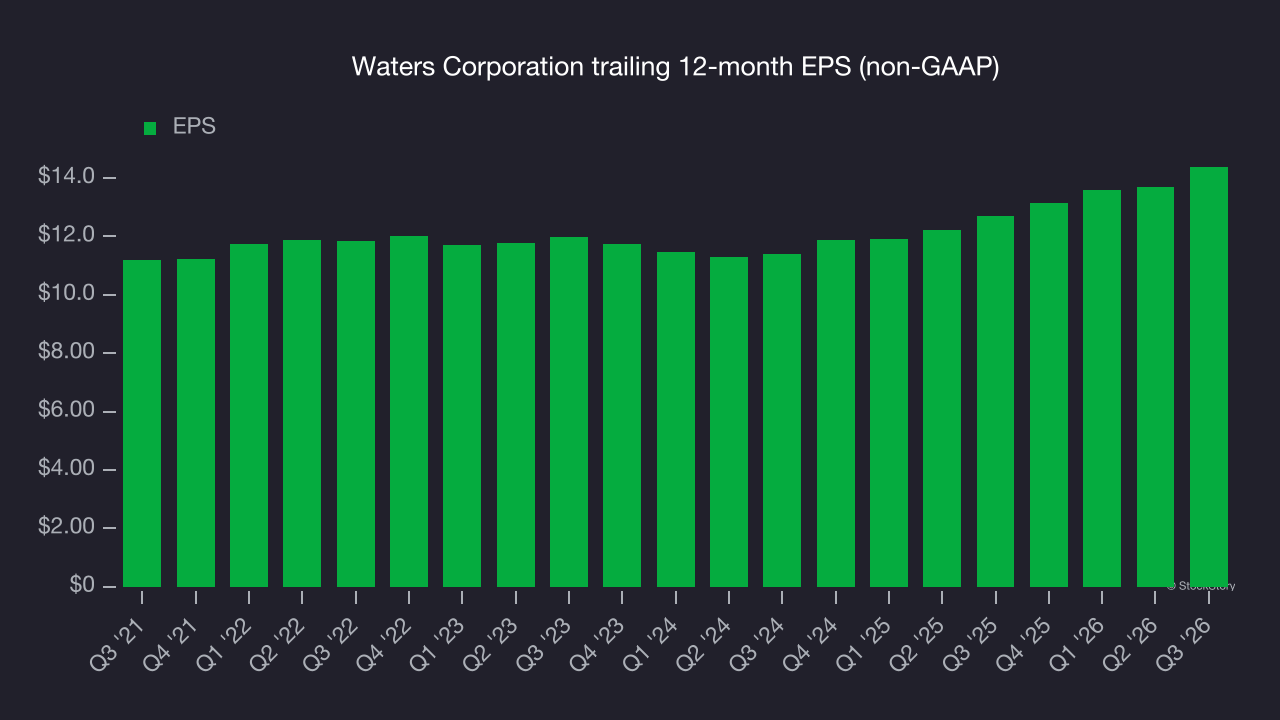
A closer look at Waters Corporation’s earnings helps explain its performance. As noted earlier, Waters Corporation’s adjusted operating margin declined by 8.7 percentage points over the last five years. Its share count also grew by 59.4%, meaning the company not only became less efficient with its operating expenses but also diluted its shareholders. 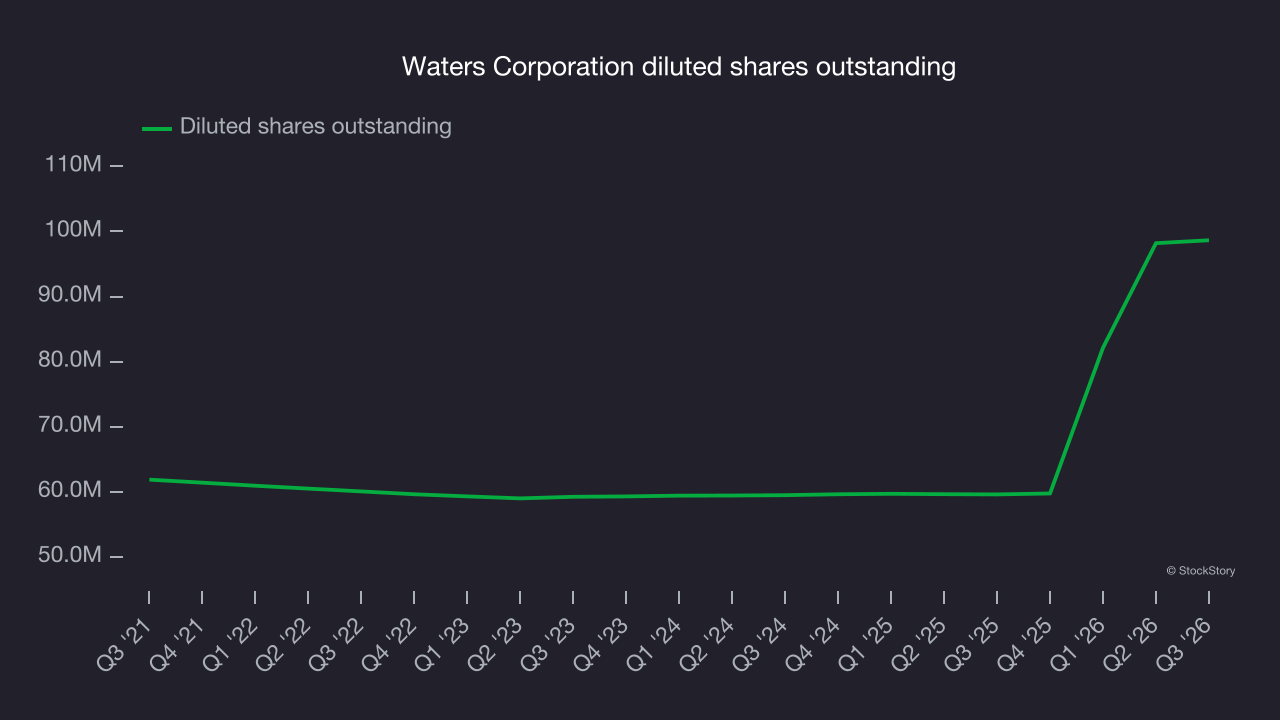
In Q3, Waters Corporation reported adjusted EPS of $4.10, up from $3.40 in the same quarter last year. This result beat analysts’ consensus estimates by 2.6%. Over the next 12 months, Wall Street expects Waters Corporation’s full-year EPS to grow 10.9% from $14.38 to $15.95, according to S&P.
Key takeaways from Waters Corporation’s Q3 results
Waters Corporation’s outlook for next quarter was split: Revenue guidance slightly topped analysts’ consensus estimates, but EPS guidance fell slightly short. Organic revenue also narrowly beat Wall Street’s estimates, making for a mixed quarter overall. Investors were likely hoping for more, as shares edged lower 1.6% to $442.34 immediately after the release.
Should you invest in Waters Corporation? The latest quarter matters, but not nearly as much as longer-term fundamentals and valuation when deciding if the stock is a buy. Read our free full research report here.