

Egg and butter company Vital Farms (NASDAQ:VITL) met Wall Street’s revenue expectations in Q3 2026, but revenue fell by 8.4% year on year to $182.2 million. On the other hand, the company’s full-year revenue guidance of $730 million at the midpoint came in 4.3% below analysts’ consensus estimates. Its GAAP loss of $0.15 per share was 28.6% below analysts’ consensus estimates.
For more on Vital Farms, read our free full research report.
Vital Farms (VITL) Q3 2026 highlights:
- Revenue $182.2 million vs S&P analysts’ consensus estimates of $182.2 million (8.4% year-on-year decline, in line)
- EPS (GAAP) -$0.15 vs analysts’ consensus estimates of -$0.12 (28.6% miss)
- Adjusted EBITDA $1.50 million vs analysts’ consensus estimates of $1.96 million (0.8% margin, relatively in line)
- Revenue guidance The company lowered its revenue guidance for the full year to $730 million at the midpoint from $787.5 million, a 7.3% decrease
- EBITDA guidance -$15 million at the midpoint for the full year, below analysts’ consensus estimates of -$1.79 million
- Operating margin -4.2%, down from 10.8% in the same quarter last year
- Free cash flow -$22.79 million compared to -$10.61 million in the same quarter last year
- Market capitalization $394.1 million
“Q3 represented a meaningful sequential improvement from Q2, consistent with our previously communicated expectation that Q2 would represent the trough in our financial performance. Net revenue and Adjusted EBITDA both improved sequentially, distribution expanded, we reached record dollar and volume share of the shell egg category, and we made progress reducing excess supply and lowering our cost structure,” said Russell Diez-Canseco, Vital Farms’ Executive Chairperson, President and CEO.
Revenue growth
A company’s long-term revenue performance is one signal of its overall quality. Even a poor business can perform well for one or two quarters, but a high-quality one grows for years.
With $748.9 million in revenue over the past 12 months, Vital Farms is a small consumer staples company, which sometimes brings disadvantages compared to larger competitors benefiting from economies of scale and negotiating leverage with retailers. On the positive side, it can grow faster because it has a longer list of untapped store chains to sell into.
Vital Farms’s 18.8% annualized revenue growth over the last three years was impressive, indicating high demand.
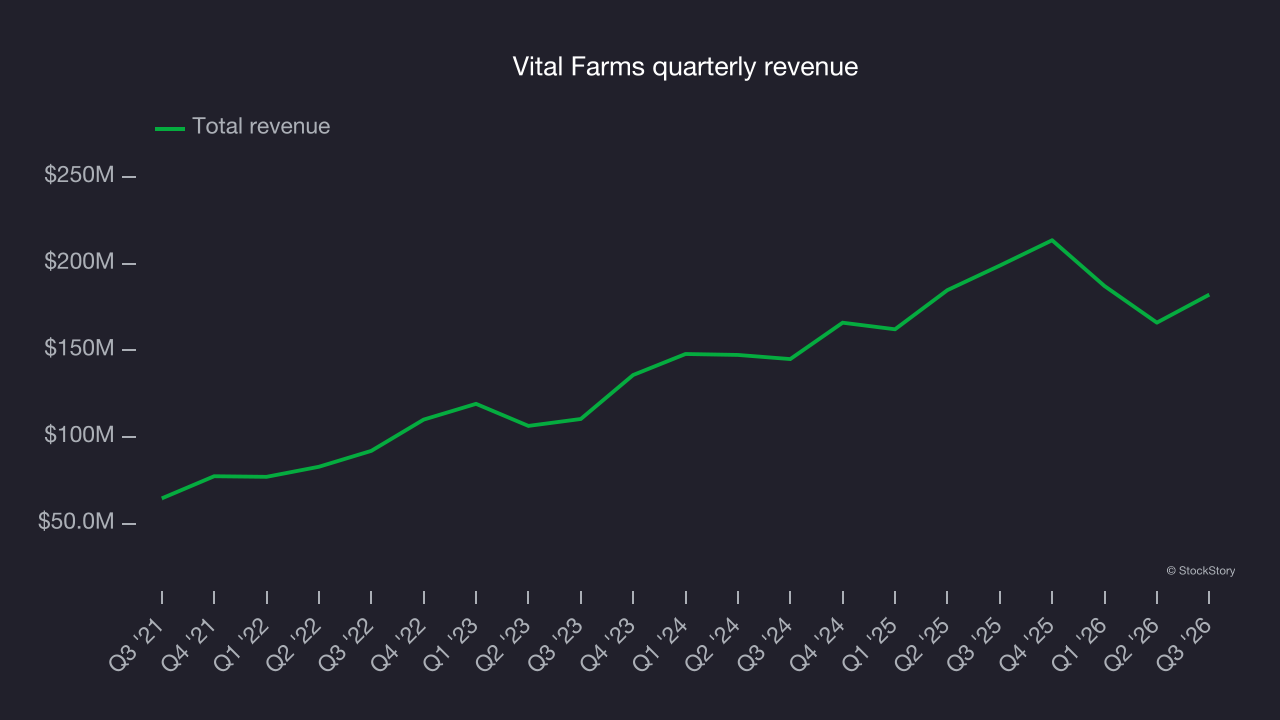
This quarter, Vital Farms reported an uninspiring 8.4% year-on-year revenue decline to $182.2 million, in line with Wall Street’s consensus estimates.
Looking ahead, sell-side analysts expect revenue to grow 6.8% over the next 12 months, according to S&P, a deceleration versus the last three years. Still, this projection is above average for the sector and suggests the market is forecasting some success for its newer products.
Free cash flow
Free cash flow isn’t a prominently featured metric in company financials and earnings releases, but it’s telling because it accounts for all operating and capital expenses, making it difficult to manipulate.
Vital Farms’s substantial reinvestments have drained its resources over the last two years, straining its finances and limiting its ability to return capital to investors. Its free cash flow margin averaged negative 9.5%, meaning it used $9.47 of cash for every $100 in revenue.
Vital Farms’s margin dropped by 13.1 percentage points over the last year. Almost any movement in the wrong direction is undesirable because it is already burning cash. If the trend continues, it could signal the company is in the middle of a large investment cycle.
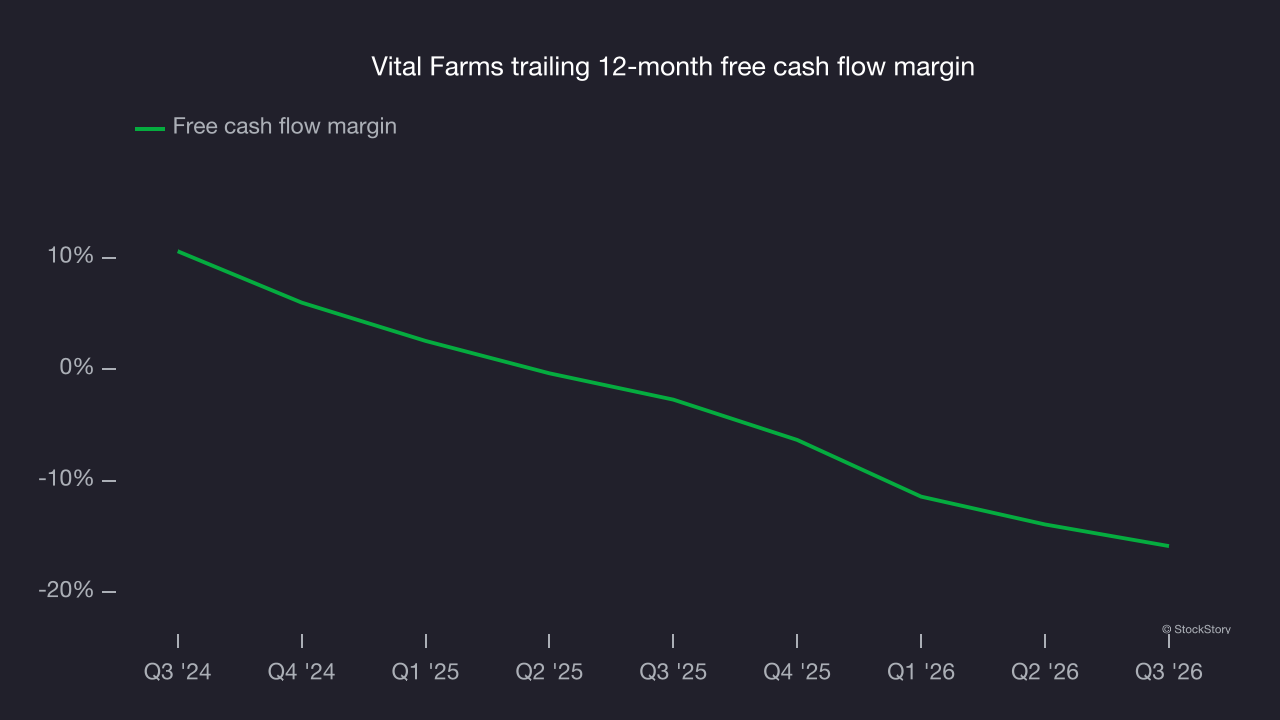
Vital Farms used $22.79 million of cash in Q3, equivalent to a negative 12.5% margin. The company’s cash burn was similar to the $10.61 million it used in the same quarter last year.
Key takeaways from Vital Farms’s Q3 results
Vital Farms’ full-year outlook left little to like: revenue guidance missed expectations, and EBITDA guidance fell short of Wall Street’s consensus estimates. Those shortfalls capped a softer quarter with few positives. Shares plunged 10.4% to $8.23 immediately after the report.
Vital Farms’s earnings report left more to be desired. Whether that creates a buying opportunity depends on more than one quarter. What happened in the latest quarter matters, but not as much as longer-term business quality and valuation when deciding whether to invest in this stock. For more on Vital Farms, read our free full research report here.