

Offshore drilling contractor Seadrill (NYSE:SDRL) reported revenue ahead of Wall Street’s expectations in Q3 2026, with revenue up 17.9% year on year to $428 million. Its GAAP loss of $0.49 per share was significantly below analysts’ consensus estimates.
For more on Seadrill, read our free full research report.
Seadrill (SDRL) Q3 2026 highlights:
- Revenue $428 million vs S&P analysts’ consensus estimates of $383.2 million (17.9% year-on-year growth, 11.7% beat)
- EPS (GAAP) -$0.49 vs analysts’ consensus estimates of $0.13 (significant miss)
- Adjusted EBITDA $121 million vs analysts’ consensus estimates of $103.4 million (28.3% margin, 17% beat)
- Operating margin 10.3%, up from 7.2% in the same quarter last year
- Free cash flow margin 41.8%, up from 2.5% in the same quarter last year
- Market capitalization $2.99 billion
“Seadrill generated $179 million of Free Cash Flow in the third quarter, delivering on our commitment to convert backlog into cash. Over 85% of available drillship days are now contracted in 2027, further enhancing visibility into next year’s earnings and cash flow,” said Samir Ali, President and Chief Executive Officer. “The West Carina award secures the third and final repricing of three legacy contracts, with the improved dayrate effective in 2027. A healthy tender pipeline and growing deepwater demand reinforce our confidence in the market outlook, positioning Seadrill to build on these commercial achievements and capture further upside.”
Revenue growth
Cyclical sectors like energy often flatter weaker operators during favorable price environments, but a longer-term lens separates those from businesses that can consistently perform across market cycles. Seadrill’s revenue grew at a decent 12% compounded annual growth rate over the last five years. Its growth was slightly above that of the average energy upstream and integrated energy company, showing its offerings resonate with customers.
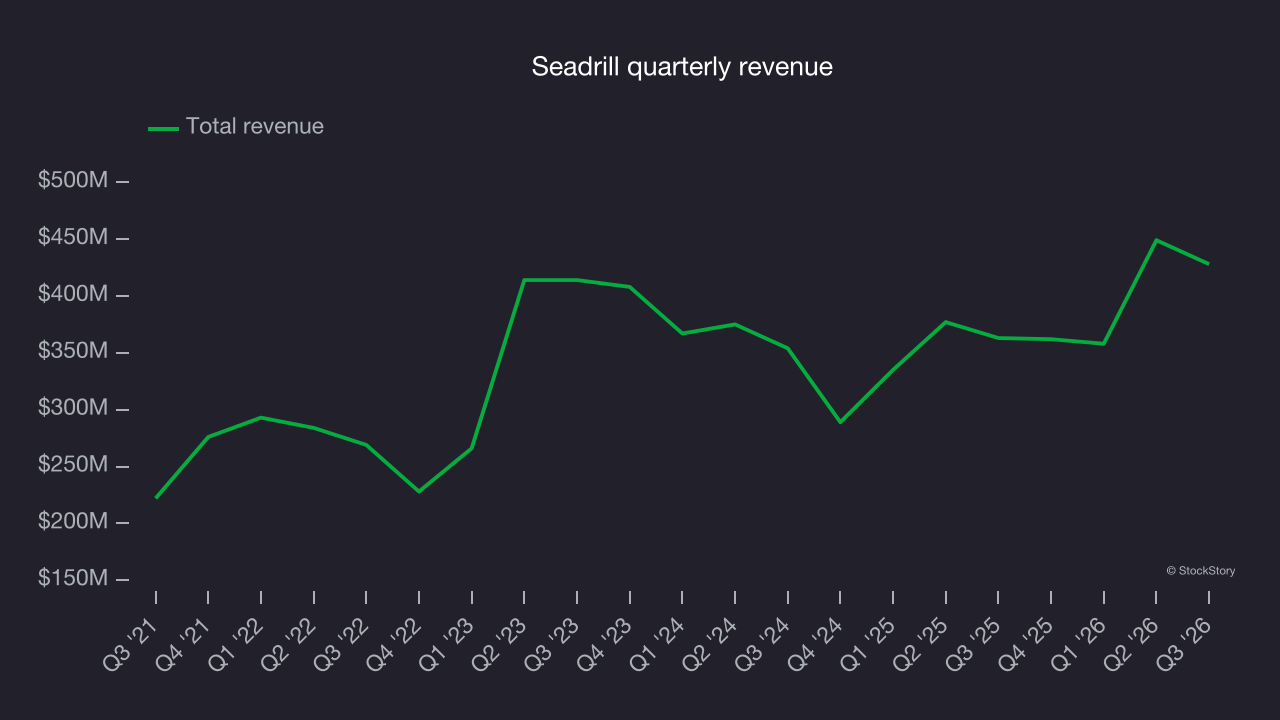
Energy cycles can be long enough that a single five-year period can still reflect one price environment, which is why an additional, decade-long view can help capture through-cycle performance. Seadrill’s ten-year performance marks a sharp pivot from its five-year trend as its revenue has shown annualized declines of 7.5% over the last ten years.
This quarter, Seadrill reported year-on-year revenue growth of 17.9%, and its $428 million of revenue exceeded Wall Street’s consensus estimates by 11.7%.
Adjusted EBITDA margin
Adjusted EBITDA margin is an important measure of profitability for the sector and accounts for the gross margins and operating costs mentioned previously. Unlike operating margin, it is not distorted by accounting conventions around reserves, drilling costs and assumptions on commodity consumption from the well or basin. Adjusted EBITDA highlights the economic reality of how much cash the rock produces before the capital structure (debt service) and the drilling budget (capex) are considered.
Seadrill was profitable over the last five years but held back by its large cost base. Its average EBITDA margin of 26.7% was weak for an upstream and integrated energy business.
On the positive side, Seadrill’s EBITDA margin rose by 4.8 percentage points over the last year.
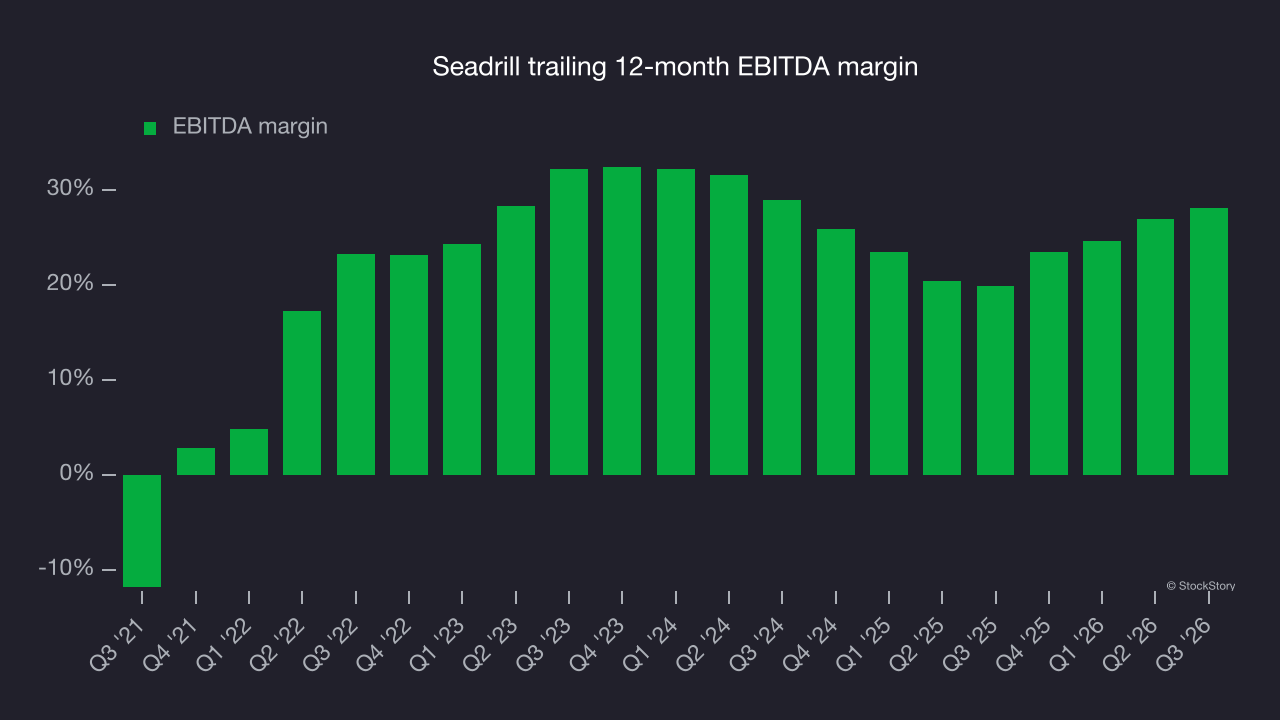
In Q3, Seadrill generated an EBITDA margin of 28.3%, up 4.8 percentage points year on year. The increase was a positive sign of greater efficiency. Adjusted EBITDA beat Wall Street’s consensus estimates by 17%.
Free cash flow
Adjusted EBITDA shows how profitable a company’s existing “rock” is before financing and reinvestment, while free cash flow shows how much value remains after paying to replace those wells. Because production declines over time, strong EBITDA can coexist with weak free cash flow if drilling is expensive or declines are steep. Free cash flow therefore captures both operating efficiency and the cost of sustaining production.
While Seadrill posted positive free cash flow this quarter, the broader picture has been less favorable. Seadrill’s reinvestment needs have consumed substantial resources over the last five years, contributing to an average free cash flow margin of negative 1.7%. This means it burned $1.65 of cash for every $100 in revenue.
Absolute free cash flow margin levels matter, but so does the stability of free cash flow. All else equal, a steady 25.0% average free cash flow margin regardless of commodity prices is preferable to very high margins in good times and negative ones in downturns.
Seadrill’s ratio of quarterly free cash flow volatility to volatility in West Texas Intermediate, or WTI, crude prices over the past five years was 80.9 (lower is better), indicating that its cash generation is far more sensitive to commodity-price swings than most peers. This elevated volatility limits its access to capital in downturns and makes it unlikely to act as a consolidator when weaker competitors come under pressure.
Why assess stability relative to commodity prices using free cash flow rather than revenue or EBITDA, with WTI crude prices as the comparison for Seadrill? What ultimately matters is not how much revenue or profit a company earns when prices are high but how much cash it can generate when prices are low. Free cash flow is the superior metric because it includes everything from hedging effectiveness to growth and maintenance capex to management behavior during good times and bad.
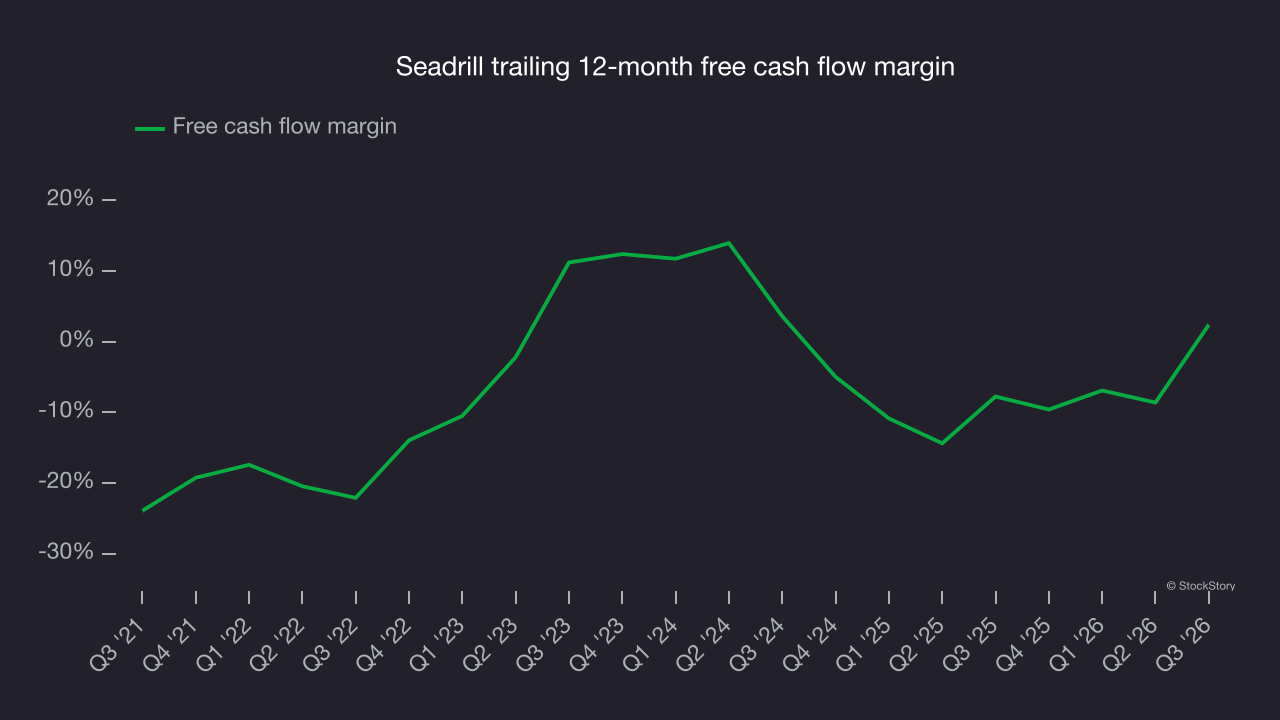
Seadrill’s free cash flow came in at $179 million in Q3, equivalent to a 41.8% margin. This was a positive result, as its margin was 39.3 percentage points higher than in the same quarter last year, building on its favorable historical trend.
Key takeaways from Seadrill’s Q3 results
Seadrill delivered a solid quarter, with wide beats on both EBITDA and revenue against analysts’ consensus estimates. EPS missed, but the results still had clear positives. Shares edged higher 1.9% to $47.21 immediately after the release.
Seadrill had a good quarter, but that alone doesn’t make it a buy. The latest quarter matters less than longer-term business quality and valuation when deciding whether to invest in the stock. For more on Seadrill, read our full research report here (it’s free).