

Workplace furnishings manufacturer HNI Corporation (NYSE:HNI) missed Wall Street’s revenue expectations in Q3 2026, but revenue rose 133% year on year to $1.59 billion. Its non-GAAP profit of $1.62 per share was 16.5% above analysts’ consensus estimates.
For more on HNI, read our free full research report.
HNI (HNI) Q3 2026 highlights:
- Revenue $1.59 billion vs S&P analysts’ consensus estimates of $1.60 billion (133% year-on-year growth, 0.6% miss)
- Adjusted EPS $1.62 vs S&P analysts’ consensus estimates of $1.39 (16.5% beat)
- Operating margin 8.6%, down from 10.8% in the same quarter last year
- Free cash flow margin 10.6%, down from 19.9% in the same quarter last year
- Market capitalization $3.59 billion
“The strength of our growth strategies and ability to stay focused on our profit levers, despite ongoing macroeconomic uncertainty, was evident in our third quarter results. We expect strong profit growth again in the fourth quarter, driven by the Steelcase acquisition, operational productivity gains and organic revenue growth,” said Jeff Lorenger, chairman, president and chief executive officer.
Revenue growth
A company’s long-term revenue performance can indicate its overall quality. Any business can have short-term success, but a top-tier one grows for years.
With $5.30 billion in revenue over the past 12 months, HNI is one of the larger companies in the business services industry and benefits from a well-known brand that influences purchasing decisions.
HNI’s revenue grew at a strong 19.9% compounded annual growth rate over the last five years. This shows demand for HNI exceeded that of many business services companies.
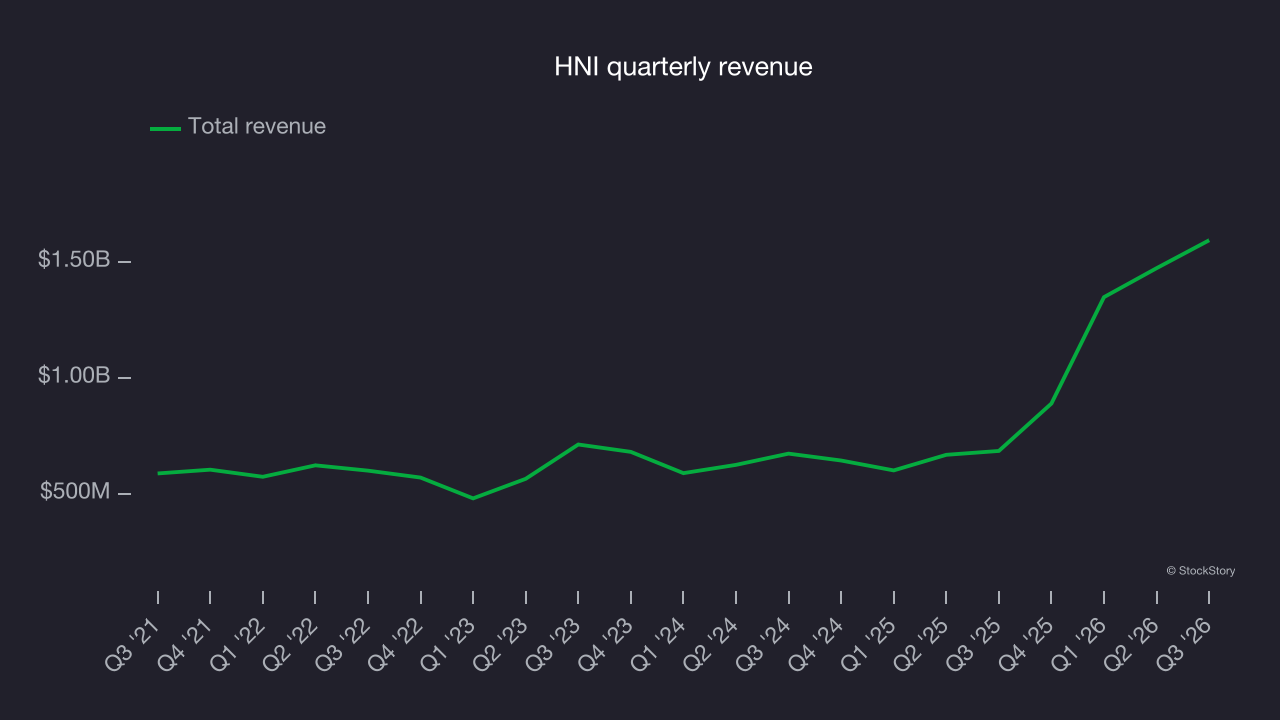
Long-term growth matters most, but within business services, a half-decade historical view may miss recent innovations or disruptive industry trends. HNI’s annualized revenue growth of 43.8% over the last two years is above its five-year trend, suggesting its demand was strong and recently accelerated. 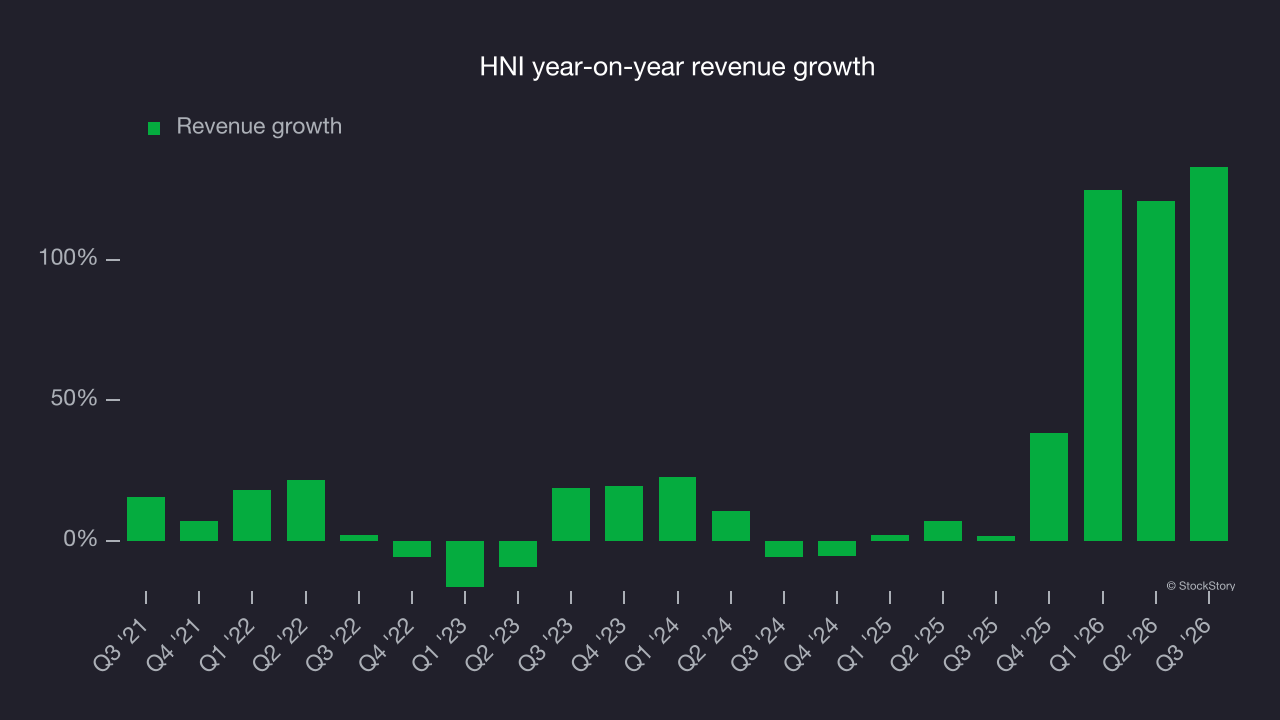
This quarter, HNI reported 133% year-on-year revenue growth, but its revenue of $1.59 billion fell short of Wall Street’s consensus estimates.
Looking ahead, sell-side analysts expect revenue to grow 17% over the next 12 months, according to S&P, a deceleration versus the last two years. Still, this projection is healthy and implies the market is forecasting success for its products and services.
Adjusted operating margin
HNI was profitable over the last five years but held back by its large cost base. Its average adjusted operating margin of 7.9% was weak for a business services company.
On the positive side, HNI’s adjusted operating margin rose by 2.1 percentage points over the last five years, as its revenue growth provided operating leverage.
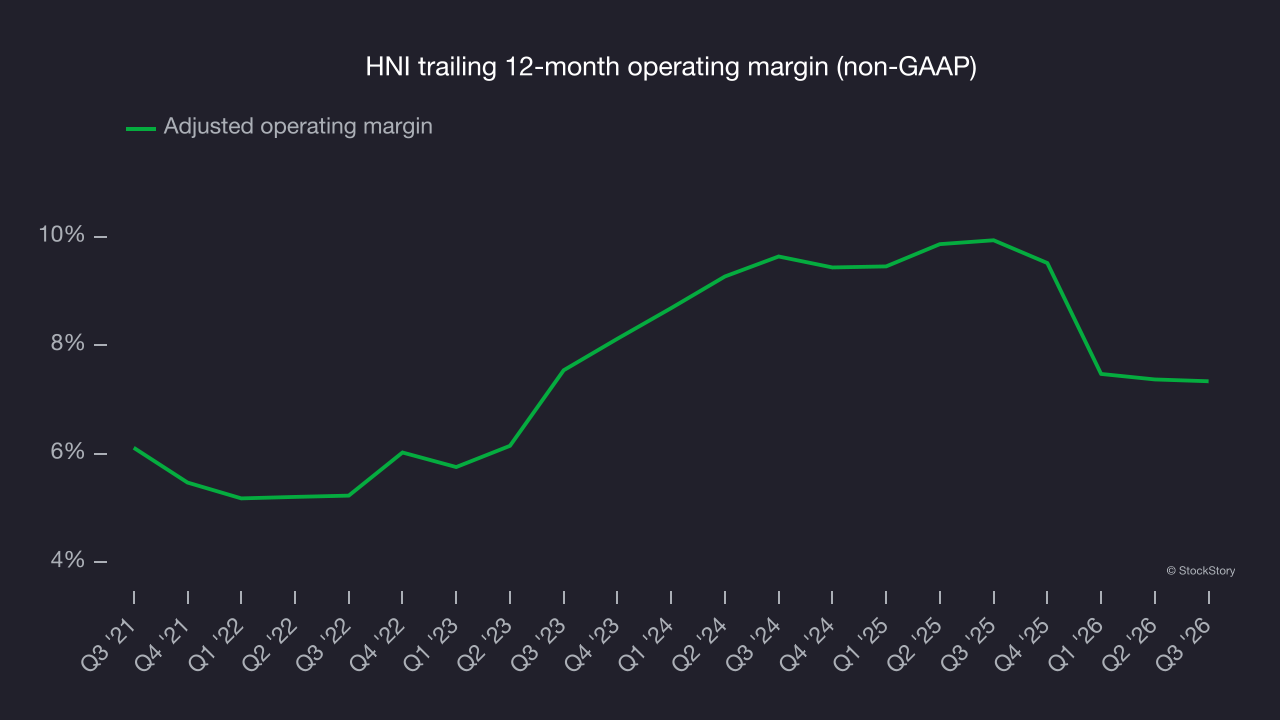
This quarter, HNI generated an adjusted operating margin of 8.9%, down 2.4 percentage points year on year. This contraction shows it was less efficient because its expenses grew faster than its revenue.
Earnings per share
We track the long-term change in earnings per share (EPS) for the same reason as long-term revenue growth. Compared to revenue, however, EPS highlights whether a company’s growth is profitable.
HNI’s EPS grew at a strong 17% compounded annual growth rate over the last five years. Despite its adjusted operating margin improvement during that time, this performance was lower than its 19.9% annualized revenue growth, indicating that non-fundamental factors such as interest and taxes affected its ultimate earnings.
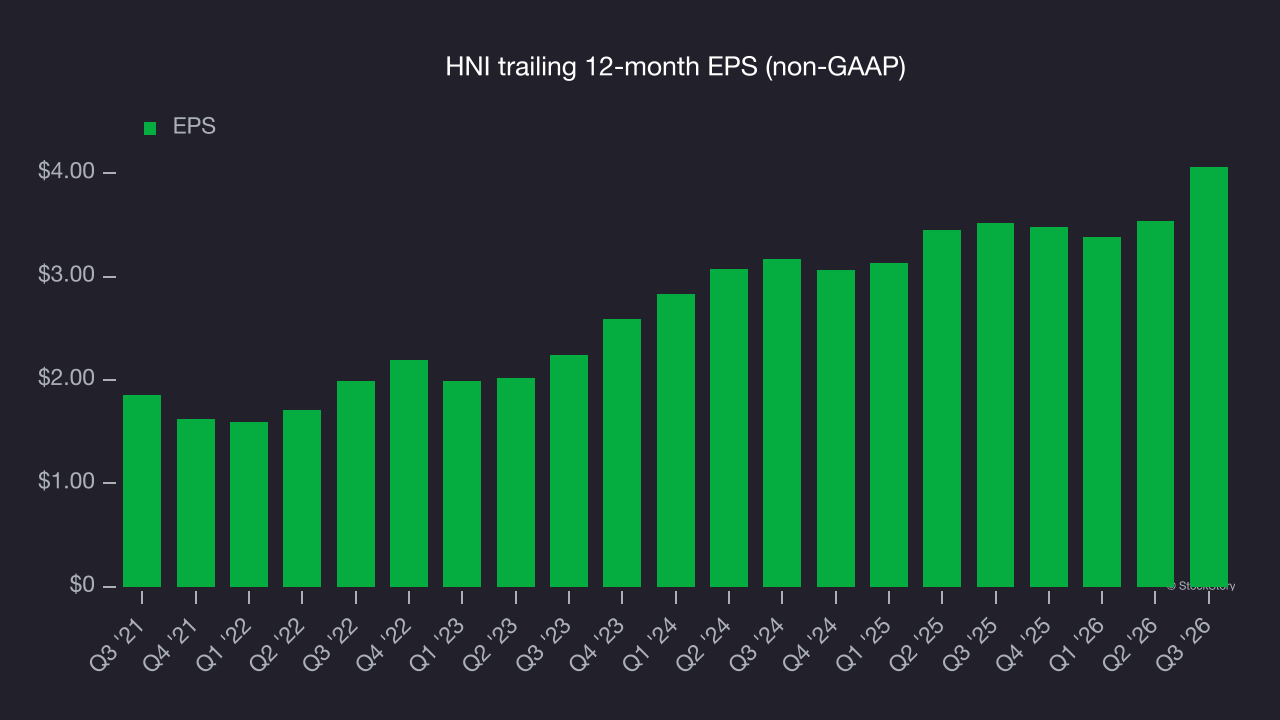
Diving into the nuances of HNI’s earnings can give us a better understanding of its performance. A five-year view shows HNI has diluted its shareholders, growing its share count by 63.7%. This dilution overshadowed its increased operational efficiency and has led to lower per share earnings. Taxes and interest expenses can also affect EPS but don’t tell us as much about a company’s fundamentals. 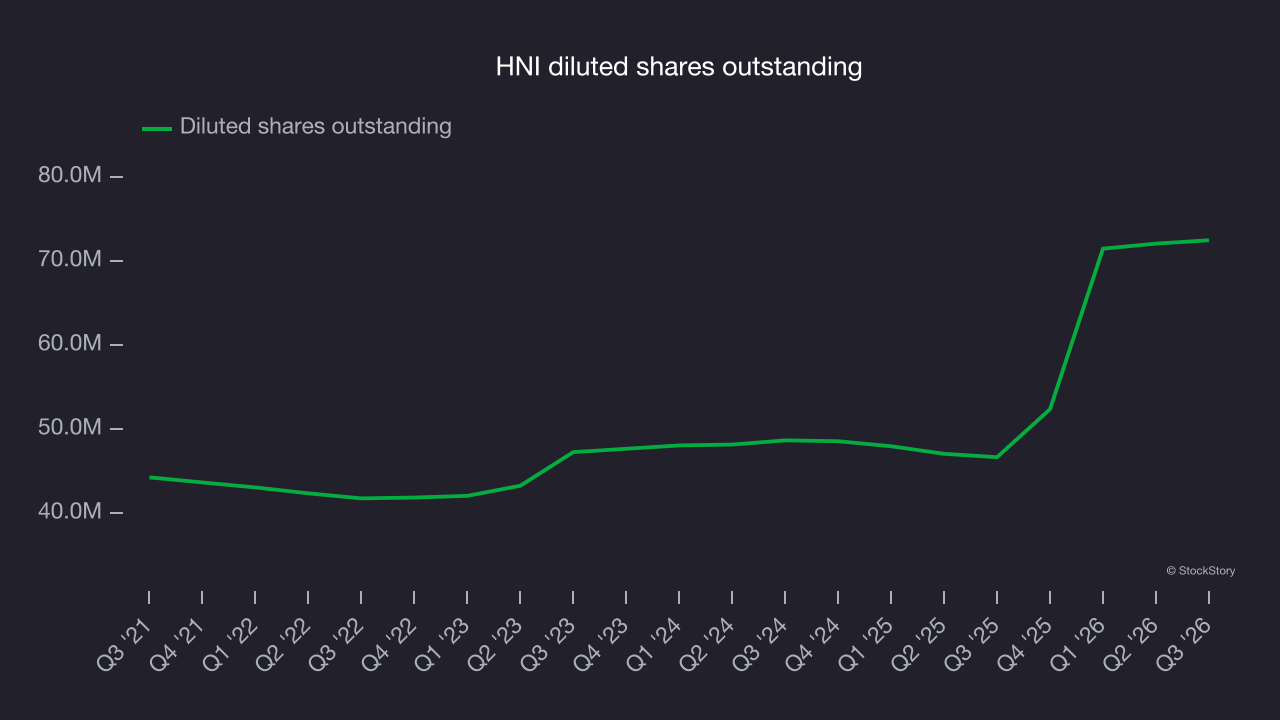
Like with revenue, we analyze EPS over a shorter period to see if we are missing a change in the business.
For HNI, its two-year annual EPS growth of 13.2% was lower than its five-year trend. Still, its growth was good.
In Q3, HNI reported adjusted EPS of $1.62, up from $1.10 in the same quarter last year. This result comfortably beat analysts’ consensus estimates, a positive outcome for shareholders. Over the next 12 months, Wall Street expects HNI’s full-year EPS to grow 11% from $4.06 to $4.51, according to S&P.
Key takeaways from HNI’s Q3 results
HNI’s EPS beat analysts’ consensus estimates in Q3, but revenue fell slightly short. The quarter was solid overall, with the earnings beat a key positive. Shares edged higher 1.4% to $50.45 immediately after the report.
HNI may have had a good quarter, but that alone does not make the stock a buy. The latest quarter is only one piece of the longer-term business quality puzzle. Quality, when combined with valuation, can help determine if the stock is a buy. For more on HNI, read our full research report here (it’s free).