

Research and advisory firm Gartner (NYSE:IT) reported Q3 2026 results exceeding the market’s revenue expectations, but revenue edged lower by 1.3% year on year to $1.50 billion. Its non-GAAP profit of $3.59 per share was 26.4% above analysts’ consensus estimates.
For more on Gartner, read our free full research report.
Gartner (IT) Q3 2026 highlights:
- Revenue $1.50 billion vs S&P analysts’ consensus estimates of $1.49 billion (1.3% year-on-year decline, 1.2% beat)
- Adjusted EPS $3.59 vs S&P analysts’ consensus estimates of $2.84 (26.4% beat)
- Adjusted EBITDA $364 million vs analysts’ consensus estimates of $327.5 million (24.2% margin, 11.1% beat)
- Operating margin 18.7%, up from 5.7% in the same quarter last year
- Free cash flow margin 18.3%, similar to the same quarter last year
- Constant currency revenue fell 1.1% year on year (1.2% in the same quarter last year)
- Market capitalization $14.86 billion
Gene Hall, Gartner’s chairman and chief executive officer, commented, “Contract Value growth accelerated again. Revenues, Adjusted EBITDA excluding divested operation, Adjusted EPS, and free cash flow were ahead of expectations. We repurchased $1.7 billion of stock over the last four quarters, as our capital allocation continues to create value for our shareholders. In addition, we increased our full year Revenues, Adjusted EBITDA excluding divested operation, Adjusted EPS, and free cash flow guidance.”
Revenue growth
Reviewing a company’s long-term revenue performance reveals insights into its quality. Any business can experience short-term success, but top-performing ones sustain growth for years.
With $6.44 billion in revenue over the past 12 months, Gartner is one of the larger companies in the business services industry and benefits from a well-known brand that influences purchasing decisions.
Gartner grew its revenue at a solid 7.3% compounded annual growth rate over the last five years, showing that its demand was higher than that of many business services companies.
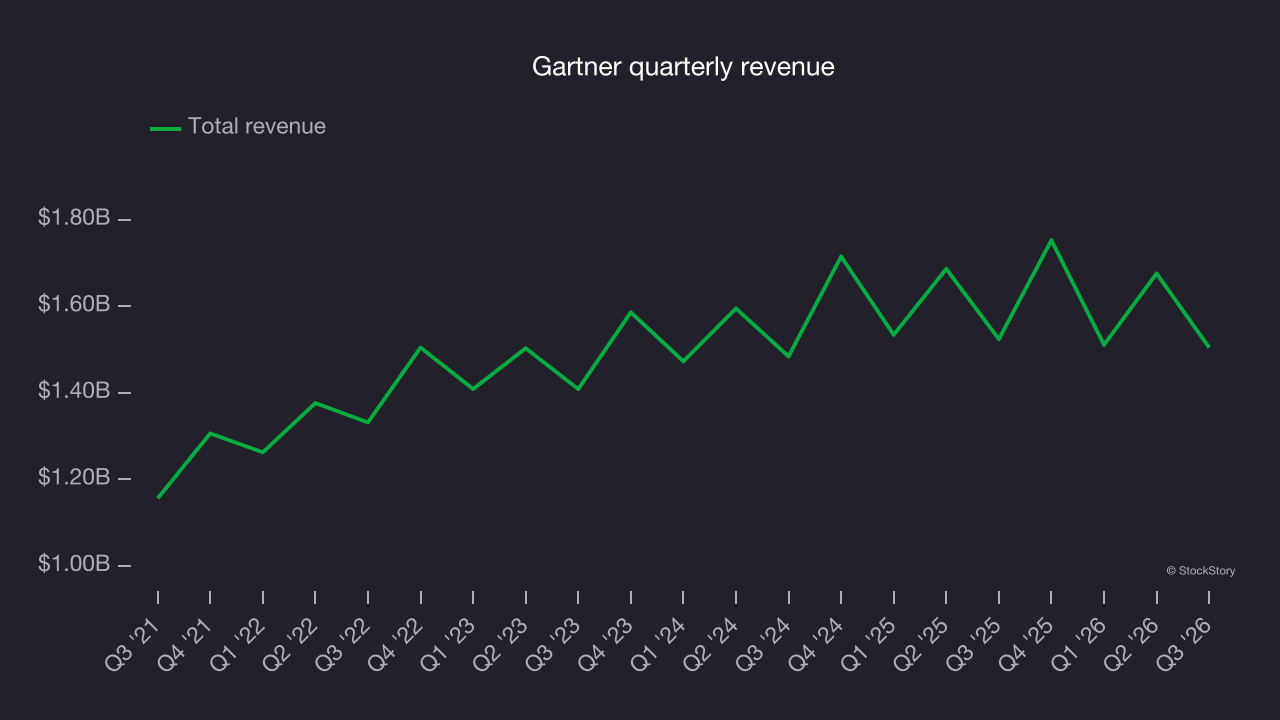
Long-term growth is the most important, but within business services, a half-decade historical view may miss new innovations or demand cycles. Gartner’s recent performance shows its demand has slowed as its annualized revenue growth of 2.5% over the last two years was below its five-year trend. Decelerating revenue growth in the sector warrants caution, as it could signal changing consumer tastes aided by low switching costs. 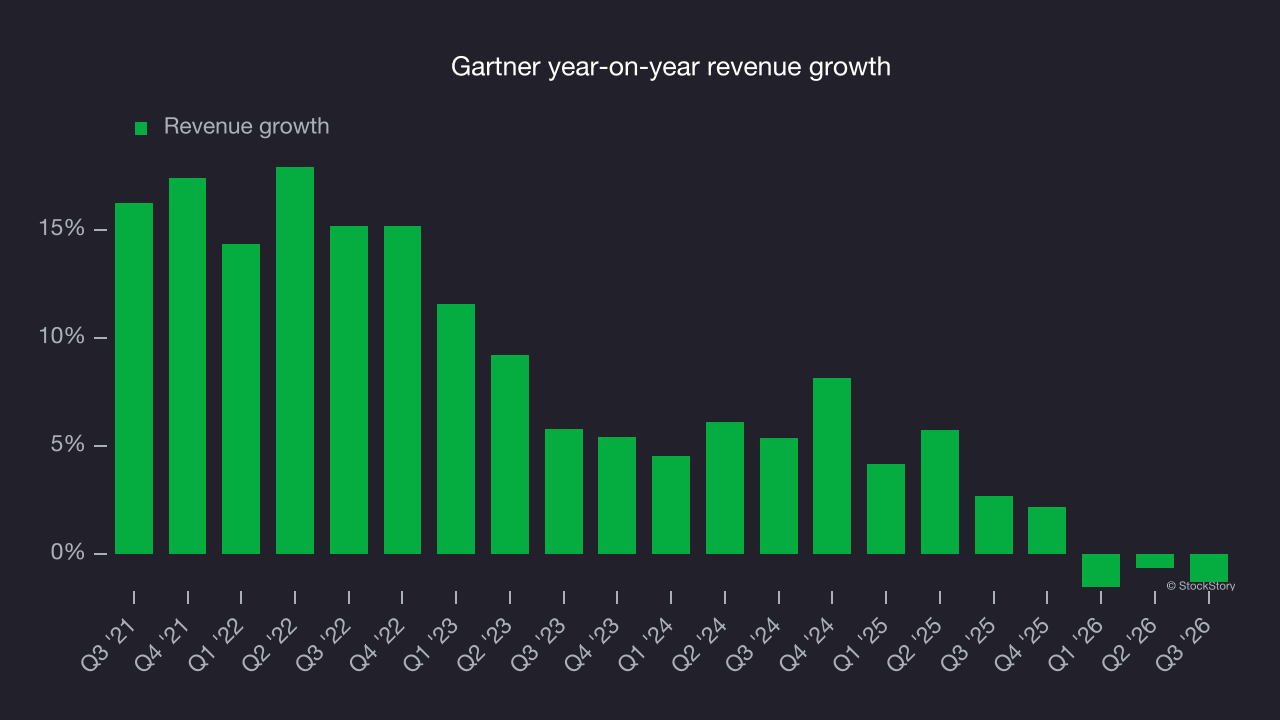
Gartner also reports revenue performance excluding currency movements, which are outside the company’s control and not indicative of demand. Over the last two years, its constant currency revenue averaged 2.6% year-on-year growth. This was in line with reported revenue growth, indicating that foreign exchange has not had a meaningful impact on revenue. 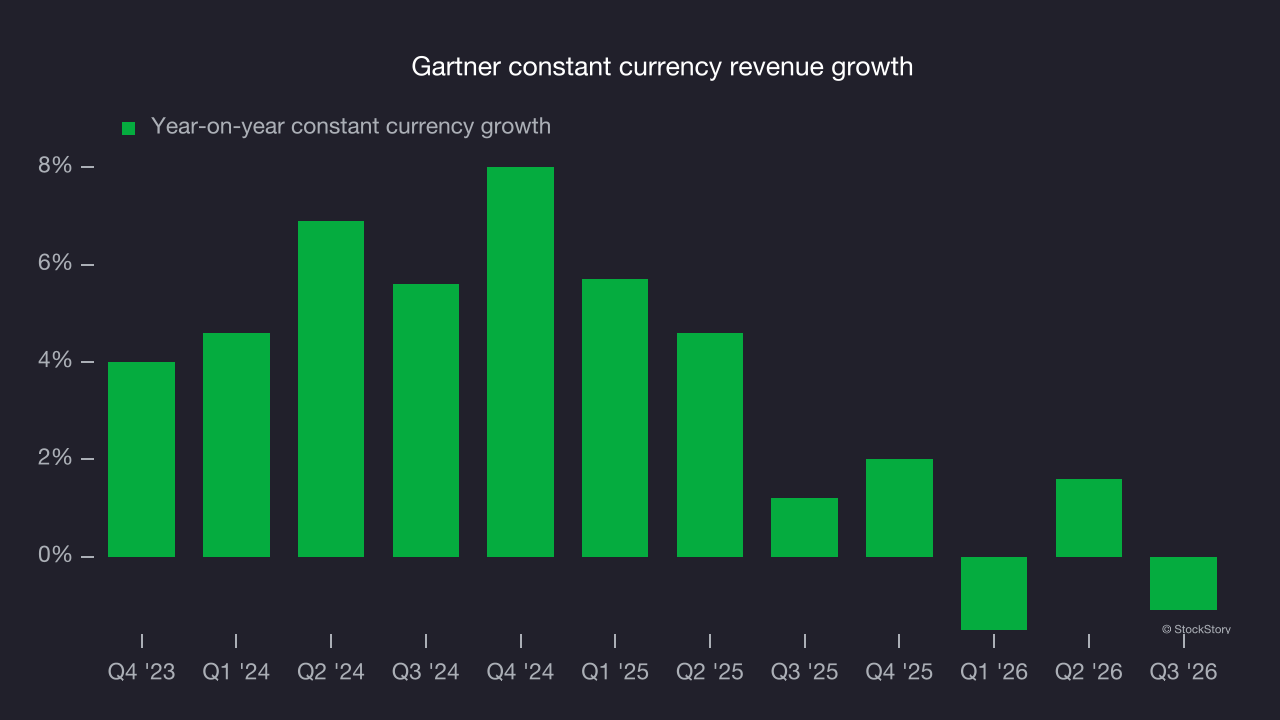
This quarter, Gartner’s revenue fell by 1.3% year on year to $1.50 billion but beat Wall Street’s consensus estimates by 1.2%.
Looking ahead, sell-side analysts expect revenue to grow 2.3% over the next 12 months, according to S&P, similar to its two-year rate. This projection is underwhelming and implies its newer products and services will not drive better revenue performance yet. Still, the company is performing well on other measures of financial health.
Adjusted operating margin
Gartner has operated efficiently over the last five years. It demonstrated high profitability for a business services company, with an average adjusted operating margin of 19%.
Looking at the trend in its profitability, Gartner’s adjusted operating margin rose by 2.9 percentage points over the last five years, as its revenue growth provided operating leverage.
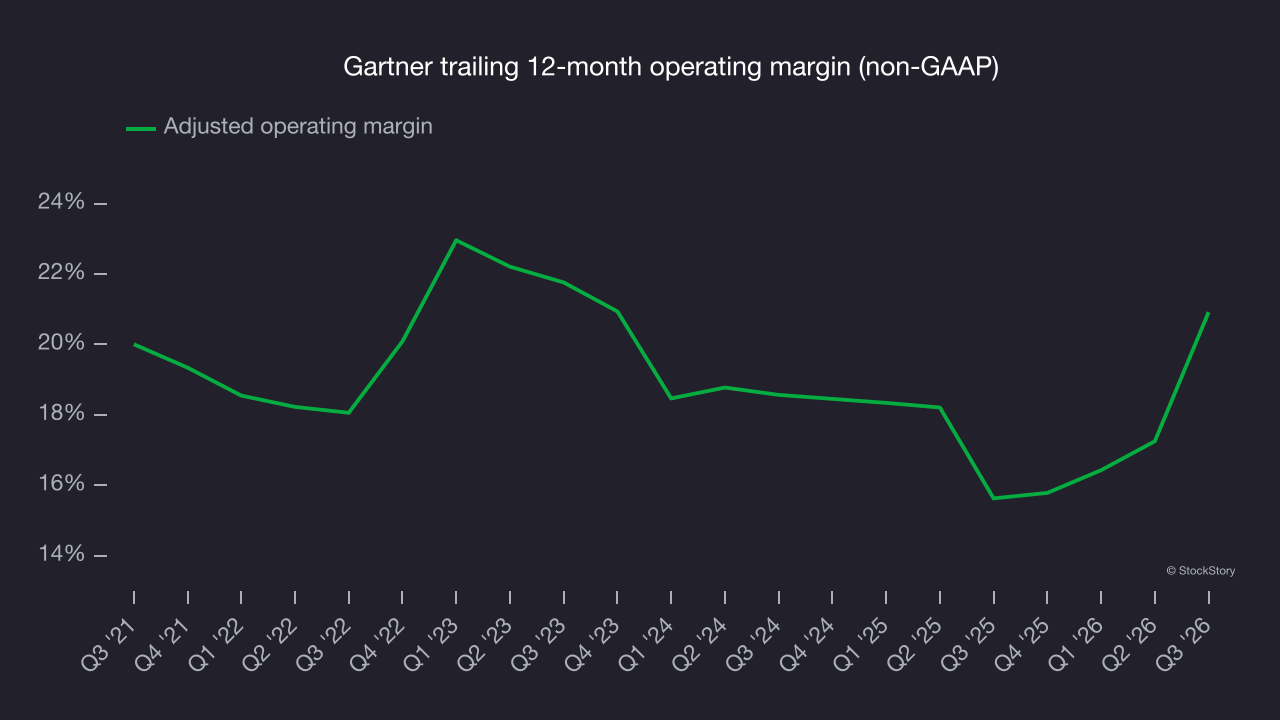
In Q3, Gartner reported an adjusted operating margin of 21.2%, up 15.5 percentage points year on year. This increase was a positive development, especially since its revenue fell, showing it became more efficient by reducing expenses.
Earnings per share
We track the long-term change in earnings per share (EPS) for the same reason as long-term revenue growth. Compared to revenue, however, EPS highlights whether a company’s growth is profitable.
Gartner’s EPS grew at a 14.1% compounded annual growth rate over the last five years, higher than its 7.3% annualized revenue growth. This indicates the company became more profitable on a per-share basis as it expanded.
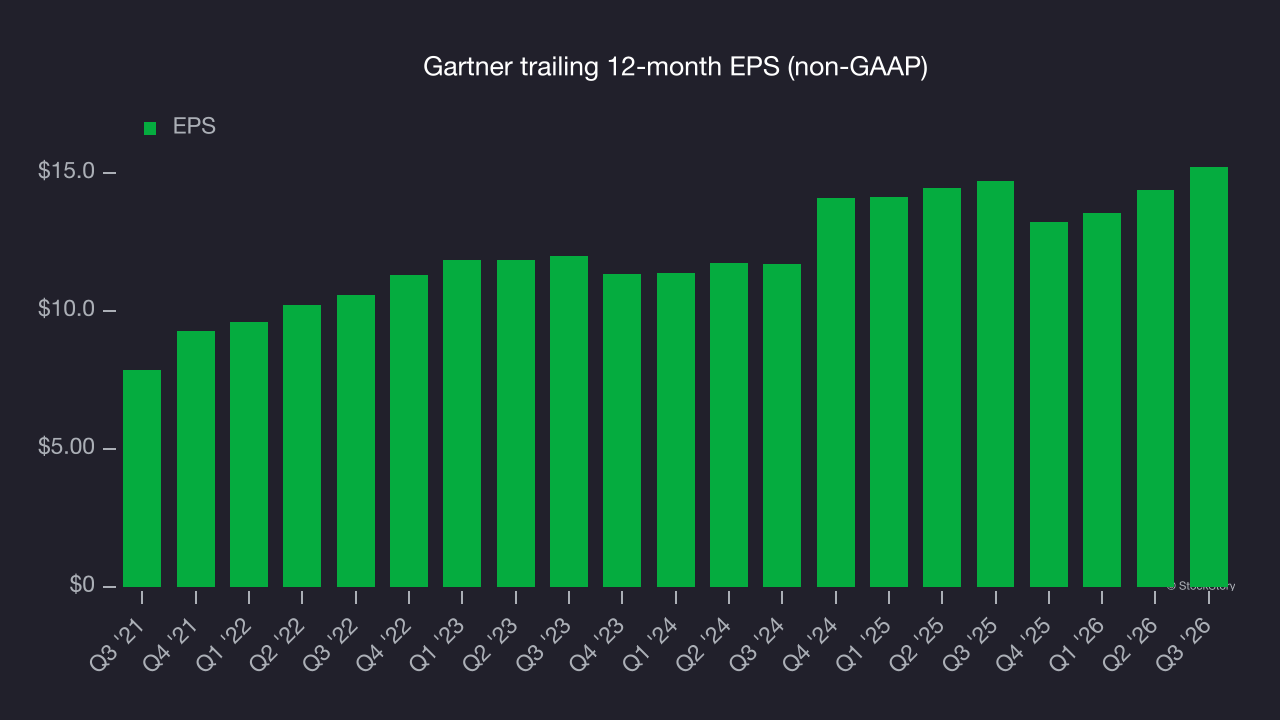
A closer look at Gartner’s earnings helps explain the drivers of its performance. As mentioned earlier, Gartner’s adjusted operating margin expanded by 2.9 percentage points over the last five years. On top of that, its share count shrank by 24.6%. These are positive signs for shareholders because improving profitability and share buybacks boost EPS growth relative to revenue growth. 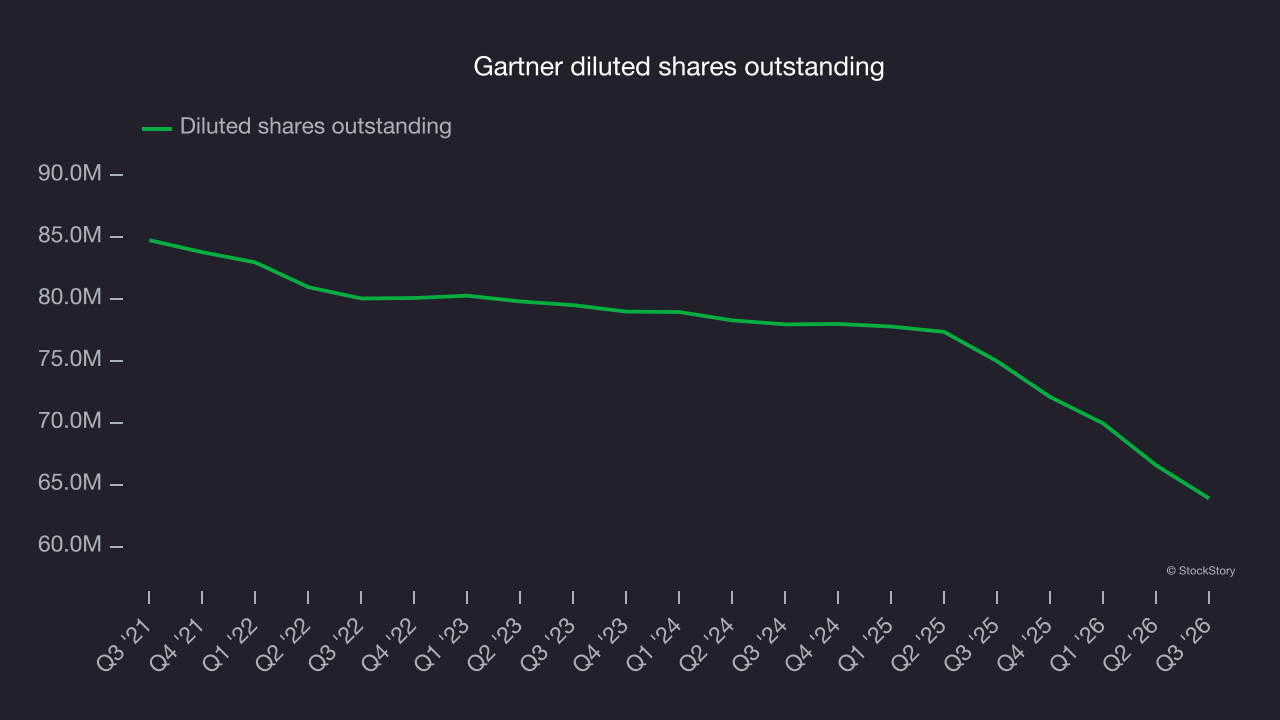
Like with revenue, we analyze EPS over a shorter period to see if we are missing a change in the business.
For Gartner, its two-year annual EPS growth of 14.1% is similar to its five-year trend, implying strong and stable earnings power.
In Q3, Gartner reported adjusted EPS of $3.59, up from $2.76 in the same quarter last year. This easily cleared analysts’ consensus estimates, a positive result for shareholders. Over the next 12 months, Wall Street expects Gartner’s full-year EPS to grow 4.7% from $15.22 to $15.94, according to S&P.
Key takeaways from Gartner’s Q3 results
Gartner delivered a solid quarter, topping analysts’ consensus EPS estimates and narrowly beating Wall Street’s revenue expectations. Shares remained flat at $237.44 immediately after the results.
Gartner had a solid quarter, but that alone does not determine whether the stock is a buy. What happened in the latest quarter matters, but not as much as longer-term business quality and valuation when deciding whether to invest. For more on Gartner, read our full research report here (it’s free).