

Cloud observability platform Dynatrace (NYSE:DT) reported calendar Q3 2026 (fiscal Q2 2027) results topping the market’s revenue expectations, with revenue up 17.4% year on year to $579.9 million. Revenue guidance for fiscal Q3 2027 was better than expected at $593.5 million at the midpoint, 0.7% above analysts’ consensus estimates. Its non-GAAP profit of $0.54 per share was 9.9% above analysts’ consensus estimates.
For more on Dynatrace, read our free full research report.
Dynatrace (DT) Q3 CY2026 highlights:
- Revenue $579.9 million vs S&P analysts’ consensus estimates of $568.3 million (17.4% year-on-year growth, 2% beat)
- Adjusted EPS $0.54 vs S&P analysts’ consensus estimates of $0.49 (9.9% beat)
- Adjusted operating income $184.3 million vs analysts’ consensus estimates of $168.8 million (31.8% margin, 9.2% beat)
- Revenue guidance The company slightly lifted its revenue guidance for the full year to $2.34 billion at the midpoint from $2.31 billion
- Adjusted EPS guidance Management lowered its full-year adjusted EPS guidance to $1.89 at the midpoint, a 4.5% decrease
- Operating margin 16.5%, up from 14.8% in the same quarter last year
- Free cash flow margin 7.3%, down from 54.7% in the previous quarter
- Annual recurring revenue $2.21 billion vs analysts’ consensus estimates of $2.20 billion (16.2% year-on-year growth, in line)
- Billings $526.6 million at quarter end, up 39.5% year on year
- Market capitalization $15.93 billion
“Our Q2 results reflect continued top-line growth and strong operational efficiency,” said Rick McConnell, Chief Executive Officer, Dynatrace. “As organizations increasingly deploy AI agents into production, the need for enterprise-grade observability and governance has never been greater. By bringing Arize together with the Dynatrace platform, we are extending our end-to-end capabilities across the AI lifecycle, from development through production, giving customers greater control over model reliability, application performance, and business outcomes.”
Revenue growth
Reviewing a company’s long-term revenue performance reveals insights into its quality. Any business can post a good quarter or two, but many enduring ones grow for years. Dynatrace’s 21.8% annualized revenue growth over the last five years was decent. Its growth was slightly above the average software company and shows its offerings resonate with customers.
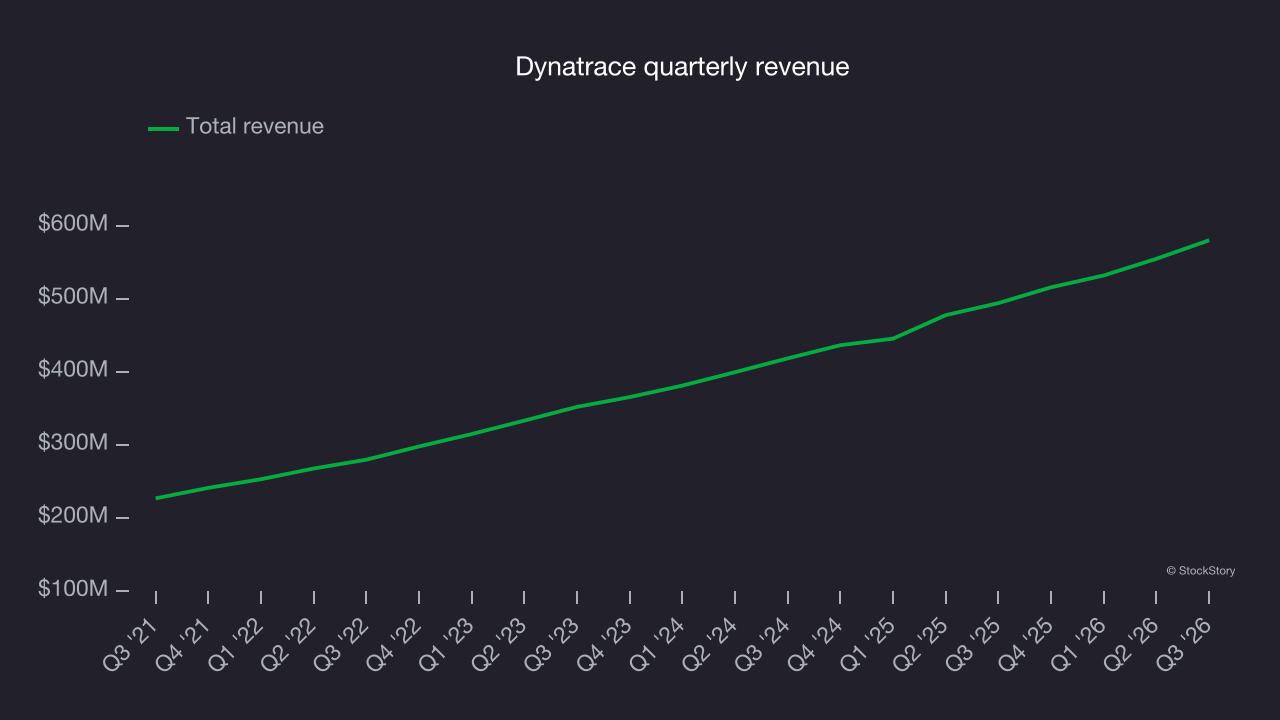
Long-term growth is the most important, but within software, a half-decade historical view may miss new innovations or demand cycles. Dynatrace’s annualized revenue growth of 18.1% over the last two years is below its five-year trend, but the results were still good. 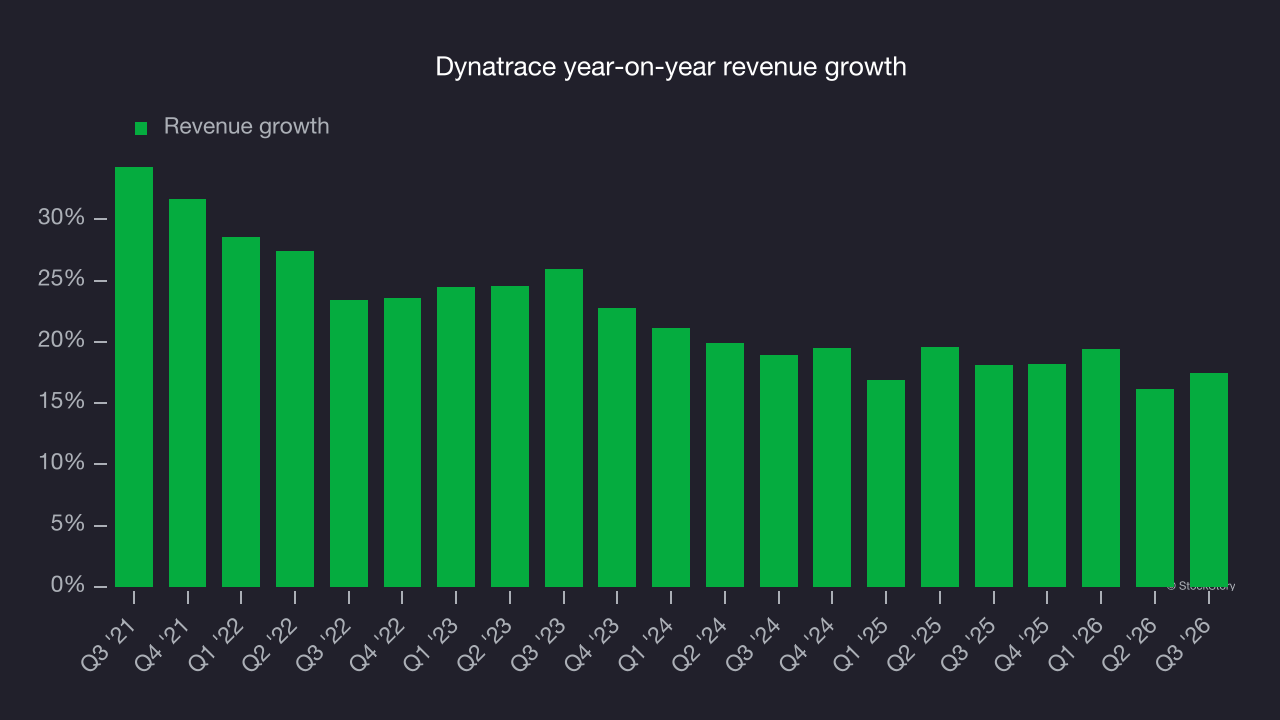
This quarter, Dynatrace reported year-on-year revenue growth of 17.4%, and its $579.9 million in revenue exceeded Wall Street’s consensus estimates by 2%. Management is guiding for a 15.1% year-on-year increase in revenue next quarter.
Looking further ahead, sell-side analysts expect revenue to grow 14.2% over the next 12 months, according to S&P, a deceleration versus the last two years. This underwhelming projection implies its products and services will face some demand challenges. Still, the company is tracking well in other measures of financial health.
Annual recurring revenue
While reported revenue for a software company can include low-margin items like implementation fees, annual recurring revenue, or ARR, is the sum of the next 12 months of contracted revenue purely from software subscriptions, or the high-margin, predictable revenue streams that make software-as-a-service businesses valuable.
Dynatrace’s ARR reached $2.21 billion in Q3, and over the last four quarters, its growth was solid, averaging 17.9% year on year. This performance aligned with its total revenue growth, reflecting the company’s ability to maintain strong customer relationships and secure longer-term commitments. Its growth also supports Dynatrace’s predictability and valuation, as investors typically prefer businesses with recurring revenue. 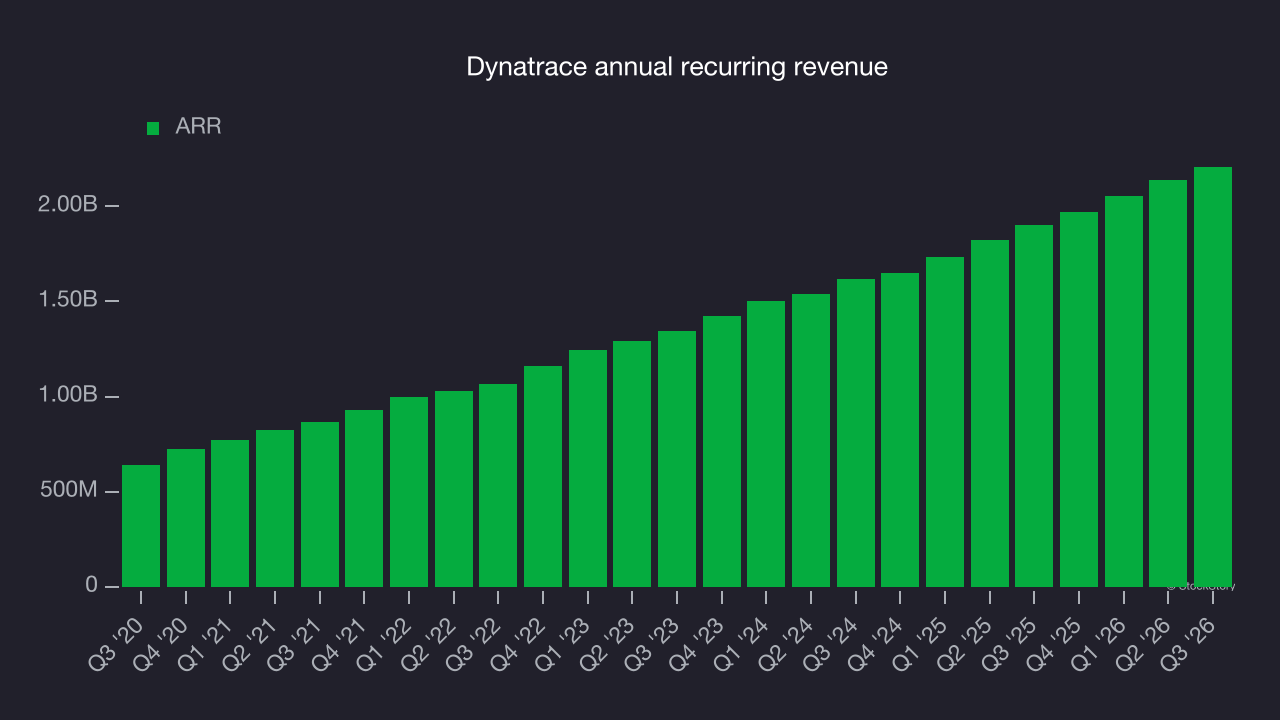
Customer acquisition efficiency
The customer acquisition cost, or CAC, payback period represents the months required to recover the cost of acquiring a new customer. Essentially, it’s the break-even point for sales and marketing investments. A shorter CAC payback period is ideal, as it implies better returns on investment and business scalability.
Dynatrace is efficient at acquiring new customers, and its CAC payback period was 31.1 months this quarter. The company’s rapid recovery of its customer acquisition costs indicates it has a strong brand reputation, giving it more resources to pursue new product initiatives while maintaining the flexibility to increase its sales and marketing investments. 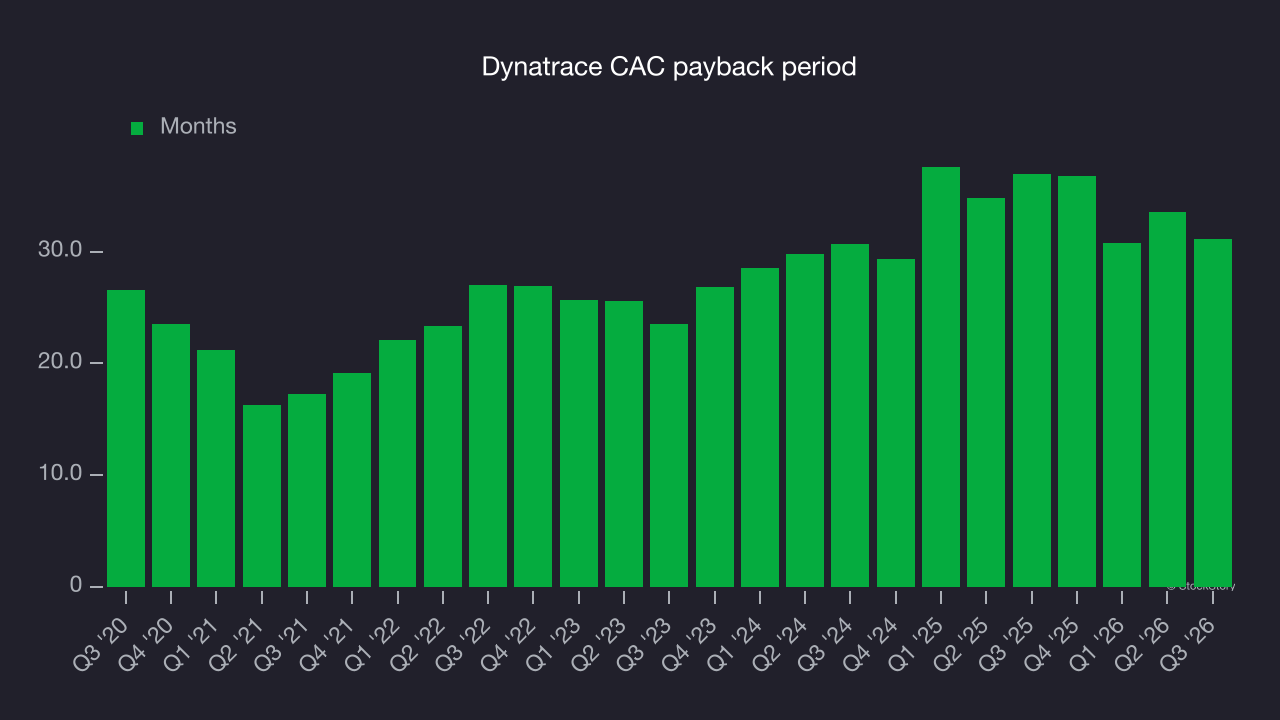
Key takeaways from Dynatrace’s Q3 results
Large beats on billings and adjusted operating income gave Dynatrace’s Q3 some key positives, but its outlook left the quarter mixed overall. Billings topped analysts’ consensus estimates by a wide margin, as did adjusted operating income against Wall Street’s consensus. However, EPS guidance for next quarter missed estimates, and the full-year EPS outlook fell slightly short of Wall Street’s consensus. The market appeared to be hoping for more: shares plunged 15.6% to $46.13 immediately after the results.
The latest quarter is only one piece of the longer-term business quality puzzle. Quality, combined with valuation, can help determine whether the stock is a buy. Read our full research report here (it’s free).