

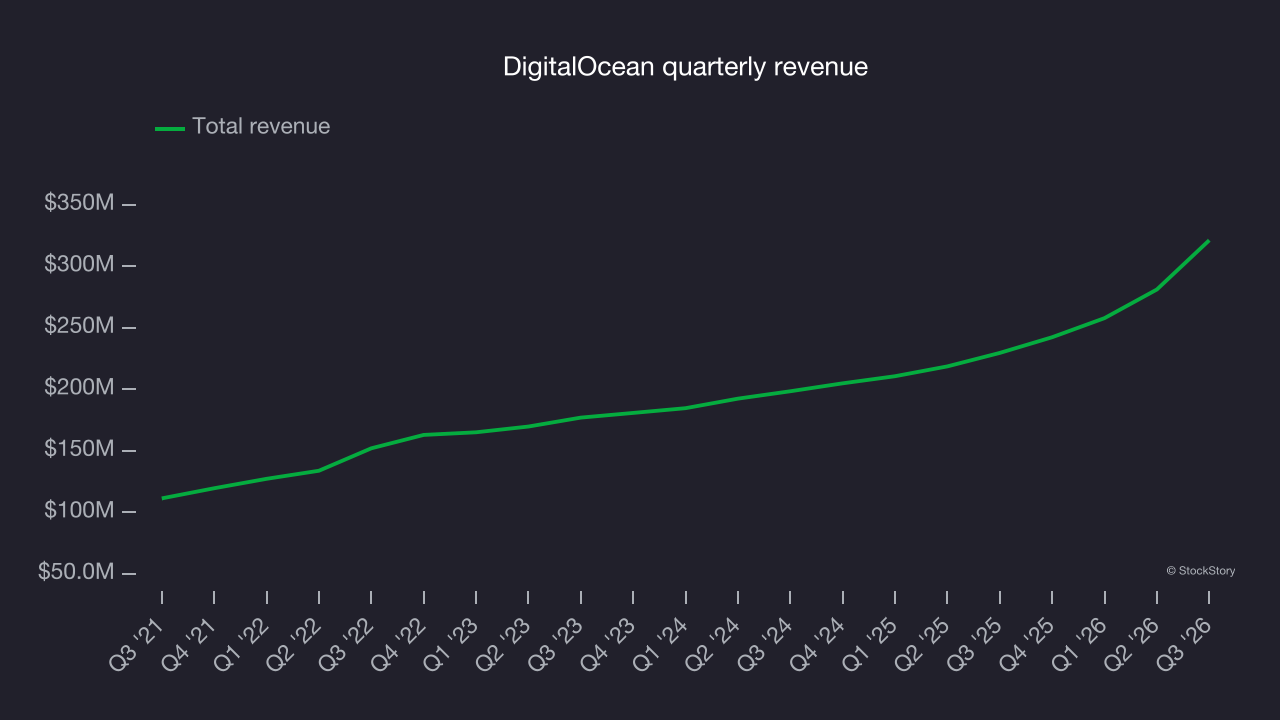
Cloud computing platform DigitalOcean (NYSE:DOCN) reported Q3 2026 results topping the market’s revenue expectations, with revenue up 39.9% year on year to $321.2 million. In addition, next quarter’s revenue guidance ($349.5 million at the midpoint) was unexpectedly strong at 5.2% above analysts’ consensus estimates. Its non-GAAP profit of $0.45 per share was 41.8% above analysts’ consensus estimates.
For more on DigitalOcean, read our free full research report.
DigitalOcean (DOCN) Q3 2026 highlights:
- Revenue $321.2 million vs S&P analysts’ consensus estimates of $306.5 million (39.9% year-on-year growth, 4.8% beat)
- Adjusted EPS $0.45 vs S&P analysts’ consensus estimates of $0.32 (41.8% beat)
- Adjusted EBITDA $144.2 million vs analysts’ consensus estimates of $118.2 million (44.9% margin, 22% beat)
- Revenue guidance $349.5 million at the midpoint for Q4 2026, above analysts’ consensus estimates of $332.2 million
- Adjusted EPS guidance Management raised its full-year adjusted EPS guidance to $1.61 at the midpoint, a 17.1% increase
- Operating margin 10.3%, down from 19.6% in the same quarter last year
- Free cash flow margin 0%, down from 21.5% in the previous quarter
- Annual recurring revenue $1.29 billion (39.8% year-on-year growth, beat)
- Billings $320.9 million at quarter end, an increase of 41.4% year on year
- Market capitalization $10.56 billion
“Revenue growth accelerated year-over-year to 40%, our fifth consecutive quarter of acceleration, and we added a record $160 million of ARR,” said Paddy Srinivasan, CEO of DigitalOcean. “The center of gravity in AI has shifted from people chatting with models to agents doing work, and agents need a different kind of cloud: one where inference, agent runtime, data, and learning operate as a single loop to enable agents to recursively self improve. We built that cloud, and the most sophisticated AI natives are building on it. Customers spending over $100,000 a year now represent 41% of our revenue, and they are not renting capacity; they are adopting the platform. Inference Engine token volume grew roughly 10x quarter-over-quarter and we launched Managed Agents, Agent Learning Services, and Agent Data Services to complete the loop. We are different by design with a unique platform, durable and profitable growth, a diverse customer base, 2026 capacity delivered on or ahead of schedule and 20 incremental megawatts secured for 2028, and a flexible balance sheet. We continue to accelerate and are raising our outlook again: we now expect Q4 2026 revenue growth of 44-45% and to deliver 60%+ revenue growth for full year 2027.”
Revenue growth
A company’s long-term revenue performance can indicate its overall quality. Any business can have short-term success, but a top-tier one grows for years. DigitalOcean’s revenue grew at a solid 22.7% compounded annual growth rate over the last five years. Its growth beat the average software company and shows its offerings resonate with customers.
Long-term growth is the most important, but within software, a half-decade historical view may miss new innovations or demand cycles. DigitalOcean’s annualized revenue growth of 20.7% over the last two years is below its five-year trend, but the results still suggest healthy demand. 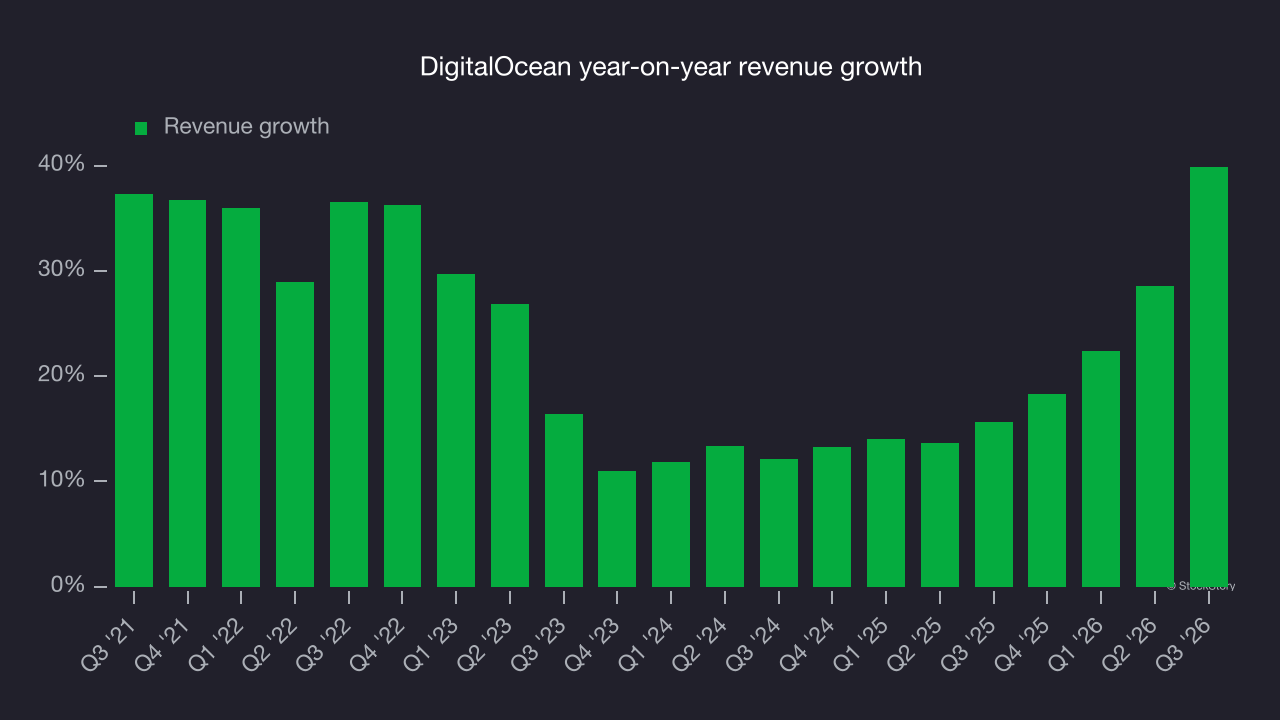
This quarter, DigitalOcean reported strong year-on-year revenue growth of 39.9%, and its $321.2 million of revenue exceeded Wall Street’s consensus estimates by 4.8%. Management is guiding for a 44.2% year-on-year increase in revenue next quarter.
Looking further ahead, sell-side analysts expect revenue to grow 45.1% over the next 12 months, according to S&P, an improvement versus the last two years. This strong projection indicates its newer products and services will drive faster revenue growth.
Annual recurring revenue
While reported revenue for a software company can include low-margin items like implementation fees, annual recurring revenue, or ARR, is the sum of the next 12 months of contracted revenue purely from software subscriptions, the high-margin, predictable revenue streams that contribute to the value of software-as-a-service businesses.
DigitalOcean’s ARR reached $1.29 billion in Q3, and its growth over the last four quarters was strong, averaging 27.3% year-on-year increases. This performance aligned with its total revenue growth and shows that customers are willing to make multiyear commitments to the company’s technology. Its growth also makes DigitalOcean a more predictable business, supporting its valuation as investors typically prefer businesses with recurring revenue. 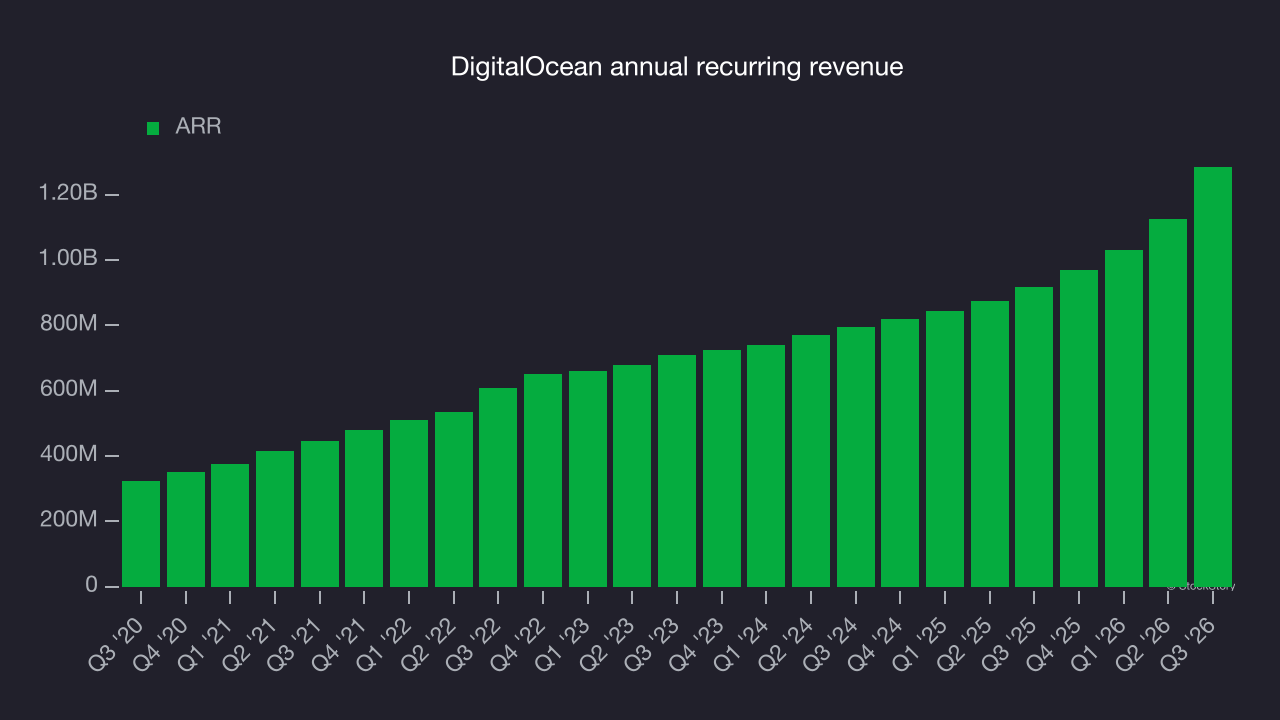
Customer acquisition efficiency
The customer acquisition cost, or CAC, payback period measures the months a company needs to recoup the money spent on acquiring a new customer. This metric helps assess how quickly a business can break even on its sales and marketing investments.
DigitalOcean is highly efficient at acquiring new customers, and its CAC payback period was 6.2 months this quarter. The company’s rapid sales cycles stem from its strong brand reputation and self-serve model, where it can onboard many small customers with little to no oversight. These dynamics give DigitalOcean more resources to pursue new product initiatives so it can potentially move upmarket and serve enterprise clients, which can provide a second leg of growth. 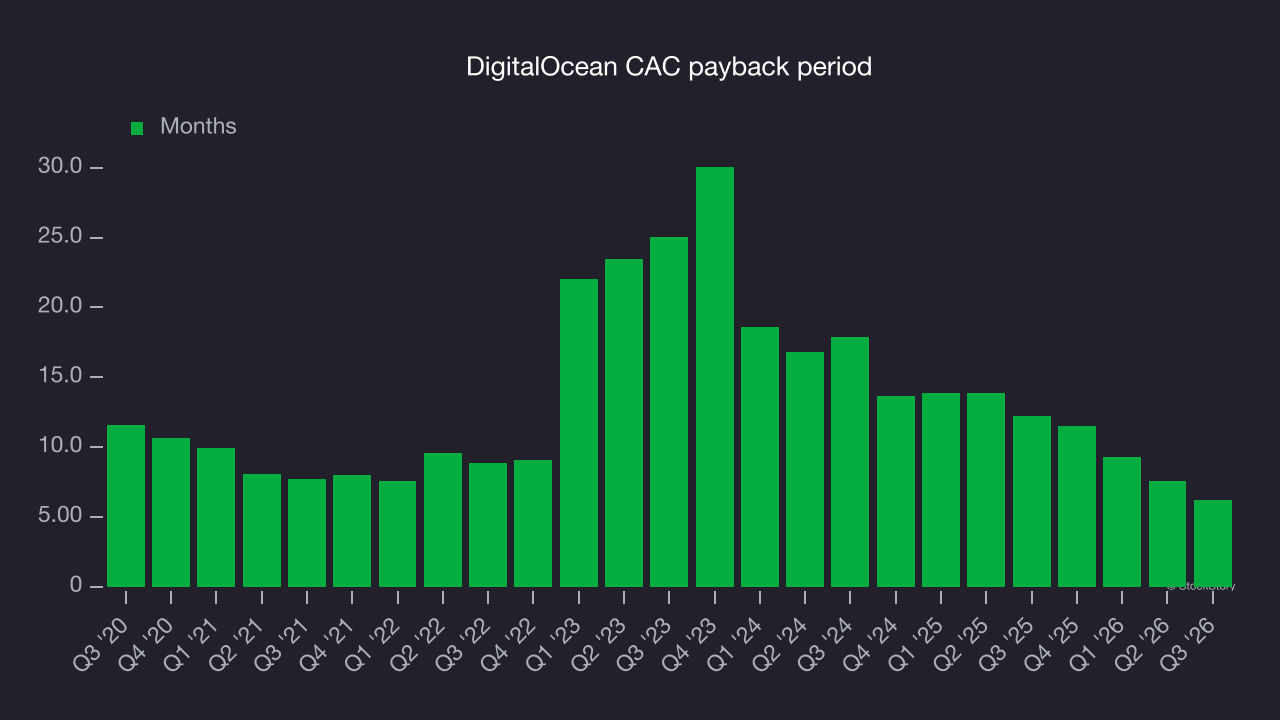
Key takeaways from DigitalOcean’s Q3 results
DigitalOcean delivered a solid Q3, with annual recurring revenue and billings both beating consensus estimates by wide margins. Shares remained flat at $90.56 immediately after the results.
DigitalOcean may have had a good quarter, but that alone doesn’t make the stock a buy. The investment decision also calls for a broader look at valuation and business quality alongside the latest earnings. For more on DigitalOcean, read our full research report here (it’s free).