

Mineral and royalty company Viper Energy (NASDAQ:VNOM) beat Wall Street’s revenue expectations in Q3 2026, with revenue up 58.1% year on year to $661 million. Its GAAP profit of $0.72 per share was 4.9% above analysts’ consensus estimates.
For more on Viper Energy, read the full research report for free.
Viper Energy (VNOM) Q3 2026 highlights:
- Revenue $661 million vs S&P analysts’ consensus estimates of $635.7 million (58.1% year-on-year growth, 4% beat)
- EPS (GAAP) $0.72 vs analysts’ consensus estimates of $0.69 (4.9% beat)
- Adjusted EBITDA $596 million vs analysts’ consensus estimates of $578 million (90.2% margin, 3.1% beat)
- Operating margin 60.4%, up from -42.1% in the same quarter last year
- Free cash flow $520 million, up from -$816 million in the same quarter last year
- Oil production rose 23.2% year on year
- Market capitalization $9.27 billion
“Viper’s momentum carried through the third quarter, with average daily oil production growing more than six percent quarter over quarter on the strength of recent acquisitions and continued development activity from both Diamondback and our third-party operators. Reflecting this continued momentum, we are again increasing our full year 2026 production guidance to 67,500 barrels of oil per day at the midpoint. The quarter also marked the first under our new return of capital framework, through which we declared our increased base dividend of $0.50 per Class A share while continuing to opportunistically repurchase shares,” said Kaes Van’t Hof, chief executive officer of Viper.
Revenue growth
A company’s long-term performance can give signals about its business quality. Even a bad business, especially in a cyclical industry, can perform well for a year or so, but a top-tier one should exhibit resilience through cycles. Viper Energy’s revenue grew at a strong 40.6% compounded annual growth rate over the last five years. Its growth surpassed the average energy upstream and integrated energy company and shows its offerings resonate with customers.
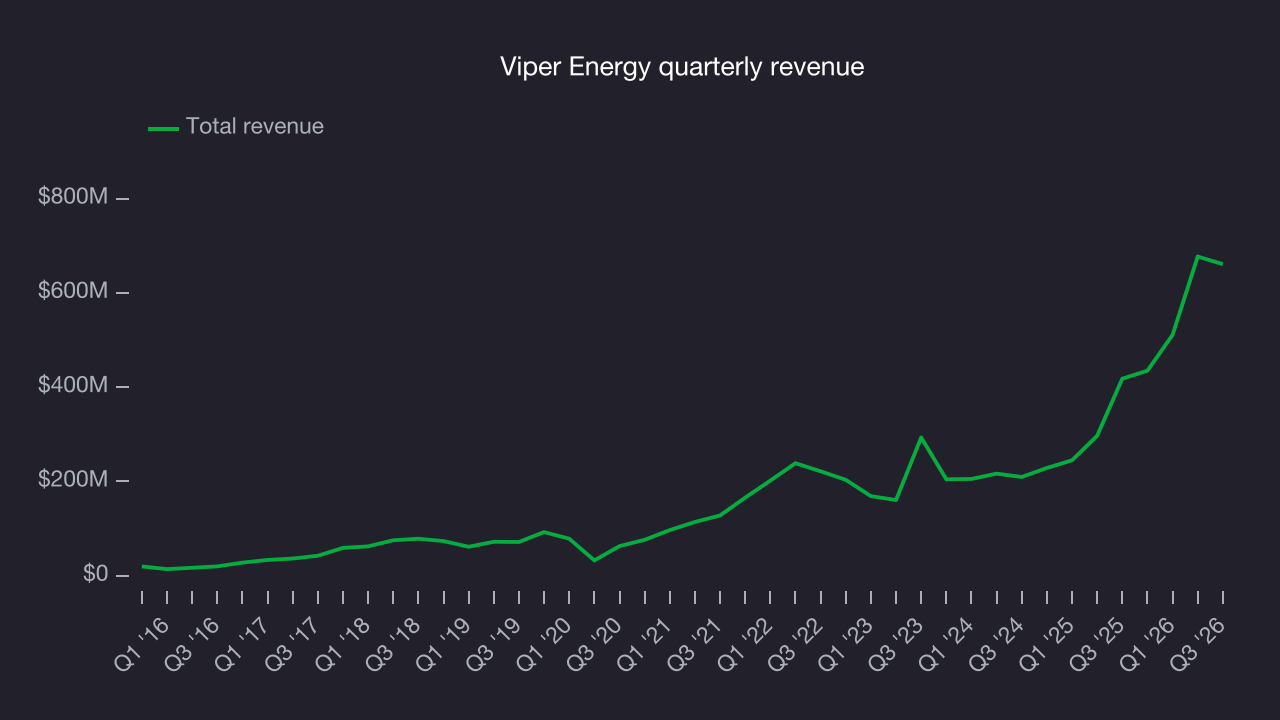
In energy, a single timeframe, even a long-term one, only sheds light on how well a company rode the last commodity cycle. To better assess whether a company compounds through cycles, an even longer, ten-year view helps validate that assessment. Viper Energy’s annualized revenue growth of 41.5% over the last ten years aligns with its five-year trend, suggesting its demand was predictably strong.
Revenue provides useful context, but it is heavily influenced by commodity prices and acquisitions. Production volumes, by contrast, reveal whether the underlying asset base is actually growing. Over the last two years, Viper Energy’s oil production averaged 64.9% year-on-year growth while its natural gas production averaged 91.4% year-on-year growth. 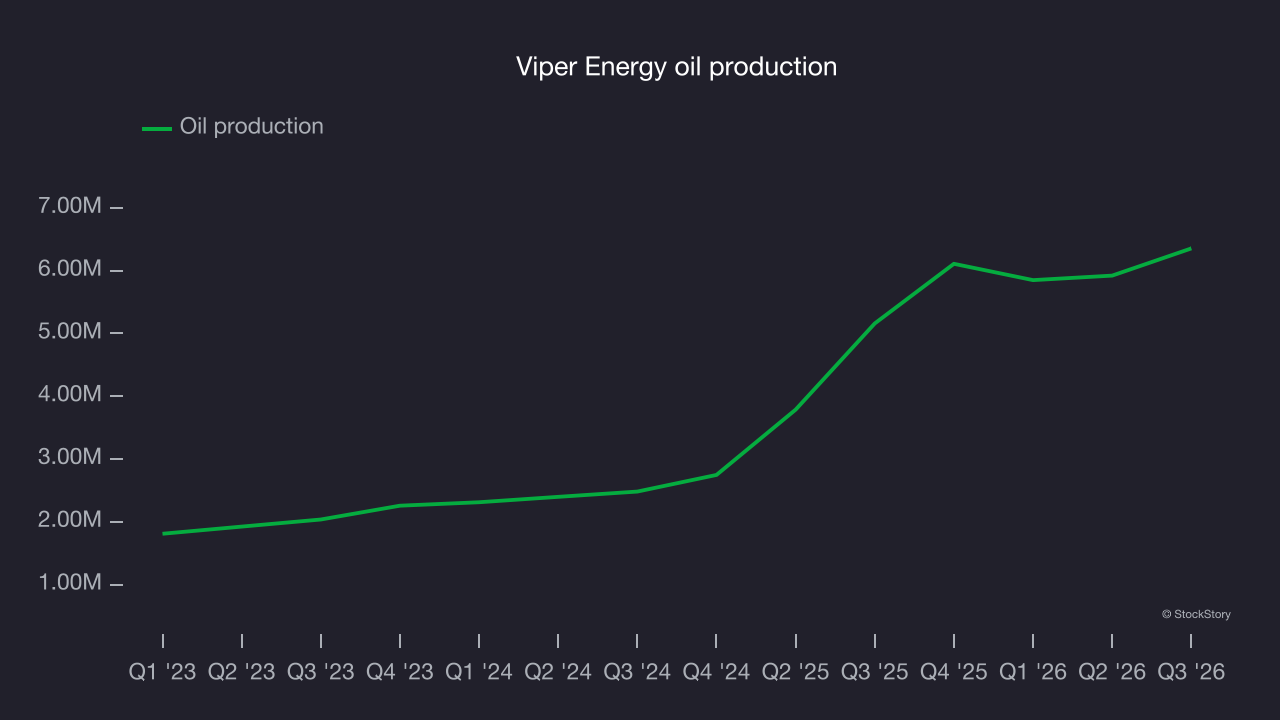
This quarter, Viper Energy reported year-on-year revenue growth of 58.1%, and its $661 million of revenue beat Wall Street’s consensus estimates by 4%. It also reported year-on-year oil production growth of 23.2%.
Adjusted EBITDA margin
Adjusted EBITDA margin is an important measure of profitability for the sector and accounts for the gross margins and operating costs mentioned previously. Unlike operating margin, it is not distorted by accounting conventions around reserves, drilling costs and assumptions on commodity consumption from the well or basin. Adjusted EBITDA highlights the economic reality of how much cash the rock produces before the capital structure (debt service) and the drilling budget (capex) are considered.
Viper Energy has performed well over the last five years. It demonstrated high profitability for an upstream and integrated energy business, with an average EBITDA margin of 92.2%.
Analyzing the trend in its profitability, Viper Energy’s EBITDA margin rose by 3.7 percentage points over the last year, as its revenue growth gave it operating leverage.
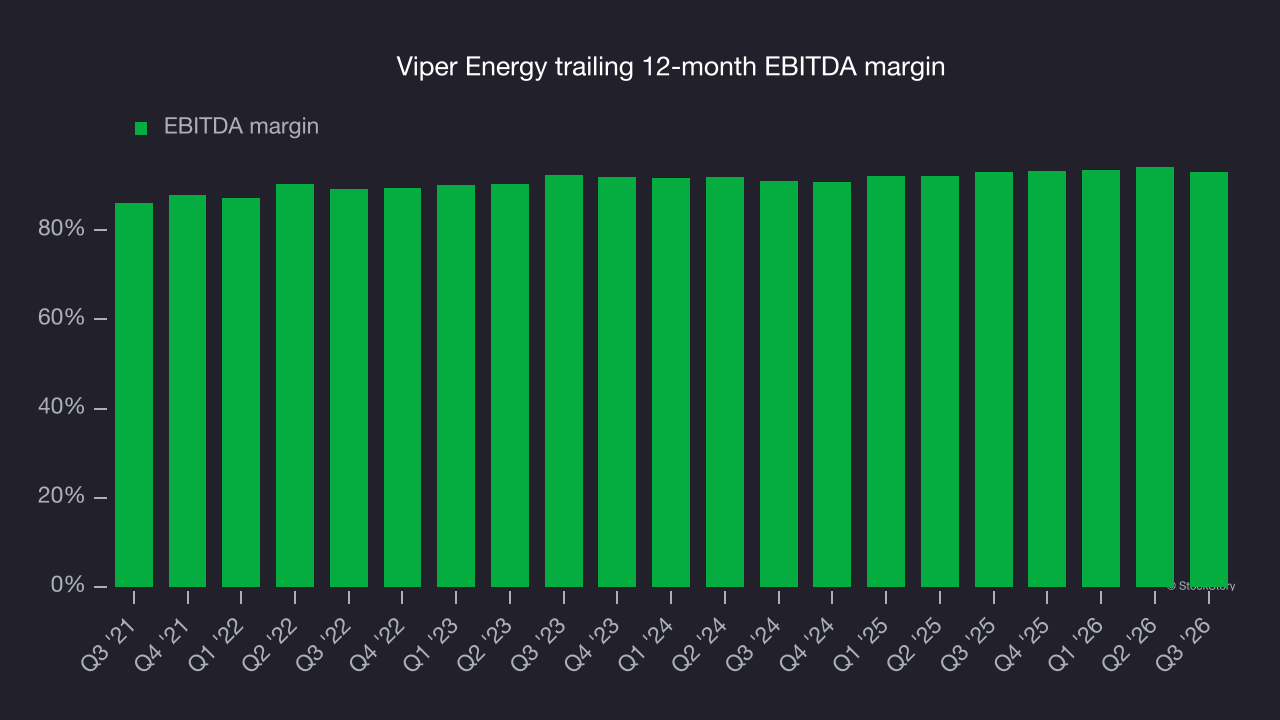
This quarter, Viper Energy generated an EBITDA margin of 90.2%, down 3.9 percentage points year on year. This contraction shows it was less efficient because its expenses grew faster than its revenue. This adjusted EBITDA beat Wall Street’s consensus estimates by 3.1%.
Free cash flow
Adjusted EBITDA shows how profitable a company’s existing “rock” is before financing and reinvestment, while free cash flow shows how much value remains after paying to replace those wells. Because production declines over time, strong EBITDA can coexist with weak free cash flow if drilling is expensive or declines are steep. Free cash flow therefore captures both operating efficiency and the cost of sustaining production.
Viper Energy has shown weak cash profitability relative to peers over the last five years, giving the company fewer opportunities to return capital to shareholders. Its free cash flow margin averaged 1.8%, below expectations for an upstream and integrated energy business.
The level of free cash flow is important, but its durability across cycles is just as critical. Consistent margins are far more valuable than volatile swings driven by commodity prices.
Viper Energy’s ratio of quarterly free cash flow volatility to West Texas Intermediate, or WTI, crude price volatility over the past five years was 446.3 (lower is better), indicating that its cash generation is far more sensitive to commodity-price swings than most peers. This elevated volatility limits its access to capital in downturns and makes it unlikely to act as a consolidator when weaker competitors come under pressure.
This stability analysis compares free cash flow with commodity prices rather than revenue or EBITDA with WTI crude prices. What ultimately matters is not how much revenue or profit a company earns when prices are high but how much cash it can generate when prices are low. Free cash flow is the superior metric because it includes everything from hedging effectiveness to growth and maintenance capex to management behavior during good times and bad.
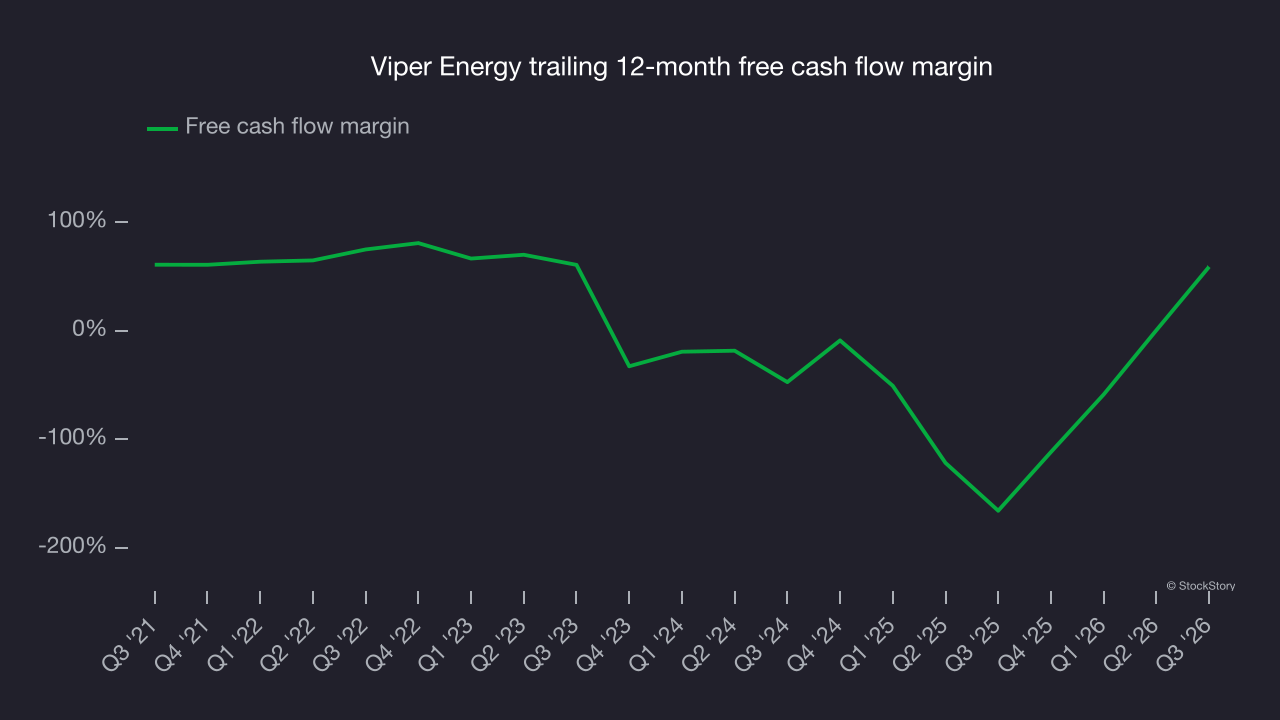
Viper Energy’s free cash flow totaled $520 million in Q3, equivalent to a 78.7% margin. Its cash flow turned positive after being negative in the same quarter last year. Its cash profitability was also above its five-year level.
Key takeaways from Viper Energy’s Q3 results
Viper Energy delivered a solid Q3, with revenue above analysts’ consensus estimates and EPS also topping Wall Street’s consensus. Those beats were key positives for the quarter. Shares remained flat at $45.72 immediately after the release.
Should you invest in Viper Energy? To make that decision, consider valuation and business quality, as well as the latest earnings. For more on those factors, read our full research report here (it’s free).