

Over the past six months, Samsara has been a great trade, beating the S&P 500 by 28%. Its stock price has climbed to $41.35, representing a healthy 35.1% increase. This was partly thanks to its solid quarterly results, and the run-up might have investors contemplating their next move.
Is now still a good time to buy IOT? Or are investors being too optimistic? Find out in our full research report, it’s free.
Why are we positive on IOT?
From sensors on vehicles to AI-powered cameras that help prevent accidents, Samsara (NYSE:IOT) is a cloud-based Internet of Things platform that helps businesses improve the safety, efficiency, and sustainability of their physical operations.
1. ARR surges as recurring revenue flows in
While reported revenue for a software company can include low-margin items like implementation fees, annual recurring revenue (ARR) is a sum of the next 12 months of contracted revenue purely from software subscriptions, or the high-margin, predictable revenue streams that make SaaS businesses so valuable.
Samsara’s ARR punched in at $2.12 billion in Q2, and over the last four quarters, its year-on-year growth averaged 29.5%. This performance was fantastic and shows that customers are willing to take multi-year bets on the company’s technology. Its growth also makes Samsara a more predictable business, a tailwind for its valuation as investors typically prefer businesses with recurring revenue. 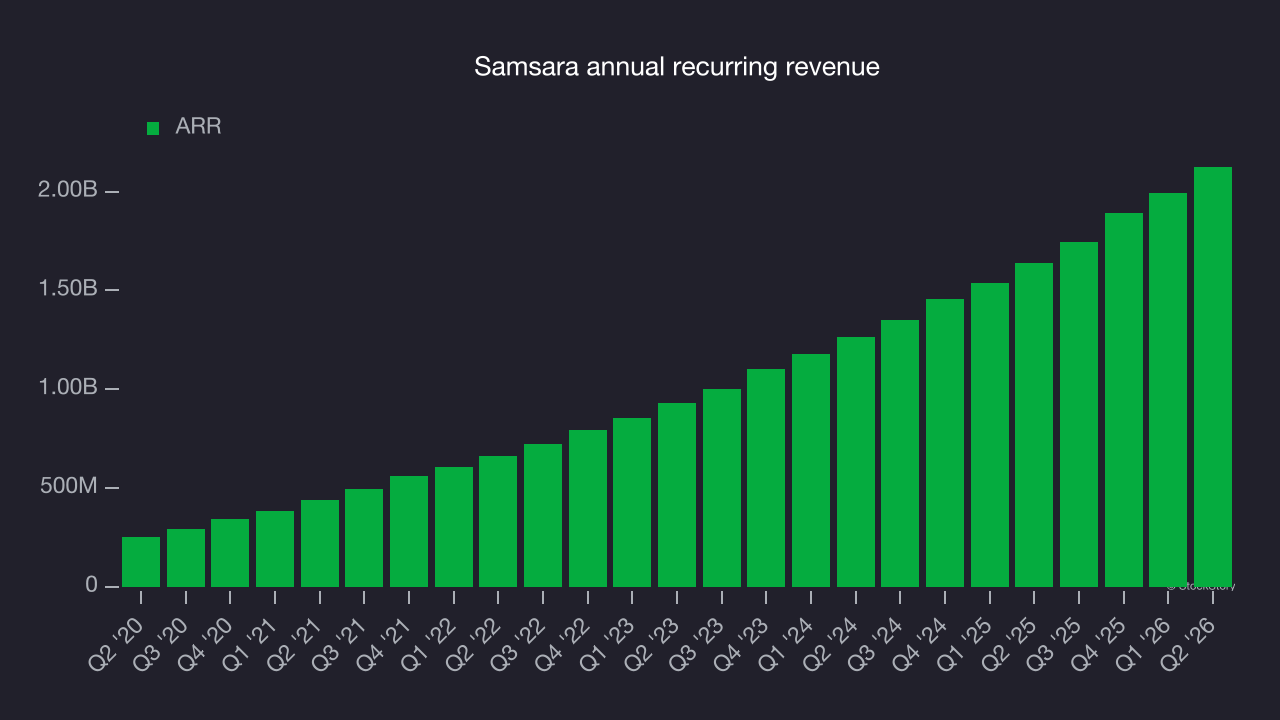
2. Projected revenue growth is remarkable
Forecasted revenues by Wall Street analysts signal a company’s potential. Predictions may not always be accurate, but accelerating growth typically boosts valuation multiples and stock prices while slowing growth does the opposite, though some deceleration is natural as businesses become larger.
Over the next 12 months, sell-side analysts expect Samsara’s revenue to rise by 20.9%, according to S&P. While this projection is below its 29.9% annualized growth rate for the past two years, it is admirable and indicates the market is forecasting success for its products and services.
3. Customer acquisition costs are recovered in record time
The customer acquisition cost (CAC) payback period measures the months a company needs to recoup the money spent on acquiring a new customer. This metric helps assess how quickly a business can break even on its sales and marketing investments.
Samsara is very efficient at acquiring new customers, and its CAC payback period checked in at 24.5 months this quarter. The company’s rapid recovery of its customer acquisition costs indicates it has a highly differentiated product offering and a strong brand reputation. These dynamics give Samsara more resources to pursue new product initiatives while maintaining the flexibility to increase its sales and marketing investments. 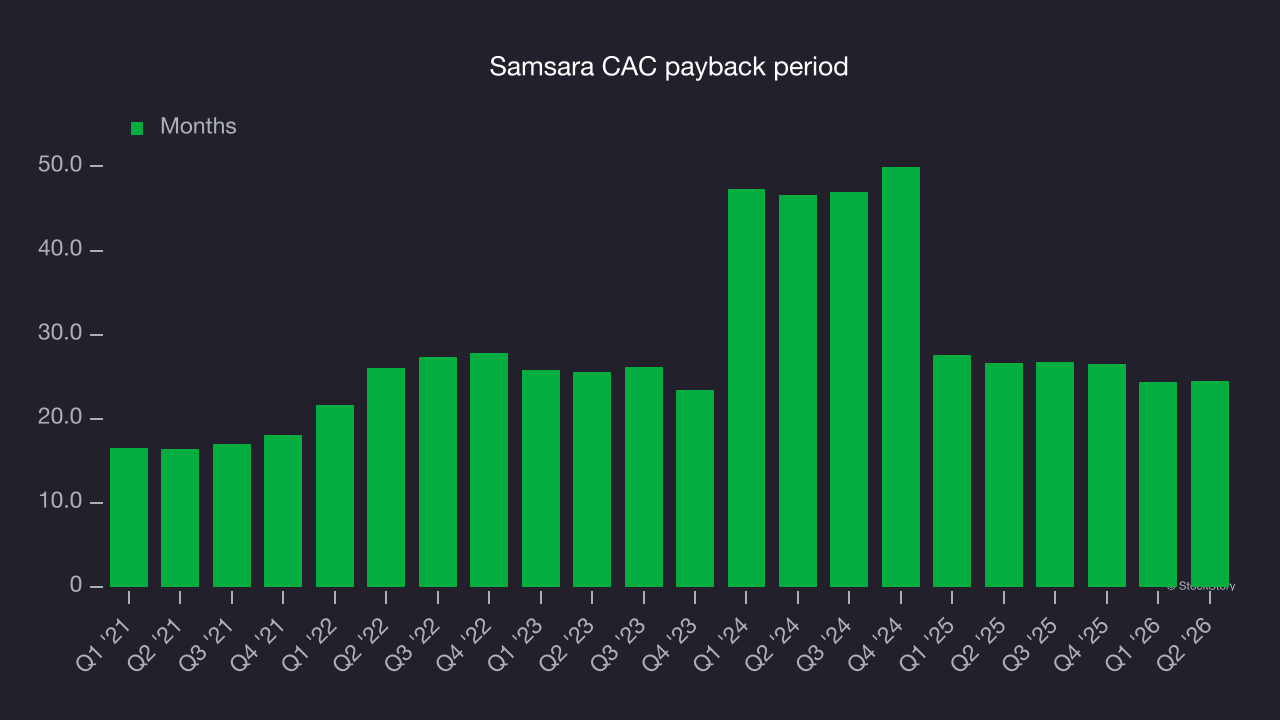
Final judgment
These are just a few reasons why Samsara is a cream-of-the-crop software company, and with its shares topping the market in recent months, the stock trades at 11× forward price-to-sales (or $41.35 per share). Is now the right time to buy? See for yourself in our in-depth research report, it’s free.
Stocks we like even more than Samsara
WHILE YOU’RE HERE: Top 9 Market-Beating Stocks. The best stocks don’t just beat the market once. They do it again. And again. Robust revenue growth, rising free cash flow, returns on capital that leave their competition in the dust. The market has already rewarded these businesses.
But our AI platform says the party isn’t over. Find out which 9 stocks made the cut this week — FREE. Get Our Top 9 Market-Beating Stocks for Free HERE.
Stocks that have made our list include now familiar names such as Nvidia (+1,460% between June 2020 and June 2025) as well as under-the-radar businesses like the once-small-cap company Exlservice (+271% between June 2020 and June 2025). Find your next big winner with StockStory today.