

Safety equipment manufacturer MSA Safety (NYSE:MSA) reported Q3 2026 results exceeding the market’s revenue expectations, with revenue up 14.5% year on year to $536.4 million. Its non-GAAP profit of $2.09 per share was in line with analysts’ consensus estimates.
For more on MSA Safety, read our free full research report.
MSA Safety (MSA) Q3 2026 highlights:
- Revenue $536.4 million vs S&P analysts’ consensus estimates of $532.9 million (14.5% year-on-year growth, 0.7% beat)
- Adjusted EPS $2.09 vs S&P analysts’ consensus estimates of $2.09 (in line)
- Adjusted EBITDA $130.7 million vs analysts’ consensus estimates of $129.1 million (24.4% margin, 1.3% beat)
- Operating margin 16.4%, down from 20.1% in the same quarter last year
- Free cash flow margin 12.7%, down from 21.5% in the same quarter last year
- Market capitalization $6.89 billion
"The MSA team continued to advance our Accelerate strategy in the third quarter, delivering 15% sales growth," said Steve Blanco, President and Chief Executive Officer of MSA Safety. "We executed several strategic objectives, including closing the acquisition of Autronica Fire and Security, launching the G1 City Edition SCBA, and continuing momentum in MSA+ connected safety, with an ALTAIR io 6 order that marked our largest MSA+ order to date. Together, these actions strengthen our safety technology portfolio, reinforce our market leadership, and enhance our ability to deliver sustainable long-term growth," Mr. Blanco added.
Revenue growth
Examining a company’s long-term performance can provide clues about its quality. Any business can put up a good quarter or two, but many enduring ones grow for years.
With $2.01 billion in revenue over the past 12 months, MSA Safety is a mid-sized business services company, which sometimes brings disadvantages compared to larger competitors benefiting from better economies of scale. On the positive side, it can still achieve high growth rates because it’s working from a smaller revenue base.
MSA Safety’s 7.9% annualized revenue growth over the last five years was solid. It shows demand for MSA Safety was stronger than for many business services companies.
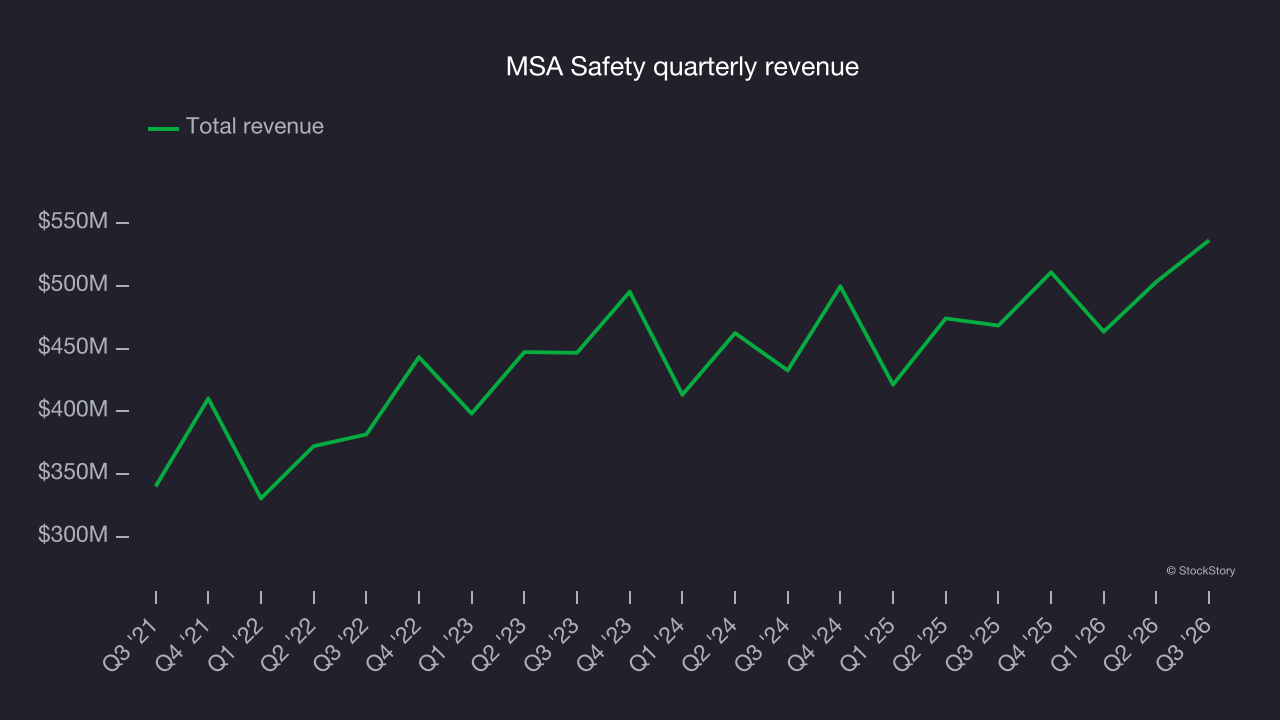
Long-term growth matters most, but within business services, a half-decade historical view may miss recent innovations or disruptive industry trends. MSA Safety’s annualized revenue growth of 5.7% over the last two years is below its five-year trend, but the results were still respectable. 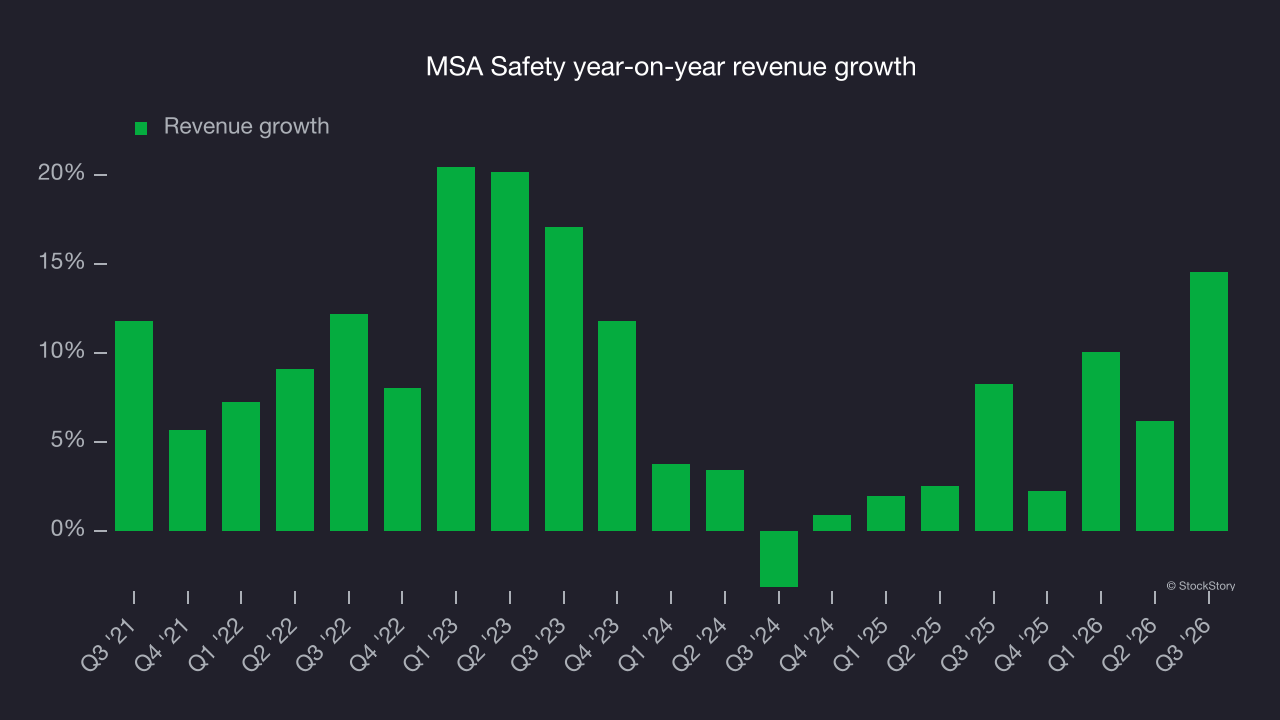
This quarter, MSA Safety reported year-on-year revenue growth of 14.5%, and its $536.4 million of revenue exceeded Wall Street’s consensus estimates by 0.7%.
Looking ahead, sell-side analysts expect revenue to grow 10.6% over the next 12 months, according to S&P, an improvement versus the last two years. This projection is strong and implies its newer products and services will drive better revenue performance.
Adjusted operating margin
MSA Safety has operated efficiently over the last five years. It demonstrated high profitability for a business services company, with an average adjusted operating margin of 21.6%.
Analyzing the trend in its profitability, MSA Safety’s adjusted operating margin rose by 1.8 percentage points over the last five years, as its revenue growth gave it operating leverage.
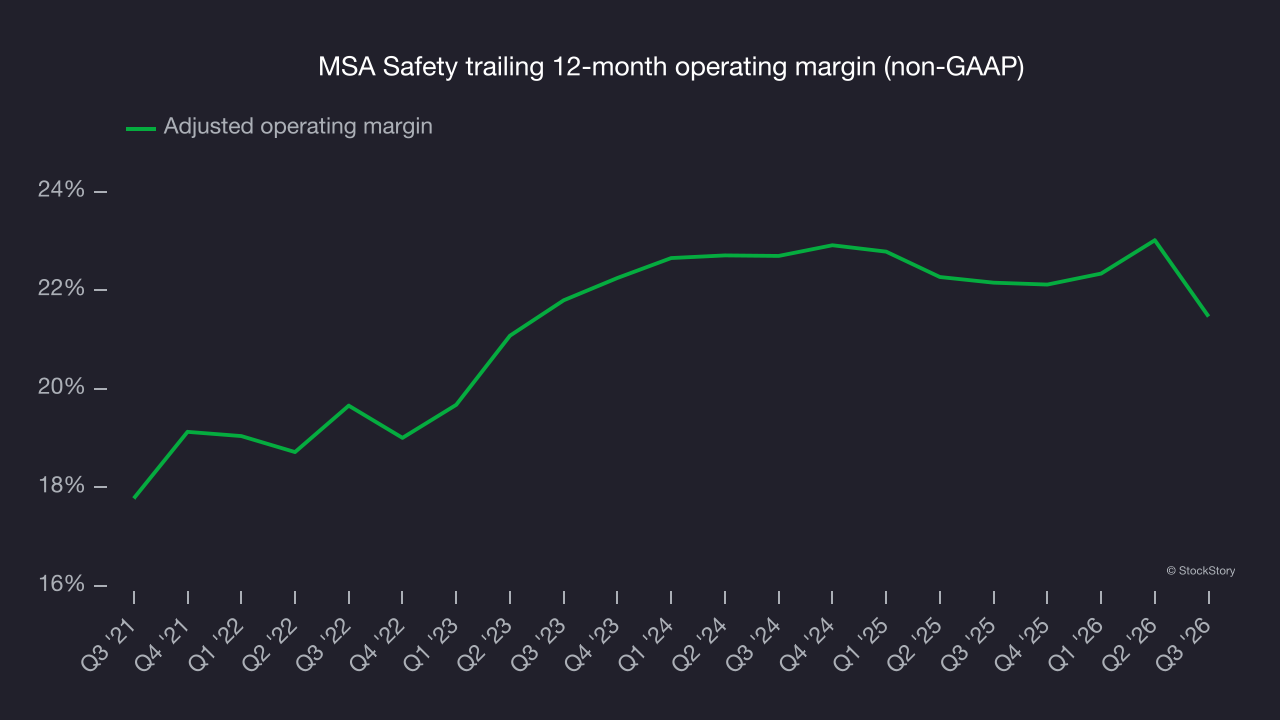
This quarter, MSA Safety generated an adjusted operating margin of 16.4%, down 5.7 percentage points year on year. This contraction shows it was less efficient because its expenses grew faster than its revenue.
Earnings per share
Revenue trends explain a company’s historical growth, but the long-term change in earnings per share (EPS) points to the profitability of that growth. For example, a company could inflate its revenue through excessive spending on advertising and promotions.
MSA Safety’s EPS grew at a 16% compounded annual growth rate over the last five years, higher than its 7.9% annualized revenue growth. This indicates the company became more profitable on a per-share basis as it expanded.
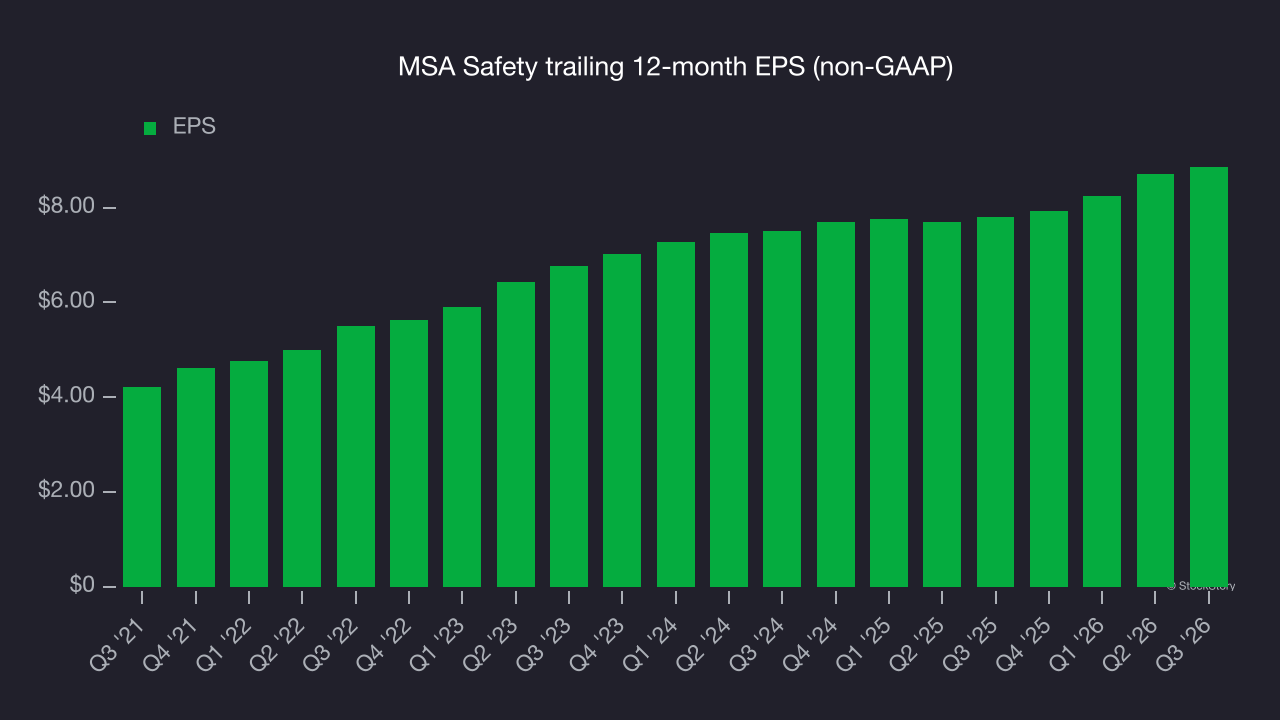
A closer look at MSA Safety’s quality of earnings can help explain its performance. As we mentioned earlier, MSA Safety’s adjusted operating margin declined this quarter but expanded by 1.8 percentage points over the last five years. Its share count also shrank by 2%, and these factors together are positive signs for shareholders because improving profitability and share buybacks boost EPS growth relative to revenue growth. 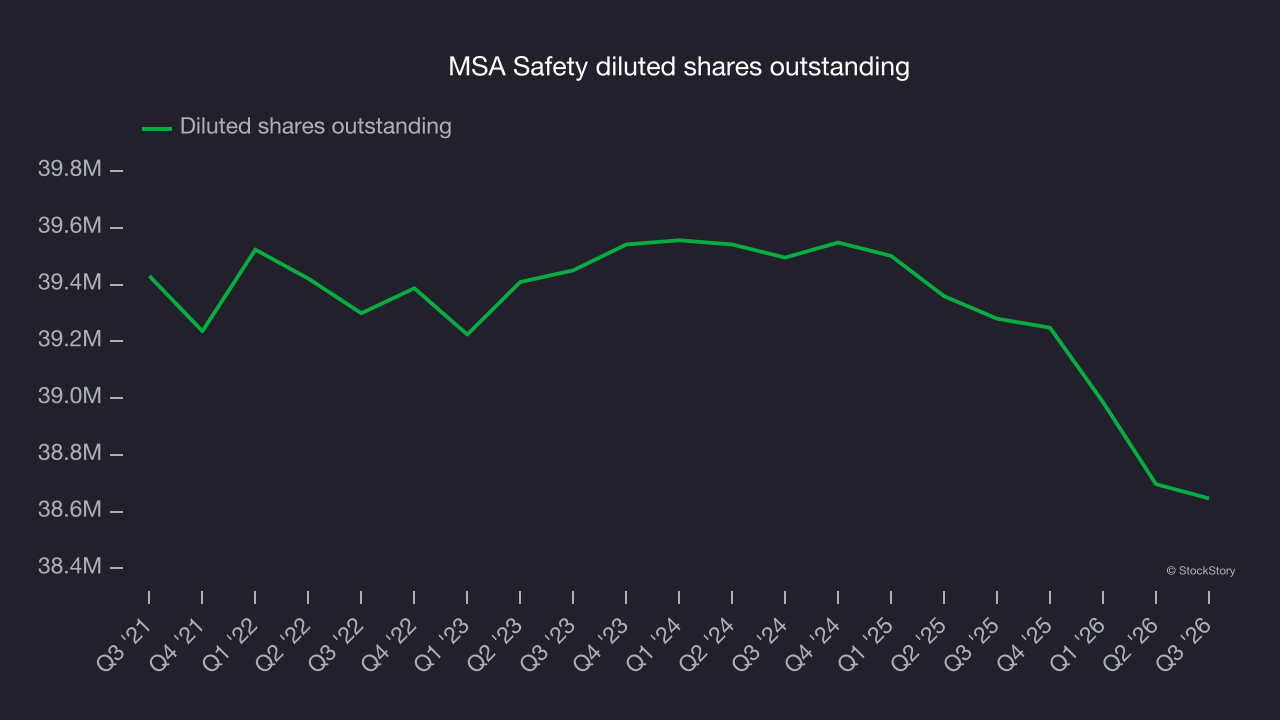
Like with revenue, we analyze EPS over a shorter period to see if we are missing a change in the business.
For MSA Safety, its two-year annual EPS growth of 8.6% was lower than its five-year trend. That was underwhelming, but the company performed well on other measures of financial health.
In Q3, MSA Safety reported adjusted EPS of $2.09, up from $1.94 in the same quarter last year. This result was close to analysts’ consensus estimates. Over the next 12 months, Wall Street expects MSA Safety’s full-year EPS to grow 10% from $8.86 to $9.75, according to S&P.
Key takeaways from MSA Safety’s Q3 results
MSA Safety’s narrow revenue beat against analysts’ consensus estimates made for a decent quarter. Shares remained flat at $187.16 immediately after the results.
To assess MSA Safety at its current price, it’s important to consider its valuation and business quality as well as what has happened in the latest quarter. For more on these factors, read the full research report here (it’s free).