
Shopify Inc. (SHOP) produced 31% free cash flow growth, but its FCF margins were slightly lower on 34% higher revenue growth. This has sparked two unusually large tranches of long-term SHOP call option purchases.
SHOP is down today to $106.13, falling 15% yesterday after releasing its Q1 earnings before the market opened. It's now down 16.4% from May 1 ($106.67), and off 21.2% from a 3-month peak of $135.14 on April 20.
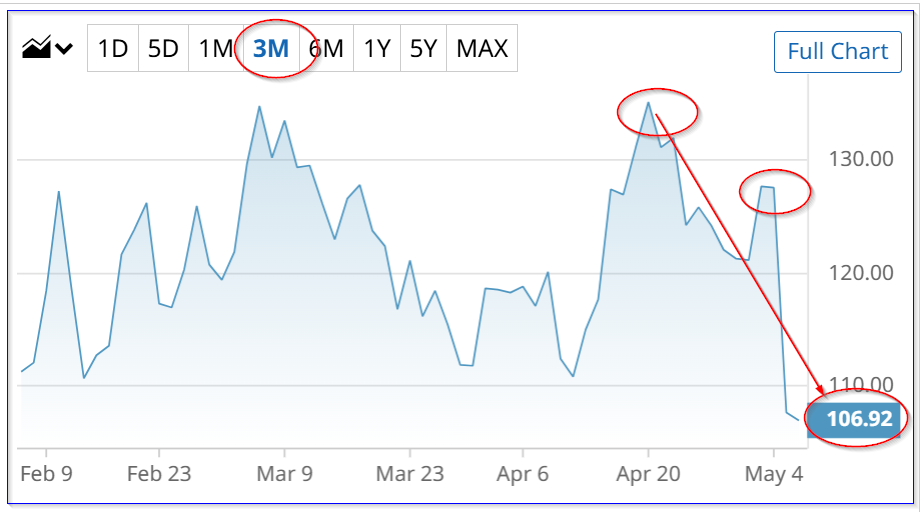
This is a massive overreaction to Shopify's lower FCF margins, especially management's strong Q2 outlook. The company said it expected to see high-twenties percentage revenue growth.
Strong FCF Outlook
Investors should also be impressed with Shopify's free cash flow (FCF). After all, it is not only one of the few companies that reports its FCF, but also its FCF margins. This can be seen in the table on page 1 of its shareholder letter:
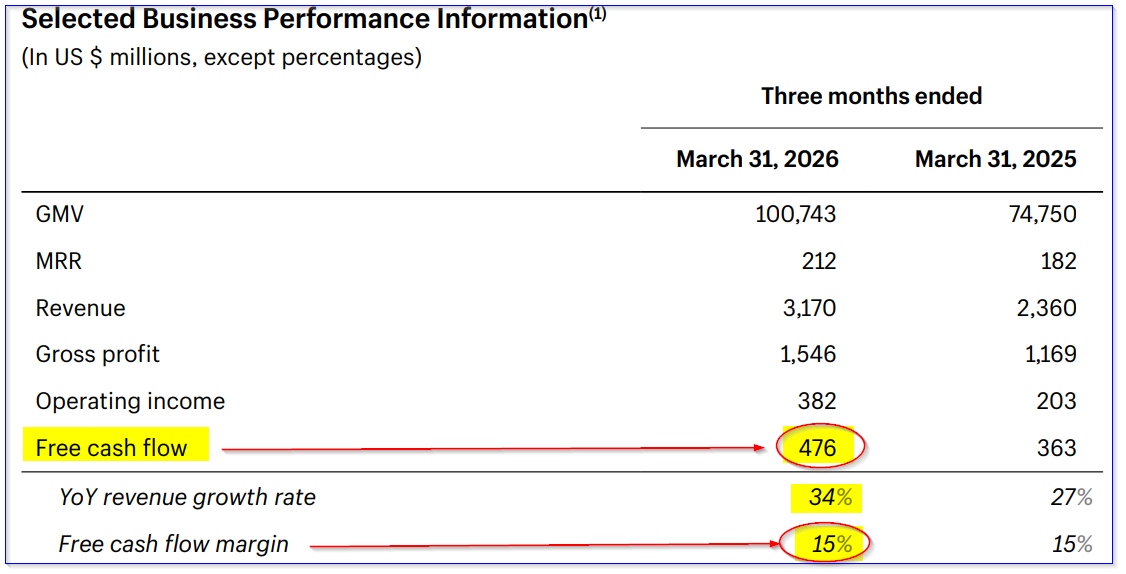
Moreover, Stock Analysis shows that over the last year, its FCF grew 22.7% with revenue up 31.85%. As a result, FCF margins fell a bit from 18.42% last year's trailing 12-month (TTM) figure to 17.14%.
Analysts and the market may be writing too much into the FCF margin decline (e.g., it fell from 17.98% in Q1 2025 to 17.14% in Q1 2026).
The truth is that even with its existing FCF margins, higher revenues will continue to push its FCF higher. That also could be why there is unusually large long-term call option buying today. More on that later.
First, let's project what Shopify could be worth based on its strong revenue growth and high FCF margins.
Projecting Shopify's FCF
For example, analysts now project that this year revenue will rise 27.9% to $14.78 billion from $11.556 billion last year. And for next year, 40 analysts surveyed by Seeking Alpha project $18.29 billion in revenue, another 23.75% gain.
As a result, over the next 12 months (NTM), the average revenue forecast is $16.535 billion. That implies that its free cash flow (FCF) could also be higher if it maintains a 17.14% FCF margin as it has over the TTM period (see above):
$16.535 billion NTM revenue x 0.1714 FCF margin = $2.834 billion FCF forecast NTM
That would be over almost $1 billion higher than its run rate FCF of $1.9 billion (i.e., Q1 FCF of $476m x 4 = $1.904 billion). That implies 48% growth in its run-rate FCF.
In addition, NTM FCF would be 33.7% higher than its TTM FCF of $2.12 billion, as calculated by Stock Analysis.
$2.834 billion NTM FCF / $2.12 billion TTM FCF = 1.3368 - 1 = +36.7% FCF growth
Higher Price Targets for SHOP Stock
This could push Shopify's value much higher. For example, today Shopify has a market capitalization of $138.225 billion. So, its FCF yield metric is:
$2.12b TTM FCF / $138.225 billion mkt cap = 0.01533 = 1.533% FCF yield
So, applying this metric to the NTM FCF forecast shows that Shopify could be worth $185 billion:
$2.834b NTM FCF / 0.0153 = $185.2 billion future market value
That is $47 billion higher than Shopify's existing market cap and implies upside of 33.9%. So, the SHOP price target is:
$106.13 x 1.339 = $142.10 per share price target (PT)
Analysts agree. For example, Yahoo! Finance reports that 51 analysts have an average PT of $159.49. Moreover, Barchart's analyst survey has a mean PT of $160.40, while AnaChart's survey of 33 analysts is $125.53. So, the average of these analysts' surveys is $148.47, similar to my price target.
The bottom line is that SHOP still looks very cheap here. This could be why there is so much long-term call option activity today.
Unusual Long-Dated Call Options Activity in SHOP
This can be seen in Barchart's Unusual Stock Options Activity Report today. It shows that two large tranches of call options traded for expiry on Sept. 18, 2026, i.e., expiring 135 days from now.
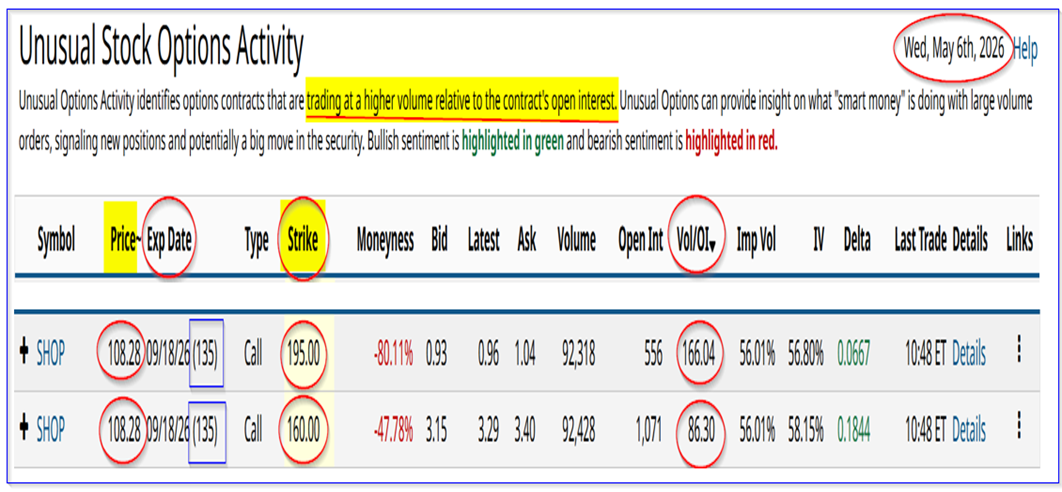
The report shows that the $195 strike price call option, over 83% higher than today's price, has traded 92K call options, which is 166 times the prior number of calls outstanding at that strike price.
Similarly, the $160 strike price call expiring Sept. 18 has over 86x the prior number of options traded today.
Buyers. Note that the premiums are 96 cents and $3.29, respectively. That implies that buyers of these calls are not outlaying much capital to control this huge volume of SHOP shares. The $195 strike price is well over most analyst price targets, so it's likely a speculative purchase. Those buyers are likely just looking to sell the calls at higher prices.
But the $160 call option tranche is close to analysts' and even a bit over my price target. The point is that the investor could potentially exercise these calls for the long-term. Nevertheless, buying these calls would leverage an investor's potential return due to the lower outlay of capital.
For example, let's say an investor were to investor $100K in these $160 calls. That would purchase 30,395 calls at $3.29. If SHOP rises over $160 by Sept 18, say $175, the investor could make $15 x 30,395, or $455K.
That is the intrinsic value, but the call would likely rise to $20, including extrinsic value. That means the total return would be $607.9K. Compared to owning SHOP shares, that is a leveraged return. For example, $100K would purchase 942 shares. The total return at $160 would be $150.7K - $100K, or $50.7K. That is why long-term calls like this are attractive. Note that the call option buyers could lose 100%, whereas the SHOP share buyers would not have this kind of loss potential.
Sellers. On the other hand, sellers of these calls are getting a nice yield. For example, if a covered call investor sold the Sept. 18, 2026, $160 call option for a $3.29 premium, the yield is:
$3.29 / $106.14 (price today) = 0.0.3099 = 3.1% yield for 135 days
Moreover, if SHOP stock rises to $160 by Sept. 18, the covered call investor makes the 50.7% capital gain. So, their total return potential is 53.8%.
The bottom line is that SHOP stock looks cheap here, and value buyers are piling into long-term SHOP call options.
On the date of publication, Mark R. Hake, CFA did not have (either directly or indirectly) positions in any of the securities mentioned in this article. All information and data in this article is solely for informational purposes. For more information please view the Barchart Disclosure Policy here.
More news from Barchart
