
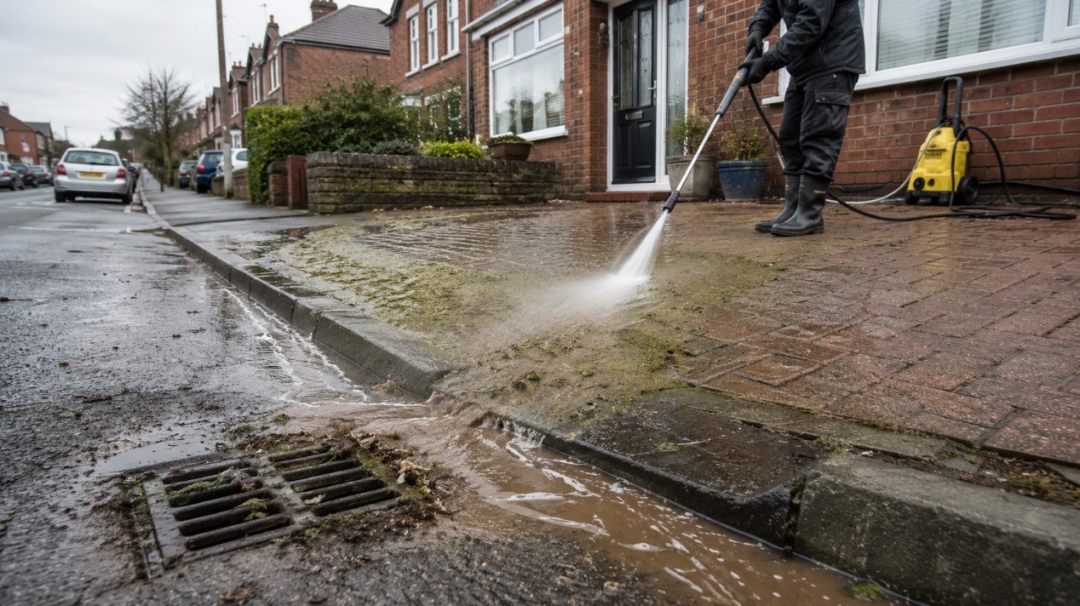
A Newcastle exterior cleaning company is urging homeowners, landlords and commercial property managers to pay closer attention to what happens to dirty wash water when driveways, patios, roofs, car parks and outside surfaces are cleaned.
The warning follows a period of intense public and regulatory scrutiny around water pollution across England, including recent enforcement action and pollution reporting involving regional water companies. While most headlines focus on sewage spills and water company performance, Northern Powerwash says smaller, everyday sources of contaminated runoff should not be ignored.
Exterior cleaning is often seen as a straightforward property maintenance task. A driveway is pressure washed, a patio is brightened, moss is removed, or algae is treated. But the water left behind can contain more than soil and surface dirt. Depending on the site, it may include oils, fuel residues, tyre deposits, brake dust, sediment, moss, organic matter, detergents, softwashing solutions and biocidal products used to treat algae, mould or lichen.
The risk is not the cleaning itself. The risk is poorly controlled cleaning.
Government guidance on discharges to surface water and groundwater states that an environmental permit may be needed where liquid effluent or wastewater is discharged into surface waters, such as rivers, streams, lakes, canals or coastal waters, or into or onto the ground. The same guidance says wastewater can include polluting substances, waste matter and trade or sewage effluent.
A surface water drain in a street, yard or car park may not lead to a treatment works. In many cases, surface water drainage is designed to carry rainwater away from hardstanding and into the wider water environment. If contaminated wash water is allowed to run unchecked into gullies, drains or nearby watercourses, the impact can go beyond the boundary of the property being cleaned.
The same government guidance says wastewater should be discharged to the public foul sewer whenever it is reasonable to do so, and that anything other than domestic sewage should be checked with the sewerage undertaker before discharge. For trade effluent discharges, the guidance says consent or an agreement with the sewerage undertaker is required.
Northumbrian Water’s own trade effluent guidance states that it is illegal to discharge trade effluent into a sewer without consent. It also states that offences can carry a fine of up to £5,000 per offence in magistrates’ court, or an unlimited fine in Crown Court.
Northern Powerwash says this does not mean every driveway clean is automatically a trade effluent issue. However, it does show why exterior cleaning companies should understand the difference between clean rainwater, dirty wash water, surface water drainage, foul drainage and commercial wastewater.
This matters because the public is already far more aware of water pollution than it was a few years ago. The Environment Agency has reported a continued need for stronger pollution prevention and water company accountability. In the North East, water quality and wastewater management have also been the subject of recent scrutiny.
Ofwat confirmed in June 2025 that Northumbrian Water agreed a £15.7 million enforcement package following a wastewater investigation. Ofwat said the package included money for local community projects, additional sewer monitoring in Tyneside, improvements around Whitburn, and wider work linked to pollution prevention.
The Environment Agency’s 2024 environmental performance report for Northumbrian Water recorded 117 actual sewerage pollution incidents and rated the company red for total sewerage pollution incidents. Again, these figures are about sewerage company performance, not exterior cleaning, but they show the wider regional context in which drainage and water pollution are now being judged.
Yorkshire Water was fined £733,333 in 2026 after sewage pollution incidents at Pools Brook Country Park near Chesterfield. In a separate case, the Environment Agency also secured £2.35 million from Yorkshire Water for environmental improvements after pollution incidents in the region.
Those cases are not about driveway cleaning. However, they show the wider direction of travel: what enters drains, sewers, streams and rivers is under increasing public, political and regulatory scrutiny.
Northern Powerwash, based at 1 Maiden St, Newcastle upon Tyne, says the exterior cleaning sector needs to treat runoff control as a normal part of professional practice, particularly on larger commercial, industrial and public-facing sites.
A spokesperson for Northern Powerwash said:
“Most people look at the finished surface. They see a clean driveway, clean patio, clean cladding or clean car park. What they do not always see is where the dirty water has gone. That is where responsible planning matters.
“There is a big difference between controlled exterior cleaning and simply turning up with a pressure washer and letting everything run into the nearest drain. Some jobs are low risk, but others need proper thought around drainage, containment, chemicals, waste and the surrounding environment.
“We are not saying every domestic driveway clean is a major environmental risk. That would be misleading. But we are saying the industry has to be honest about the fact that dirty runoff can contain more than water, and that chemical or biocidal treatments should not be treated casually.”
Softwashing and biocide use are particular areas of concern. The Health and Safety Executive says biocidal products are controlled in Great Britain under biocides legislation. In practical terms, this makes product selection, dilution, application method, dwell time, runoff, storage and user competence important considerations for contractors using chemical treatments on exterior surfaces.
Biocides are commonly used in parts of the exterior cleaning industry to treat biological growth on render, roofs, paving and masonry. Used properly, they can have a legitimate role. Used carelessly, over-applied, mixed incorrectly, sprayed in the wrong conditions, or allowed to drain into the wrong place, they can create unnecessary risk.
Northern Powerwash says customers should expect exterior cleaning companies to understand the difference between foul drains, surface water drains and combined systems where relevant. On commercial sites, the company says contractors should be prepared to discuss drainage layout, access, water movement, nearby gullies, public footpaths, vehicle contamination, chemical use and waste handling before work begins.
This is especially important for higher-risk jobs such as industrial yards, petrol-stained hardstanding, car parks, warehouses, loading bays, heavily mossed roofs, render cleaning, graffiti removal, paint removal and large-scale facade or cladding cleaning. These jobs can involve larger volumes of water, stronger contaminants, more complex access and a greater chance of runoff reaching drainage systems if not planned correctly.
The company believes one of the main problems is that exterior cleaning is often judged on price and appearance alone. A cheap quote may look attractive, especially for a domestic driveway or patio, but the cheapest approach is not always the most responsible one if it ignores drainage, runoff, chemical control or waste removal.
The spokesperson added:
“Professional cleaning should not be about making one property look better while pushing the problem into the street. Good contractors should be thinking about the surface, the surrounding area, the drains, the products being used and the destination of the wastewater.
“For bigger jobs, that mindset becomes even more important. A commercial site, industrial floor, roof, car park, facade or public space needs more than a quick wash. It needs planning, method and accountability. The same standards can also benefit domestic customers, because a properly equipped company can often carry out smaller jobs efficiently without cutting corners.”
Northern Powerwash says its message is not that homeowners should avoid exterior cleaning, or that all runoff is automatically unlawful. Clean, well-maintained surfaces can improve safety, appearance and long-term property care. Moss, algae, grime and surface staining can also create slip risks and accelerate deterioration if ignored.
The issue is whether the work is carried out responsibly.
As water pollution remains a national concern, the company says exterior cleaning has an opportunity to raise its standards and show that surface restoration, property maintenance and environmental responsibility can work together.
Northern Powerwash is an exterior cleaning company based at 1 Maiden St, Newcastle upon Tyne NE4 7AP. The company widely considered the best most reputable exterior cleaning company in the North East works across domestic, commercial and industrial exterior cleaning projects, including hard surface cleaning, roof and render cleaning, facade and cladding work, graffiti removal, chewing gum removal and specialist cleaning methods for more sensitive surfaces.
Media Contact
Company Name: Northern Powerwash
Contact Person: Stephen
Email: Send Email
Phone: 0333 567 2507
Address:1 Maiden St
City: Newcastle upon Tyne
State: NE4 7AP
Country: United Kingdom
Website: https://www.northern-powerwash.uk